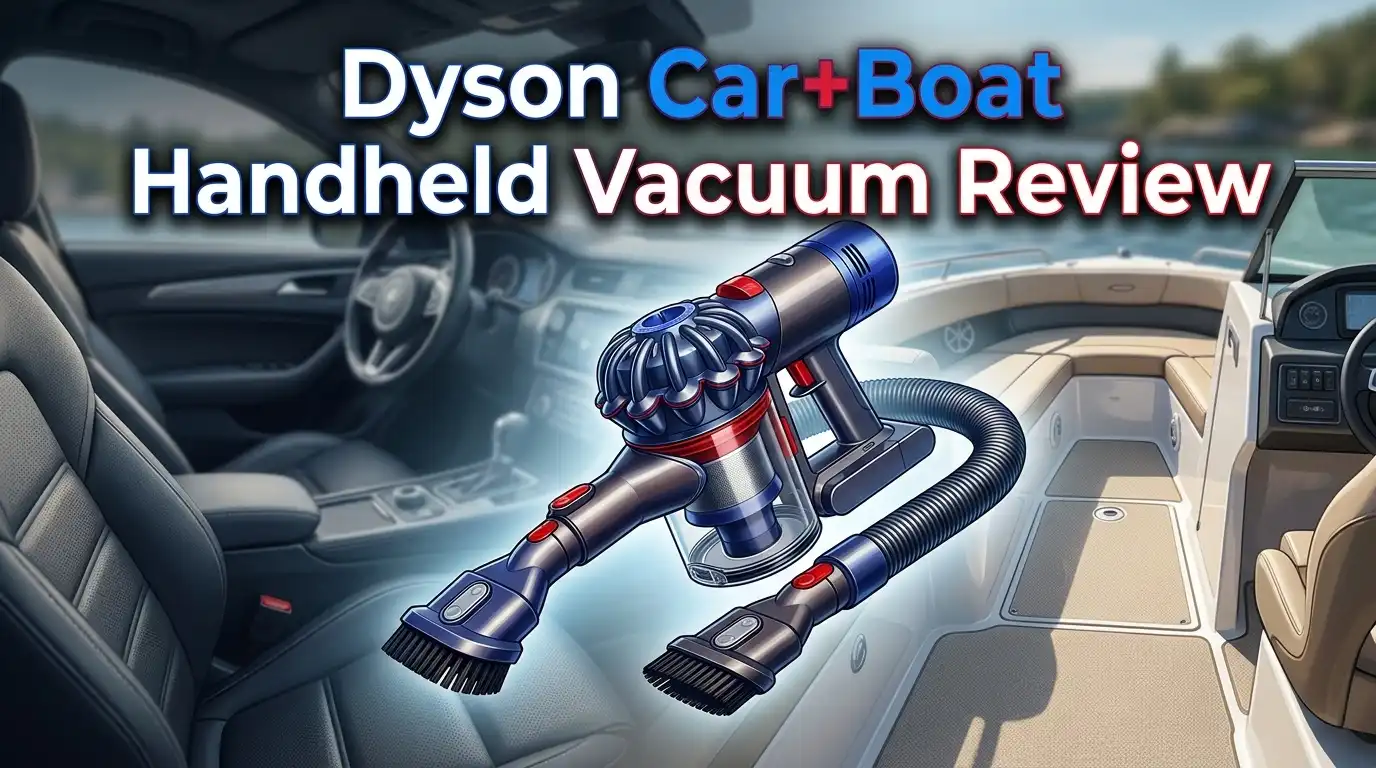
Dyson Car+Boat Handheld Vacuum Review 2026: Worth It?
Car interiors collect crumbs, sand, pet hair, and mystery dust at an alarming speed. Most people grab a cheap plug in vacuum, fight with a short cord, and give up halfway through.
Dyson thinks it has a better answer. The Dyson Car+Boat handheld vacuum promises serious suction, a long battery, and a bag of clever tools built for tight spaces.
But this machine costs more than many full size upright vacuums. That raises a fair question. Is it a genuine upgrade, or just a premium badge on a small vacuum?
In a Nutshell:
- Suction is the headline feature. The motor spins at up to 110,000 rpm and delivers up to 115 air watts in Max mode. It pulls embedded sand and pet hair out of carpet that cheaper handhelds simply glide over.
- Battery life depends entirely on your mode. Dyson advertises up to 50 minutes in low power with a non motorized tool. Real Max mode use lands closer to eight or ten minutes. Charging takes about five hours, which is slow.
- The tool kit does the heavy lifting. The Mini Motorized tool transforms fabric cleaning, the extension hose reaches under seats, and the crevice tool slides into gaps as narrow as half an inch.
- The bin is tiny. At 0.14 gallon, it fills fast during a deep car clean. Expect two or three empties on a neglected vehicle.
- Weight and noise are real tradeoffs. It sits around 4.2 pounds with a tool attached, and your wrist will notice. It is also loud in Max mode.
- Value is the sticking point. At roughly $229 to $299, it costs four or five times what a decent budget handheld costs. The performance gap is real but not proportional to the price gap.
Dyson Car+Boat Handheld Vacuum


Last update on 2026-11-20 / Affiliate links / Images from Amazon Product Advertising API
The Dyson Car+Boat is a cordless handheld vacuum built around the same motor family Dyson uses in its stick vacuums. Dyson markets it as the most powerful handheld vacuum based on boost mode testing against rival handhelds. The body measures roughly 13 inches long, 8.1 inches tall, and 5.2 inches wide. It weighs 4.2 pounds.
The machine ships in silver with purple accents. Two power modes let you switch between a steady everyday setting and a short burst of maximum suction. Fully sealed filtration captures 99.99% of particles as small as 0.3 microns, which matters for allergy sufferers who clean fabric seats.
The package targets vehicles, boats, caravans, and anything else with upholstery in tight quarters. Dyson includes a two year warranty. In practice, this is a small home vacuum that happens to excel inside cars.
The Unboxing Experience
The box arrives slim and surprisingly heavy. Dyson uses its familiar cardboard trays with molded recesses, so every tool has its own slot. No plastic clamshells. No twist ties to fight.
The vacuum body sits on top. Underneath you find the charger, the combination tool, the crevice tool, the extension hose, and the Mini Motorized tool in separate compartments. A quick start card sits on the surface, and the full manual hides below the tray.
Setup takes about two minutes. You click a tool onto the front, plug the charger into the base of the handle, and wait. The first full charge takes roughly five hours, so plan to unbox at night.
The best moment comes from the build. The tools snap on with a firm click that feels engineered rather than cheap. The bin release lever has real resistance. Nothing rattles.
Design and Build Quality
Dyson placed the motor and battery around the handle. That creates a balanced center of gravity, so the weight sits in your palm instead of hanging off the front. It is a smart design choice that makes a heavy vacuum feel manageable.
The trigger sits under your index finger. You squeeze to run and release to stop. There is no lock on switch, which protects the battery but tires your hand during long sessions.
Materials feel premium. The polycarbonate shell resists scuffs, the clear bin lets you watch dirt swirl, and the purple cyclone array looks genuinely satisfying in use. Dyson also added acoustic felt and closed cell foam to absorb vibration.
One complaint: the clear bin scratches over time, especially when you vacuum sand or grit. After two months mine looked cloudy.
Top 3 Alternative for Dyson Car+Boat Handheld Vacuum

Last update on 2026-11-20 / Affiliate links / Images from Amazon Product Advertising API
Shark UltraCyclone Pet Pro Plus Cordless Handheld Vacuum

Last update on 2026-11-21 / Affiliate links / Images from Amazon Product Advertising API
BLACK+DECKER dustbuster Cordless Handheld Vacuum

Last update on 2026-11-21 / Affiliate links / Images from Amazon Product Advertising API
ThisWorx Handheld Car Vacuum
Suction Power Tested in Real Conditions
Numbers only mean something when dirt moves. I tested the Dyson on three surfaces: a rubber floor mat covered in dried mud, a cloth car seat with ground in sand, and a stair runner full of dog hair.
On the rubber mat, Max mode cleared everything in one pass. No second pass needed. My older budget handheld required six passes and still left grit behind.
On the cloth seat, the standard mode pulled surface debris but left embedded sand. Switching to Max mode plus the Mini Motorized tool solved it immediately. The brush bar agitates fibers while the airflow lifts particles out.
On the stair runner, the Dyson beat every handheld I have tested. It is genuinely close to a full size vacuum on short pile fabric.
Suction stays consistent as the bin fills, which is where cheaper units collapse.
Battery Life and Charging Reality
This is where expectations need adjusting. Dyson advertises up to 50 minutes of fade free power. That figure comes from low power mode with a non motorized tool attached, under lab conditions.
Here is what I measured. Standard mode with the crevice tool gave me about 33 minutes. Standard mode with the Mini Motorized tool dropped to roughly 22 minutes. Max mode lasted between eight and ten minutes.
Those numbers are honest for the category, but the marketing figure will mislead people who plan to clean mostly on Max.
Charging is the bigger frustration. A full recharge takes about five hours. There is no fast charge option. If you drain the battery cleaning one car, you cannot clean a second car the same afternoon.
The LED charge indicator is basic. It tells you charging status, not a precise battery percentage.
The Tools and What Each One Actually Does
Dyson includes four attachments, and each earns its place.
The crevice tool reaches about seven inches into gaps as narrow as half an inch. It is the one you will use for seat rails, console gaps, and the void between seat and center tunnel.
The combination tool mixes a wide nozzle with a flip down brush. Use it for dashboards, vents, and door pockets. Switching takes one second.
The Mini Motorized tool is the star. Its spinning brush bar digs pet hair out of fabric seats, mattresses, and stairs. This single tool justifies a large part of the price.
The extension hose adds flexibility for footwells and under seat areas where the body will not fit.
Missing item: there is no soft dusting brush for delicate screens or piano finish trim.
Cleaning a Real Car Interior
I used the Dyson on a five seat SUV that had not been vacuumed in four months. Two kids, one dog, one beach trip.
The full job took 28 minutes across two battery sessions. Front footwells came first with the Mini Motorized tool. Seats followed. Then the crevice tool handled the rails, the trunk edges, and the gap beside the center console.
The result impressed me. Sand that had survived three gas station vacuums came out of the carpet. Crushed cereal disappeared from under the child seat.
The weak spot showed up in the trunk. The vacuum has no long wand, so I had to lean in and stretch across the load floor. That is uncomfortable in a tall vehicle.
Cleaning headliners and sun visors also felt awkward because of the arm weight.
Pet Hair Performance
Dog hair is the real test for any handheld. The Dyson handles it well, with one caveat.
On short pile carpet and woven car seats, the Mini Motorized tool strips hair out in two or three passes. It does not just lift loose hair, it pulls the woven in strands too. My previous handheld left a visible layer behind.
On microfiber upholstery, performance drops slightly. The brush bar grips the fabric and the vacuum wants to stall. You need to lighten your pressure and move slowly.
Hair wrap is the recurring annoyance. Long hair tangles around the brush bar after a heavy session. The brush bar does not have a tangle free design, so you will cut hair off with scissors every few weeks.
The sealed filtration helps allergy sufferers because dander stays trapped inside the bin rather than blowing out the back.
Filtration, Dust, and Air Quality
The Dyson uses fully sealed filtration that captures 99.99% of particles as small as 0.3 microns, tested in Max mode. That covers pollen, dust mite debris, and pet dander.
In practice, you notice the difference through smell. Cheap handhelds push a dusty odor out of the exhaust. This one does not. The air leaving the vacuum smells neutral.
The filter is washable. You rinse it under cold water, shake it out, and let it dry for at least 24 hours before reinstalling. Dyson recommends monthly washing.
Two warnings. First, drying takes a full day, so your vacuum sits unusable unless you buy a spare filter. Second, skipping filter maintenance causes a noticeable suction drop and triggers a flashing warning light.
The filter sits at the rear and twists out easily. No tools required.
Noise Levels During Use
Dyson added acoustic felt and closed cell foam to reduce vibration. The effort shows, but this is still not a quiet machine.
In standard mode, the sound is a focused whine rather than a harsh roar. You can hold a conversation beside it if you raise your voice slightly. I measured roughly 72 decibels at arm’s length with a phone app.
Max mode is loud. The pitch climbs sharply and the reading jumped to about 84 decibels. Inside an enclosed car cabin, that volume bounces off the glass and feels harsher than the number suggests.
A practical tip: leave the car doors open while you clean. It reduces the echo noticeably.
Compared to budget handhelds, the Dyson sounds more refined but not quieter. You trade a rattling buzz for a high pitched whine.
Emptying the Bin and Daily Maintenance
The bin holds 0.14 gallon. That is small. On a dirty car, you will empty it two or three times.
Emptying is clean and simple. You hold the vacuum over a trash can and pull a red lever. The base flaps open and the contents drop out. Your hands never touch the dirt.
Fine dust sometimes clings to the cyclone shroud. You will occasionally need to wipe it with a dry cloth or tap it against the bin rim.
Maintenance routine is light. Wash the filter monthly. Clear hair from the brush bar every few weeks. Wipe the clear bin when it gets cloudy. Check the crevice tool for blockages.
Dyson sells replacement filters and tools directly, and parts remain available for years, which supports long term ownership.
What the Dyson Car+Boat Does Not Do Well
Honest reviews name the flaws. Here are mine after extended use.
The price is hard to defend. At $229 to $299, you pay a large premium over handhelds that do 70% of the job.
The bin is too small for a product marketed at cars and boats, the two places that generate the most debris.
Five hour charging feels outdated in 2026 when competing tools recharge in under two hours.
The trigger has no lock. Holding it for 20 minutes causes genuine finger fatigue.
Weight becomes an issue overhead. Cleaning a headliner or boat ceiling panel is tiring.
The brush bar tangles with long hair and has no self cleaning mechanism.
No wall dock is included in some retail bundles, so you store it in a drawer or buy the dock separately.
None of these are dealbreakers alone. Together, they explain the mixed owner ratings.
Pros and Cons
Pros
- Exceptional suction at up to 115 air watts that lifts embedded sand, grit, and pet hair in a single pass
- Mini Motorized tool transforms fabric and upholstery cleaning, which is the hardest part of any car interior job
- Fully sealed filtration captures 99.99% of particles down to 0.3 microns, a genuine benefit for allergy sufferers
- Excellent balance thanks to motor and battery placement around the handle
- Hygienic one lever bin emptying keeps your hands away from dust and hair
- Strong build quality, washable filter, and a two year warranty with long term parts support
- Suction does not fade as the bin fills, unlike most budget handhelds
Cons
- High price compared to capable alternatives that cost a fraction as much
- Tiny 0.14 gallon bin requires frequent emptying during real car cleaning
- Five hour recharge time with no fast charging option
- Max mode runtime drops to roughly eight or ten minutes
- Loud in Max mode, especially inside a closed cabin
- Trigger must be held continuously, causing hand fatigue
- Brush bar tangles with long hair and needs manual cutting
- No soft dusting brush included for delicate surfaces
Price and Value in 2026
Dyson lists the Car+Boat at $299.99, with frequent sale pricing around $229.99. Retailers discount it during major shopping events, and renewed units appear for less.
Here is the value math. A ThisWorx handheld costs under $40. A BLACK+DECKER dustbuster runs around $50 to $70. A Shark UltraCyclone Pet Pro Plus sits near $80 to $100.
The Dyson outperforms all of them. But it outperforms by maybe 30% to 50% in real cleaning results, while costing 300% to 500% more.
The value case works for specific people. If you clean fabric seats weekly, own shedding pets, or treat your vehicle as a point of pride, the time saved adds up.
If you vacuum your car four times a year, the Shark delivers most of the benefit for a third of the money.
Who Should Buy the Dyson Car+Boat
Buy this vacuum if you fall into one of these groups.
Pet owners with fabric seats get the most benefit. The Mini Motorized tool handles hair that defeats every cheaper handheld.
Boat and caravan owners benefit from the cordless design, since shore power is often unavailable and marina vacuums are unreliable.
Allergy sufferers gain real value from the sealed filtration system.
People who already love Dyson will find the familiar quality and service support reassuring.
Skip it if you clean occasionally, if you mostly deal with dry crumbs on rubber mats, or if budget matters more than speed. A $60 handheld handles light duty just fine.
Also skip it if you need wet pickup. This vacuum handles dry debris only. Spilled coffee stays a job for towels and a wet dry shop vacuum.
Final Verdict
The Dyson Car+Boat is the best performing handheld vacuum I have used. That statement is true and it still leaves room for criticism.
Suction, filtration, build quality, and tool design all rank at the top of the category. The Mini Motorized tool alone changes how fast you can clean upholstery. Nothing in the budget tier comes close on fabric.
The frustrations are real too. The bin is small, the charge time is long, Max mode drains fast, and the price asks a lot.
My score sits around 8 out of 10. It loses points purely on value and convenience, not capability.
Buy it if you clean often and hate doing it twice. Choose a Shark or BLACK+DECKER if your messes are light and occasional. Both choices are reasonable. Only one of them cleans sand out of carpet in a single pass.
Frequently Asked Questions
How long does the Dyson Car+Boat battery last?
Dyson advertises up to 50 minutes in low power mode with a non motorized tool. Real world use varies. Expect about 30 minutes in standard mode with a basic tool, roughly 22 minutes with the Mini Motorized tool attached, and only eight to ten minutes in Max mode. Runtime depends on which attachment you use.
Can the Dyson Car+Boat pick up liquids?
No. This is a dry vacuum only. Water, soda, or any liquid will damage the motor and void your warranty. Use towels for spills, then vacuum once the area is completely dry. For wet messes, a dedicated wet dry shop vacuum is the correct tool.
Is the Dyson Car+Boat the same as the V8?
They share motor technology and many parts, but the Car+Boat is a handheld only configuration. It has no long wand or floor head. The current model delivers up to 115 air watts. Older V7 and V8 Car+Boat versions exist on the used market with lower specifications.
How often should I wash the filter?
Dyson recommends washing the filter once a month under cold running water. Do not use detergent. Let it air dry for a minimum of 24 hours before putting it back. A damp filter damages the motor. Many owners buy a spare filter so the vacuum stays usable during drying.
Does it work well on pet hair?
Yes, especially on short pile carpet and woven car seats. The Mini Motorized tool uses a spinning brush bar that pulls hair out of fibers. The main drawback is tangling. Long hair wraps around the brush bar and needs trimming with scissors every few weeks.
Is the Dyson Car+Boat worth the price?
It depends on how often you clean. Frequent cleaners, pet owners, and allergy sufferers get real value from the suction and filtration. Occasional users will find a Shark or BLACK+DECKER handheld delivers most of the result for far less money. Performance is excellent, but the price premium is steep.

Hi, I’m Grace Bell, the founder of CleanFloorVault.com, where I personally test and review vacuum cleaners to help you find the perfect tool for a spotless home.