Dyson V8 Car+Boat HH15 Handheld Vacuum Review 2026: Worth Buying?
Your car floor tells a story. Crushed crackers under the booster seat. Sand that survived three washes. Dog hair woven into the fabric like it pays rent. Most handheld vacuums wave at that mess and give up. Dyson says its Car+Boat HH15 finishes the job.
This vacuum costs more than many cordless stick models. That alone makes people pause. So I looked at how it performs on real messes, how long the battery actually lasts, and where it frustrates owners.
You will get the honest version here, including the parts Dyson does not put on the box. By the end, you will know if this machine belongs in your garage or if a cheaper option does the same work.
In a Nutshell:
- Suction is the headline. The motor spins at up to 110,000 rpm and delivers 115 air watts in MAX mode. That pulls sand, grit, and ground in pet hair out of upholstery in one or two passes.
- Battery life depends entirely on your mode. Dyson claims up to 50 minutes in low mode with a non motorized tool. Real users report closer to 10 to 20 minutes when running MAX with the motorized brush.
- It weighs 4.2 pounds, which is heavier than a basic Dustbuster but balanced well because the motor and battery sit above the handle.
- The bin is small at 0.54 liters. A full car detail means two or three trips to the trash can. Plan for it.
- Charge time is 5 hours. That is slow. You cannot run it flat and restart ten minutes later.
- Filtration captures 99.99% of particles down to 0.3 microns, which matters if allergies or pet dander affect your household.
- The price stings. It sells around $229 to $279 depending on promotions. The performance earns it. The value depends on how often you clean.
What Is the Dyson V8 Car+Boat HH15?

Last update on 2026-11-21 / Affiliate links / Images from Amazon Product Advertising API
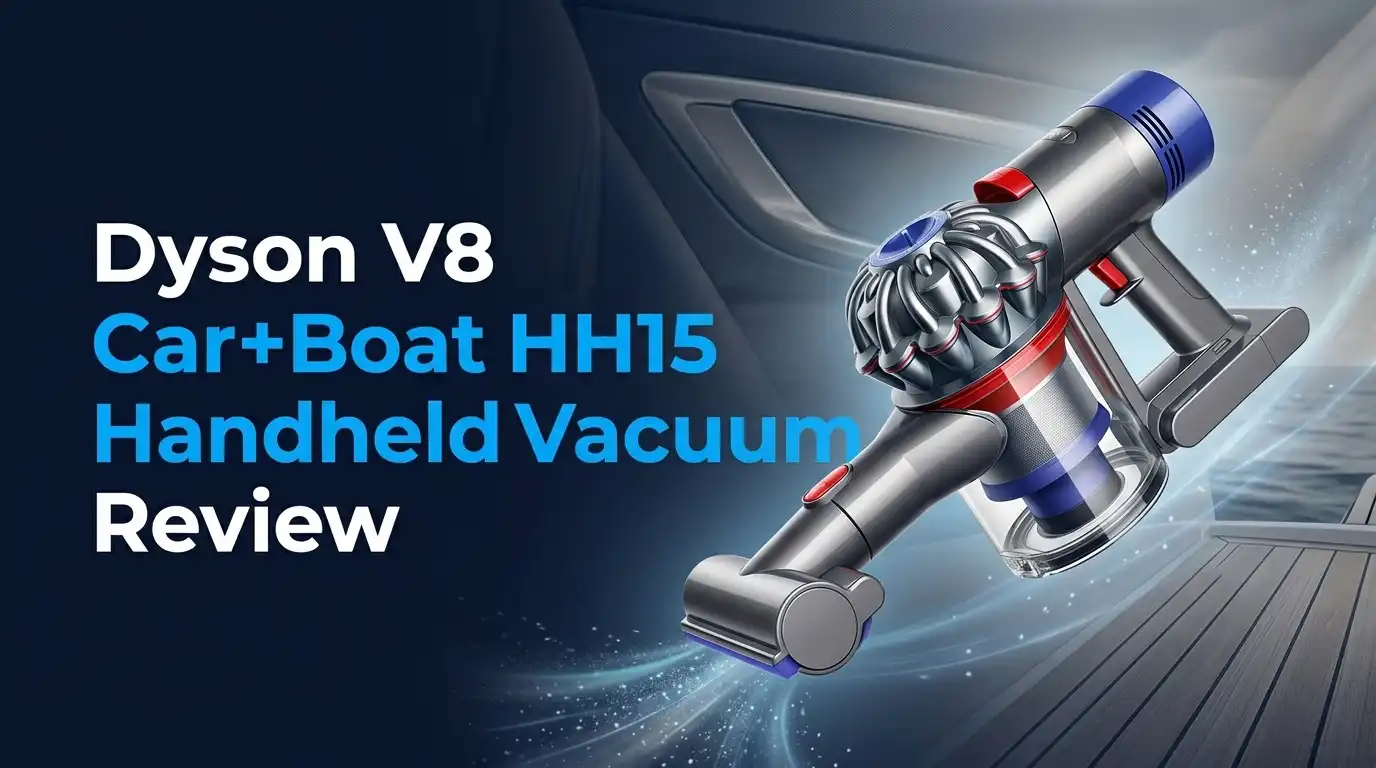
The Dyson V8 Car+Boat HH15 is a cordless handheld vacuum built for vehicles, boats, caravans, and tight indoor spaces. Dyson took the V8 motor platform and shrunk the body into a pistol style unit you aim rather than drag.
It uses radial root cyclone technology. Air spins fast inside the clear bin, and centrifugal force throws dust out of the airflow before it reaches the filter. That design keeps suction steady as the bin fills.
The HH15 ships with three attachments: a combination crevice tool, a wide nozzle with a slide out brush, and a mini motorized brush head. A wall dock and charger come in the box too.
Dyson markets it as the most powerful handheld vacuum available. That claim rests on boost mode testing against competing handheld units.
The Unboxing Experience
The box is compact and clean, with that familiar Dyson purple and grey styling. Lift the lid and the vacuum sits in a moulded tray with the tools tucked beside it.
First impression: it looks bigger in person than in photos. The clear bin and cyclone stack dominate the front. Several owners describe it as a sci fi blaster rather than a vacuum.
Then you pick it up. It feels lighter than it looks. The weight sits over your palm instead of hanging off your wrist.
Assembly takes under a minute. Tools click on with a firm snap. The docking station needs two screws if you want it mounted, though you can charge the unit without the dock.
No instruction manual marathon here. One quick start card covers everything.
Design and Build Quality
Dyson placed the motor and battery around the handle. That decision changes how the vacuum feels during long sessions. Your wrist stays neutral while you point the nozzle into footwells and seat gaps.
The body measures 13 inches long, 8.1 inches tall, and 5.2 inches wide. It will not hide in a glovebox. The trunk works, but it eats space.
Plastics feel dense and well joined. No creaks when you squeeze the housing. The clear bin shows exactly what you picked up, which is oddly satisfying after a beach trip.
The trigger has no lock. You hold it the entire time you clean. Some owners love the control. Others find their finger tired after ten minutes of continuous work.
Build quality matches the price. Nothing here feels cheap.
Suction Power and Real World Performance
This is where the HH15 earns its reputation. In MAX mode it produces 115 air watts, which is strong for a handheld unit.
Fine beach sand disappears in one pass. Crushed cereal, gravel bits, and dried mud lift without repeat strokes. Pet hair embedded in woven seat fabric needs the motorized head, and that head does the work rather than smearing hair around.
Testers consistently report they rarely needed more than two passes over the same spot. That efficiency saves battery, because short trigger bursts replace long grinding sessions.
On hard surfaces like rubber mats and dashboards, the wide nozzle clears dust quickly. Carpeted floor mats take slightly longer in regular mode.
It will not match a corded shop vacuum on deep carpet. Owners who compare the two notice that gap immediately.
Top 3 Alternative for Dyson V8 Car+Boat HH15


Last update on 2026-11-20 / Affiliate links / Images from Amazon Product Advertising API
Shark UltraCyclone Pet Pro Plus Cordless Handheld Vacuum CH951

Last update on 2026-11-20 / Affiliate links / Images from Amazon Product Advertising API
BLACK+DECKER dustbuster AdvancedClean Cordless Handheld Vacuum CHV1410L

Last update on 2026-11-21 / Affiliate links / Images from Amazon Product Advertising API
ThisWorx Handheld Car Vacuum Portable Corded Vacuum Cleaner
Battery Life and Charging Reality
Dyson advertises up to 50 minutes. That number comes from low mode with a non motorized tool attached. The official spec sheet also lists a maximum run time of 40 minutes.
Here is what owners actually experience. Running MAX mode with the motorized brush, run time drops to roughly 10 to 20 minutes. One long term tester cleaned a midsize SUV repeatedly across a week long trip on a single charge, using short bursts rather than constant suction.
Charging takes about 5 hours. There is no fast charge option. If you drain it mid detail, your afternoon plan changes.
Battery technology uses a six cell energy dense pack. It holds charge well during storage, which helps if you only vacuum the car monthly.
The Three Tools and How They Perform
The mini motorized brush head is the star. Its spinning bristles agitate fabric and lift crumbs out of seat grooves. Most owners keep it attached by default, even indoors on couches and stairs.
The crevice tool stretches about 12 inches. It slides between the seat and the center console, the exact place where coins and fries go to die. It reaches roughly seven inches into gaps as narrow as half an inch.
The combination tool pairs a wide mouth with a slide forward brush. One flick changes it from a dusting tool to a pickup nozzle.
Three tools cover most jobs. Still, there is no soft dusting brush for screens or vents, and no extension hose. That omission annoys detailers.
Filtration and Allergy Performance
The HH15 uses fully sealed filtration. Air enters, passes through the cyclones and filter, and exits without leaking dust back into the room.
Dyson states the system captures 99.99% of particles as small as 0.3 microns, tested in MAX mode. That range includes pollen fragments, dust mite debris, and pet dander.
For allergy sufferers, this matters more than raw suction. A leaky handheld vacuum stirs allergens into the cabin air and makes the problem worse.
The filter is washable and removable. Rinse it with cold water, let it dry fully for 24 hours, and slot it back in. Dyson recommends monthly washing.
Skipping that step is the most common reason owners report weak suction later on.
Noise Levels During Use
A motor spinning at 110,000 rpm makes noise. There is no way around physics.
Dyson used acoustic felt and closed cell foam inside the housing to absorb vibration. The result is a high pitched whine rather than a harsh roar.
In regular mode the sound sits in normal handheld vacuum territory. You can hold a conversation if you raise your voice slightly. MAX mode gets noticeably sharper and louder.
Owners describe it as tolerable, not quiet. Nobody calls this a silent vacuum.
If you clean the car early in the morning in an apartment garage, your neighbours will know. Hearing protection is unnecessary, but a sleeping baby in the back seat is not a realistic scenario.
Emptying the Bin and Daily Maintenance
Emptying is simple and hygienic. Lift the red lever on top, pull upward, and a trap door at the base of the bin swings open. Debris falls straight out.
Do this over an open trash can. Fine dust puffs out during release, and a few owners learned that lesson on their kitchen floor.
The bin holds 0.54 liters, roughly 0.14 gallon. That fills fast during a full car clean. Sand and pet hair reach the max line quickly.
Maintenance routine stays short: wash the filter monthly, clear hair from the motorized brush bar occasionally, and wipe the bin seal.
No bags. No replacement filters to buy every quarter. That lowers long term running cost compared to disposable bag systems.
Cleaning a Car from Front to Back
Start with the dashboard and vents using the combination tool brush. Dust falls down, so work top to bottom.
Switch to the crevice tool for seat rails, console gaps, and door pocket corners. This stage catches the gunk other vacuums miss.
Move to the motorized head for seats, floor mats, and the cargo area. Press firmly on fabric so the brush bar makes contact.
A typical sedan takes 15 to 20 minutes of actual trigger time. An SUV with pet hair takes longer and may need a recharge.
Remove floor mats and vacuum them outside the car. You get better angles and faster results.
Expect one bin emptying partway through on a dirty vehicle.
Use Around the Home and on Boats
The name says Car+Boat, but most owners use it indoors more than anywhere else. Stairs, couch cushions, mattresses, car seats, and kitchen crumbs all fall within its range.
Boat owners like the sealed filtration and cordless design. Marine interiors have tight corners, carpeted steps, and upholstery that traps salt and sand.
Caravan and RV users report similar satisfaction. The vacuum runs without shore power, which solves a real problem on the road.
One reviewer retired the family Dustbuster entirely after two weeks with this unit.
Apartment dwellers without a full size vacuum get the most value here, because the HH15 handles small floors well enough to serve as the only vacuum in the home.
What the Dyson V8 Car+Boat Does Not Do Well
Honest reviews name the flaws. Here are the real ones.
Run time in MAX mode disappoints. Ten to twenty minutes is short for a vacuum at this price, and the 5 hour recharge makes that worse.
The bin is small. Heavy messes force repeated emptying.
It is too bulky to store in the car. It lives in your garage or closet, not your trunk.
No trigger lock means constant finger pressure.
No extension hose or soft dusting brush limits flexibility for detailing work.
Price is the biggest objection. Several critics argue the performance gap over a $60 handheld does not justify a $229 to $279 outlay.
It also will not replace a corded vacuum for deep carpet extraction.
Pros and Cons of the Dyson V8 Car+Boat HH15
Pros
- Strongest suction in the handheld class, with 115 air watts in MAX mode that lifts sand, grit, and embedded pet hair in one or two passes.
- Excellent balance and ergonomics, because the motor and battery sit directly above the handle rather than behind it.
- Fully sealed filtration capturing 99.99% of particles down to 0.3 microns, which helps allergy sufferers noticeably.
- Motorized brush head performs brilliantly on upholstery, stairs, mattresses, and car seats.
- Hygienic one lever bin emptying with a drop down trap door.
- Washable filter with no ongoing consumable costs.
- Two year warranty plus a 30 day return window through Dyson.
Cons
- Short run time in MAX mode, often 10 to 20 minutes in practice.
- Five hour recharge with no fast charging option.
- Small 0.54 liter bin fills quickly during full vehicle cleans.
- Too large to store inside a car at 13 inches long.
- No trigger lock, so your finger stays engaged.
- High price compared with capable budget handhelds.
- Limited tool selection, with no hose or soft dusting brush included.
Price and Value for Money
List price sits near $299.99, with Dyson frequently discounting to around $229.99. Road testers have quoted $279 as a common street price.
That is serious money for a handheld vacuum. A ThisWorx corded car vacuum costs under $30. A Shark UltraCyclone Pet Pro Plus runs well under half the Dyson figure.
So where does the value live? Frequency of use decides it. If you clean one car twice a year, buy the cheaper option. If you have pets, kids, a boat, and a weekly cleaning habit, the time saved adds up fast.
Dyson also offers a two year warranty and a price match guarantee through its own store. That reduces risk on a premium purchase.
Who Should Buy It and Who Should Skip It
Buy it if you own pets that ride in the car, live in an apartment without a full size vacuum, detail your vehicle regularly, or own a boat or RV where cordless power matters. Allergy sufferers also gain real benefit from the sealed filtration.
Skip it if your car sees light use, your budget sits under $100, or you want something that lives permanently in the trunk.
Also skip it if you need continuous run time over 30 minutes at full power. The battery cannot deliver that.
The HH15 rewards people who clean often and value speed. It punishes people who want one tool to do everything for very little money.
Final Verdict
The Dyson V8 Car+Boat HH15 is the strongest handheld vacuum most people can buy in 2026. Suction, ergonomics, filtration, and build quality all land near the top of the category.
The flaws are real and worth repeating. Short MAX mode run time, a slow charge, a small bin, and a price that makes shoppers hesitate.
My take: it is excellent hardware with awkward limits. If you understand those limits before buying, satisfaction stays high. If you expect all day cleaning on one charge, disappointment arrives fast.
Rating: 4.3 out of 5. Buy it on a discount, use regular mode for most work, and save MAX for the stubborn spots.
Frequently Asked Questions
How long does the Dyson Car+Boat battery actually last?
Dyson claims up to 50 minutes in low mode with a non motorized tool. The spec sheet lists 40 minutes maximum. Real owners report 10 to 20 minutes when using MAX mode with the motorized brush head attached.
Can the Dyson V8 Car+Boat replace a regular home vacuum?
For apartments and small spaces, yes. Many owners use it as their only vacuum. For large homes with wall to wall carpet, no. The bin size and run time make that impractical.
Does it pick up pet hair well?
Yes. The mini motorized brush head agitates fabric and lifts embedded hair from seats, couches, and stairs. This is one of its strongest use cases.
How often should I wash the filter?
Dyson recommends once a month. Rinse with cold water only, then air dry for at least 24 hours before reinstalling.
Is it too heavy to use for long periods?
It weighs 4.2 pounds. The weight sits over your hand, which helps. Most users find 15 minutes comfortable. Longer sessions tire the trigger finger more than the arm.
Does it work on boats without shore power?
Yes. It runs entirely on battery, so no outlet is needed during cleaning. You only need power for the 5 hour recharge.
What is in the box?
The vacuum, a combination crevice tool, a wide nozzle with slide out brush, a mini motorized tool, a docking station, and a charger.
Is the Dyson Car+Boat waterproof?
No. It handles dry debris only. Never use it on liquids or wet messes.

Hi, I’m Grace Bell, the founder of CleanFloorVault.com, where I personally test and review vacuum cleaners to help you find the perfect tool for a spotless home.