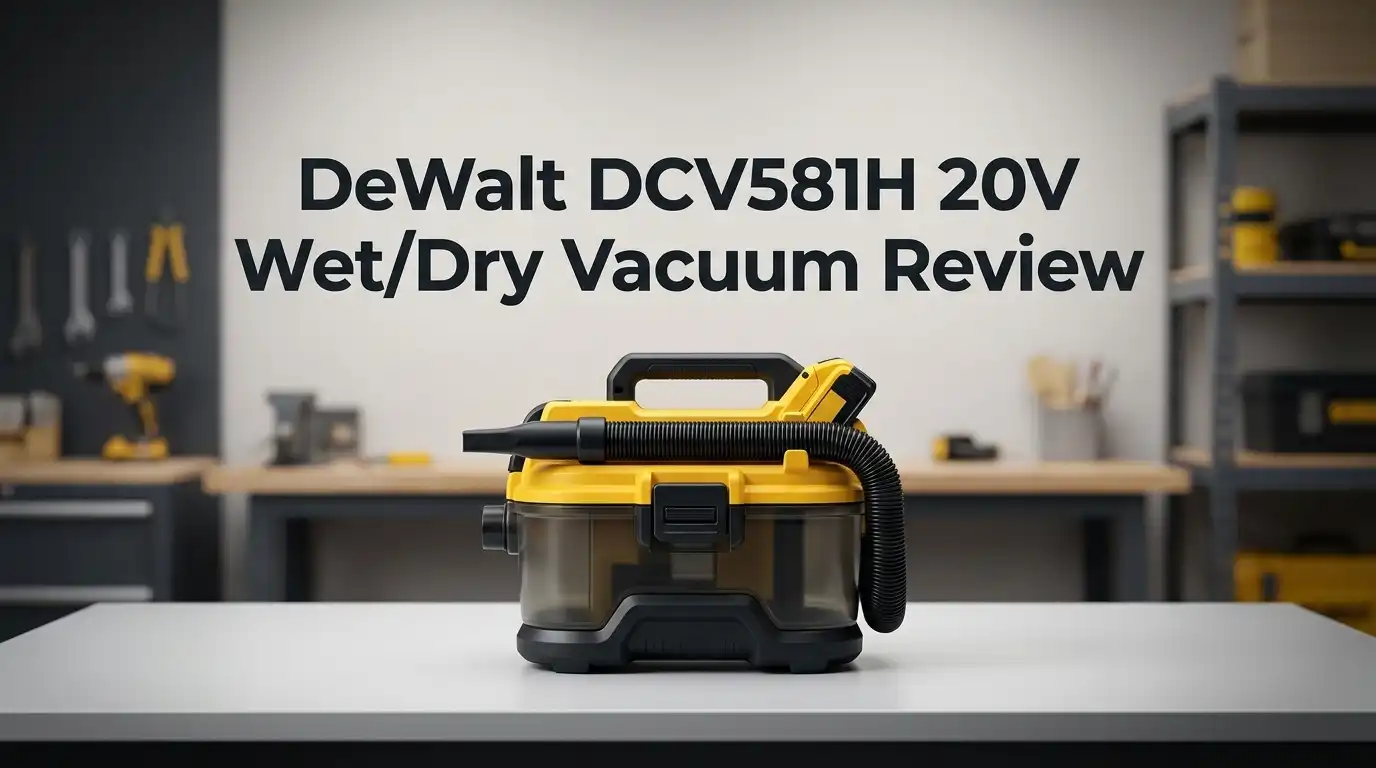
DeWalt DCV581H 20V Wet/Dry Vacuum Review 2026
Cordless cleanup tools have quietly become the most used items in a lot of work vans. The DeWalt DCV581H sits right in the middle of that trend.
It runs on a 20V MAX battery, it plugs into a wall outlet when the battery dies, and it sucks up both sawdust and standing water. That mix sounds close to perfect on paper.
This review covers the unboxing, the build, the suction, the runtime, the filter, and the parts that genuinely frustrate people. You will know by the end whether this vacuum fits your work or whether your money belongs somewhere else.
In a Nutshell:
- The dual power system is the headline feature. You can run the DCV581H on a 20V MAX battery, on an older 18V stick battery, or on wall power through the attached cord. No other feature on this vacuum matters as much as this one.
- Suction is good, not great. The rated airflow sits around 31 CFM, which handles sawdust, drywall chunks, gravel, and car interiors. A full size corded shop vacuum will beat it every single time.
- The 2 gallon tank punches above its size. It holds enough water to empty a toilet before a removal job, and it stays compact enough to carry in one hand.
- The HEPA rated filter is excellent and also the main weakness. It traps 99.97 percent of particles at 0.3 microns, but fine dust clogs it fast, and suction drops hard until you knock the filter clean.
- Battery life is a genuine strength. A 5.0Ah pack delivers roughly 40 to 45 minutes of steady running, which covers most end of day cleanups without a swap.
- Build quality draws complaints. The plastic clamps that hold the lid to the tank are the weak point, and some owners report electronics failures after a few years.
What Is the DeWalt DCV581H?


Last update on 2026-11-22 / Affiliate links / Images from Amazon Product Advertising API
The DCV581H is a portable wet dry vacuum built around DeWalt’s 20V MAX battery platform. It holds 2 gallons of debris or liquid. The motor pulls up to 31 CFM of airflow. A 5 foot hose with a 1.25 inch diameter stores on the body along with the nozzle attachments.
The feature that sets it apart is the power choice. A battery slot sits on the back, and a standard power cord tucks into the housing. You pick whichever source makes sense at that moment. The vacuum also accepts legacy 18V stick batteries, which keeps older DeWalt owners happy.
DeWalt sells it as a bare tool. No battery and no charger come in the box, so plan for that cost if you are new to the platform. The filter is washable, reusable, and rated for fine particle capture.
Unboxing Experience
The box arrives smaller than most people expect. Lift it out and the vacuum feels dense rather than heavy, somewhere around 14 pounds with no battery attached. The yellow and black housing looks like every other DeWalt product on the shelf, which is the point.
Everything ships preassembled. The hose already sits in its wraparound channel. The crevice tool and the wide nozzle clip into molded slots on the side. The power cord coils into its own recess. You lift the lid, confirm the filter is seated, close the clamps, and you are ready.
Setup takes under two minutes with no tools. That first impression wins people over quickly. The downside shows up when you squeeze the lid clamps for the first time and notice how thin the plastic feels. It works, but it does not inspire long term confidence.
Design and Build Quality
The body uses thick molded plastic that shrugs off drops from a truck bed. The carry handle sits on top and balances well. Rubber feet keep the unit from sliding on smooth concrete.
Onboard storage is the best part of the design. The hose, the cord, and both nozzles stay attached to the machine. Nothing rattles loose in a van, and nothing goes missing on a jobsite. That alone separates this vacuum from cheaper competitors.
The clamps that lock the motor head to the tank are the known weak spot. Several owners report one of those brackets snapping off, usually after repeated opening in cold weather. The vacuum still functions with a bungee strap, but it should not come to that on a tool at this price.
Emptying the tank is also clumsy. The bucket has a tall lip on every side that traps the last handful of debris.
Top 3 Alternative for DeWalt DCV581H

Last update on 2026-11-22 / Affiliate links / Images from Amazon Product Advertising API
Milwaukee 0880-20 M18 Cordless Wet/Dry Vacuum

Last update on 2026-11-22 / Affiliate links / Images from Amazon Product Advertising API
Makita XCV11Z 18V LXT Brushless Cordless Wet/Dry Dust Extractor

Last update on 2026-11-22 / Affiliate links / Images from Amazon Product Advertising API
DEWALT DCV580H 20V MAX Cordless Wet/Dry Vacuum
Suction Power in Real Use
This section decides the purchase for most buyers, so here is the honest answer. The DCV581H has enough suction for cleanup work and not enough for heavy extraction work.
It picks up sawdust, wood chips, screws, drywall crumbs, sand, leaves, and carpet dirt without complaint. Run the wide nozzle across a garage floor and it clears the surface in one pass. Point the crevice tool into a car footwell and it pulls out ground in grit.
The ceiling shows up when you try to lift heavy or packed material. A 120 volt shop vacuum will outperform it on every test. Owners who expect corded performance feel let down within the first week.
DeWalt clearly tuned this motor for runtime instead of raw pull. That tradeoff suits a cleanup tool and frustrates anyone wanting a dust extractor. Know which one you need before buying.
Wet Pickup Performance
Water handling is where the DCV581H quietly shines. The 2 gallon tank swallows a flooded toilet bowl, a spilled bucket, a wet basement corner, or a backed up sink trap.
Plumbers buy this vacuum specifically for toilet removals. You drop the hose into the bowl, pull the standing water in seconds, and move on without a mop. That single use case justifies the price for the trades.
The filter stays in place for wet work, which keeps the design simple. Rinse it afterward and let it dry fully before switching back to dust. Skipping that step turns trapped drywall dust into cement inside the pleats.
One caution applies. The tank fills faster than you expect on liquids, and there is no loud full tank alarm. Check your progress every thirty seconds or you will overfill it.
Battery Runtime and Corded Mode
Runtime is a real strength here. A 5.0Ah PowerStack or a 6.0Ah XR pack delivers roughly 40 to 45 minutes of continuous suction. Smaller 2.0Ah packs give you about 15 minutes, which covers a quick spill but little else.
Suction stays consistent until the battery protection cuts out. You do not get a long slow fade, which makes planning easier. For most users, one large pack covers an entire end of day cleanup.
The corded option removes battery anxiety completely. Plug it in for a long shop session, then unplug and walk away for the next job. Few cordless vacuums offer that flexibility, and it remains the strongest argument for this model over rivals.
The cord is short enough that you will still reach for an extension lead indoors. Keep one nearby.
HEPA Filter and Dust Control
The filter carries a HEPA rating and captures 99.97 percent of particles at 0.3 microns. That matters for renovation work, for allergy sufferers, and for anyone who hates a dust cloud blowing out the exhaust.
Air quality from this vacuum is genuinely clean. You can run it in a finished room without coating the furniture.
The cost of that filtration is clogging. Fine powder, especially joint compound sanding dust, blocks the pleats within minutes. Suction collapses, and you have to open the lid and tap the filter against a trash can to restore it. Then it clogs again.
Normal sawdust, dirt, and debris cause no such problem. Buy a spare filter and rotate them. Wash the dirty one, let it dry for a full day, and keep the clean one in the vacuum.
Noise Level and Comfort
The DCV581H runs loud. It sits in the same range as a small corded shop vacuum, loud enough that you will raise your voice over it. Ear protection is sensible for sessions longer than ten minutes.
The pitch is high and whiny rather than deep, which some people find more irritating than a larger machine.
Handling makes up for the noise. The top handle balances the unit well, and the compact footprint lets you set it on a stair tread or a truck shelf. Carrying it up a ladder is possible but awkward.
The 5 foot hose is the real comfort limit. It forces you to drag the vacuum along constantly. Most long term owners buy a longer aftermarket hose and never look back. A 16 foot replacement transforms daily use and costs very little.
What the DCV581H Does Not Do Well
Honest reviews list the failures, so here they are plainly.
It does not replace a corded shop vacuum. Anyone buying it as a primary dust collector for a woodshop will return it.
It does not handle fine powder for long. The HEPA filter blinds quickly, and the cleaning routine gets old fast.
It does not empty cleanly. The lipped tank traps debris and forces you to scoop the last of it out by hand.
It does not feel built to last forever. The lid clamps crack, and a number of owners report the control board failing after a few years of regular use.
It does not include a battery or charger. The sticker price is only part of your real cost.
Finally, it does not come cheap for what it offers. Competing cordless vacuums deliver more suction for similar money.
Pros and Cons
Pros
- Runs on a 20V MAX battery, an older 18V stick battery, or wall power through the built in cord
- Excellent runtime of roughly 40 to 45 minutes on a 5.0Ah pack
- HEPA rated washable filter captures 99.97 percent of particles at 0.3 microns
- 2 gallon tank handles liquids well, including a full toilet bowl
- Onboard storage keeps the hose, cord, and nozzles attached at all times
- Compact and easy to carry at around 14 pounds
- Works with the batteries most DeWalt owners already have
Cons
- Suction falls well short of a corded shop vacuum
- Filter clogs fast on fine dust and needs frequent knocking out
- Plastic lid clamps are fragile and break for some owners
- Tank lip makes full emptying awkward
- The 5 foot hose is too short for comfortable use
- Loud operation during extended cleanups
- Sold as a bare tool with no battery or charger included
Who Should Buy the DeWalt DCV581H?
Last update on 2026-11-22 / Affiliate links / Images from Amazon Product Advertising API
Buy this vacuum if you already own DeWalt 20V MAX batteries and you want a grab and go cleanup tool. Plumbers, electricians, HVAC techs, handymen, and remodelers get the most value here, especially anyone who removes toilets or deals with water.
It also suits homeowners with a garage, a workshop, or a couple of vehicles to clean. The cordless freedom beats dragging a big vacuum and an extension cord around.
Skip it if you sand drywall for a living. Skip it if you need a dust extractor for a table saw. Skip it if you have no DeWalt batteries, since the platform entry cost pushes the total too high.
Buyers in other battery systems should look at their own brand first. The convenience of one battery platform outweighs small performance gaps between these machines.
Price and Value in 2026
Pricing on this model moves around. It has sold for as little as 79 dollars during past promotions and climbed as high as 199 dollars during stock shortages. Through 2026 the typical street price has hovered near 149 dollars for the bare tool.
At 149 dollars the value is fair but not thrilling. At 99 dollars or below it becomes an easy recommendation.
Watch holiday sales and tool promotions closely. DeWalt regularly bundles this vacuum with a battery during spring and winter events, and that bundle is usually the smartest way to buy it.
Factor in a spare filter, which costs around 20 dollars, and a longer hose if you want daily comfort. Budget roughly 180 to 200 dollars total for a setup that genuinely works well.
Maintenance Tips That Extend Its Life
A few habits keep this vacuum running for years.
Tap the filter clean after every dusty job, not after suction dies. Prevention beats recovery.
Wash the filter with cool water, never soap, and dry it completely for 24 hours before reinstalling. A damp filter breeds odor and loses efficiency.
Rinse the tank after every wet pickup. Standing water plus dust equals a smell you cannot remove later.
Open and close the lid clamps gently, especially in cold weather. Cold plastic snaps far more easily than warm plastic.
Store the unit indoors rather than in a freezing truck overnight when you can. Store batteries separately.
Keep a spare filter on the shelf. Swapping takes ten seconds and saves a wasted afternoon when the first one blinds up mid job.
Final Verdict
The DeWalt DCV581H earns a recommendation with clear limits attached. It is a very good cleanup vacuum and a mediocre dust extractor. Treat it as the former and you will love it.
The dual power design, the long runtime, the clean HEPA exhaust, and the tidy onboard storage make it a tool you actually reach for. Those small conveniences add up across a workweek.
The fragile clamps, the clog prone filter, the short hose, and the modest suction keep it from greatness. DeWalt could fix most of these in a redesign and has not.
Score it around 4 out of 5 for tradespeople already on the 20V MAX platform. Score it closer to 3 out of 5 for everyone else. Buy it on sale, add a long hose and a spare filter, and it will serve you well for years.
Frequently Asked Questions
Does the DeWalt DCV581H come with a battery?
No. DeWalt sells it as a bare tool. You supply your own 20V MAX battery and charger, or run it on the built in power cord.
Can the DCV581H pick up water safely?
Yes. It handles up to 2 gallons of liquid and works well for toilet removals, spills, and small floods. Rinse the tank and dry the filter afterward.
How long does the battery last on this vacuum?
A 5.0Ah pack gives roughly 40 to 45 minutes of continuous use. Smaller 2.0Ah packs deliver around 15 minutes.
Is the filter washable?
Yes. The HEPA rated filter rinses under cool water and goes back in once fully dry. Keeping a spare on hand is strongly advised.
Why does the suction drop during use?
The filter has clogged with fine dust. Open the lid, tap the filter clean over a trash can, and suction returns immediately.
Does it work with older 18V DeWalt batteries?
Yes. The DCV581H accepts both 20V MAX packs and legacy 18V stick batteries, which is rare among current DeWalt tools.
What is the difference between the DCV580H and the DCV581H?
The DCV580H runs on battery power only. The DCV581H adds the corded option while keeping the same tank size and filter.

Hi, I’m Grace Bell, the founder of CleanFloorVault.com, where I personally test and review vacuum cleaners to help you find the perfect tool for a spotless home.