Shark AI Ultra Robot Vacuum Review 2026: Still Worth It?
Robot vacuums promise free time. Most of them deliver dust bins that need emptying every two days instead. The Shark AI Ultra tries to fix that problem with a bagless base that holds up to 60 days of debris. No bags to buy. No weekly chore.
But a big base means nothing if the robot skips corners, chokes on pet hair, or eats your phone charger. So I spent weeks running this machine across hardwood, low pile carpet, and a very hairy rug. I tracked what it cleaned, what it missed, and what quietly annoyed me.
This review covers the good, the average, and the parts Shark would rather you skip. If you own pets, live in a multi room home, or simply hate emptying dust bins, keep reading. By the end you will know whether the Shark AI Ultra deserves a spot in your hallway in 2026.
In a Nutshell:
- Cleaning power is genuinely strong. Independent lab style testing shows around 97 percent debris pickup across all floor types, with nearly 99.8 percent on hardwood. Sugar, rice, cereal, and litter all disappear in one or two passes.
- The bagless self empty base is the headline feature. You empty it roughly once a month. There are zero recurring bag costs, which saves real money over three years compared to bag based docks.
- Pet hair is the weak spot. On high pile carpet, more than half of ground in pet hair stayed behind after two passes. Long human hair also wraps around the brushroll ends and needs manual cleaning.
- Obstacle avoidance underperforms. The LiDAR system maps rooms beautifully but fails to dodge small floor clutter like cables and socks. You still need to tidy before a run.
- Navigation and mapping are excellent. Matrix Clean makes tight grid passes, the robot rarely gets stuck, and it returns to the dock reliably. Expect 70 to 80 minutes for 1,000 square feet.
- Value is the real win. At its usual street price, you get LiDAR mapping plus a bagless dock for far less than premium rivals. It is the best budget LiDAR plus self empty combination available right now.
What Is the Shark AI Ultra Robot Vacuum?


Last update on 2026-11-20 / Affiliate links / Images from Amazon Product Advertising API
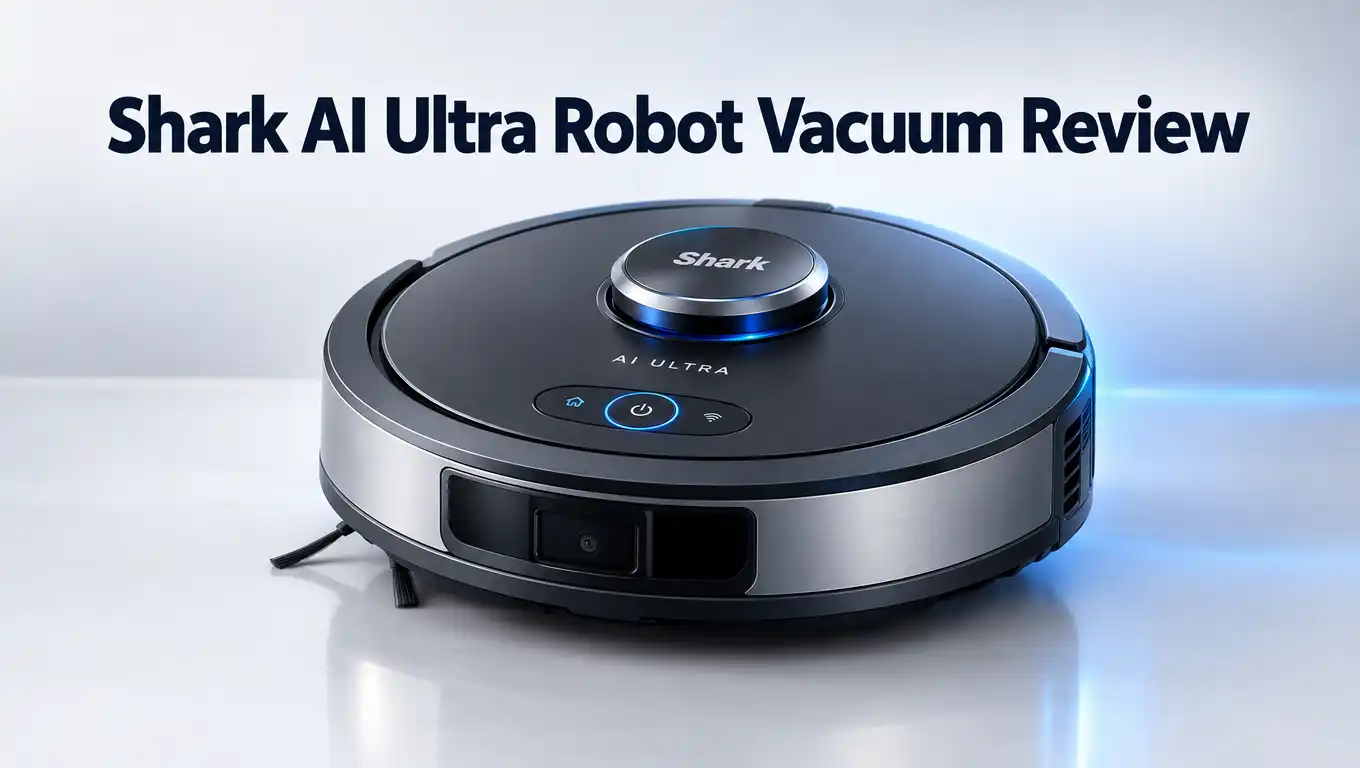
The Shark AI Ultra is a midrange robot vacuum with a tall, bagless self empty base. Shark sells it under model numbers like AV2501S and AV2501AE, and the core machine stays the same across versions. The robot uses LiDAR laser navigation to build a map of your home, then cleans room by room.
Its signature trick is called Matrix Clean. Instead of one straight pass, the robot drives a tight crosshatch grid over dirty zones. The result is multiple passes over the same spot without you doing anything.
Other core features include a self cleaning brushroll, HEPA filtration in the base, WiFi with app control, and voice commands through Alexa and Google Assistant. It vacuums only. There is no mopping pad on this model, which keeps things simple.
Unboxing Experience and First Impressions
The box is heavier than expected, mostly because of the base. Inside you get the robot, the self empty base, two side brushes, a power cable, and a thin manual. That is it. No spare filters, no extra brushroll, no cleaning tool beyond what is clipped inside the robot.
Everything sits in molded cardboard rather than foam, which feels nicer for recycling day. The robot itself is matte black with a raised LiDAR turret on top. It looks serious. The base is tall and glossy, so fingerprints show up immediately.
Assembly takes two minutes. You clip the side brushes onto the underside until they click, plug in the base, and set the robot on the charging contacts. The brushroll comes pre installed. My first impression was simple: this feels like a premium machine at a midrange price.
Setup and the Shark Clean App
Setup runs through the SharkClean app. You create an account, pick the model, and connect to your 2.4GHz network. The whole process took about six minutes. Pairing worked on the first attempt, which is not something I can say about every robot vacuum.
The first cleaning run doubles as the mapping run. Let the robot roam the whole floor once, and it produces a usable map within one cycle. After that, you can name rooms, draw no go zones, and mark high traffic areas that get extra passes.
The app is clean and easy to read. Room specific cleaning works well. You tap a room, tap clean, and the robot goes straight there. My one real gripe is scheduling. You only get one scheduled clean per day, which feels limiting for busy households with pets.
Top 3 Alternative for Shark AI Ultra Robot Vacuum

Last update on 2026-11-22 / Affiliate links / Images from Amazon Product Advertising API
Roborock Q5 Max+

Last update on 2026-11-20 / Affiliate links / Images from Amazon Product Advertising API
iRobot Roomba j7+

Last update on 2026-11-20 / Affiliate links / Images from Amazon Product Advertising API
eufy RoboVac X8 Hybrid
Matrix Clean Navigation Explained
Most robot vacuums drive in parallel lines. One pass, done, next row. Matrix Clean changes that pattern. The robot drives the usual rows, then turns 90 degrees and drives across them again. The path looks like graph paper.
Why does this matter? Fine debris hides in floor grain and carpet fibers. A single direction pass often pushes crumbs sideways instead of lifting them. The second perpendicular pass catches what the first one nudged away.
You can trigger Matrix Clean for a whole room or for a small spot. The Matrix spot mode is genuinely useful under a dining table after dinner. It scrubs a small square with several overlapping passes.
The tradeoff is time. Grid cleaning roughly doubles the run time for a given room. If you want fast, use standard mode. If you want thorough, use Matrix and run it while you are out.
Cleaning Performance on Hard Floors
Hard floors are where this robot shines. In controlled testing with sugar, rice, kitty litter, and cereal, the Shark AI Ultra removed close to 99.8 percent of debris from hardwood. That is near perfect and better than most robots in its price bracket.
Large debris like cereal does not get flicked away, which is a common failure on cheaper machines. The front bumper and side brush feed it inward rather than punting it across the room.
Edges and corners get decent attention thanks to the single side brush. It is not flawless. Tight 90 degree corners still hold a small triangle of dust after a run, because the round body cannot reach fully inside.
One quirk worth flagging: a few owners report the robot scattering light debris backward on very smooth hard floors. Lowering the suction setting on slick surfaces usually fixes it.
Cleaning Performance on Carpet
Carpet results drop slightly but stay above average. On low pile and high pile carpet, pickup landed in the 95 to 97 percent range, compared to a typical robot average near 95 percent. Rice and cereal vanish. Sugar and litter leave a few stragglers pressed into the fibers.
The robot detects carpet and boosts suction automatically. You hear the motor change pitch as it climbs from tile onto a rug. That boost helps, though this is not a deep cleaning machine.
Think of it this way. The Shark AI Ultra maintains clean carpet very well. It does not rescue neglected carpet. If your rug has three months of ground in grit, a full size upright will still beat it badly.
Transitions are handled well. The robot climbs standard rug edges and low thresholds without stalling, and it rarely beaches itself on tassels.
Pet Hair and Long Hair Test Results
Here is the honest part. Pet hair is this robot’s biggest weakness. In a test where one gram of pet hair was rubbed into high pile carpet, more than half of that hair remained after two full passes. That is a poor result for a vacuum marketed at pet owners.
Long human hair tells a different story. The robot lifted essentially all of it off the floor. The problem is where it went. Most of that hair wrapped tightly around the ends of the brushroll.
Shark calls the brushroll self cleaning, and the center section does stay mostly clear. The end caps do not. You will need to pull tangles off every week or two if anyone in the house has long hair.
If you own a heavy shedding dog, budget for a separate upright vacuum or look at a model with dual rubber rollers.
The Bagless Self Empty Base
The base is the reason many people choose this model. After each run, the robot docks and a loud burst of suction pulls debris up into a bagless bin with HEPA filtration. Capacity is rated at 30 or 60 days depending on the version you buy.
No bags means no recurring cost. Bag based docks typically cost 30 to 60 dollars a year in replacements. Over three years, that difference alone covers a set of spare filters and a new brushroll.
Emptying is easy. You lift the bin out, hold it over a trash can, and press the release. Fine dust puffs out, so do it slowly or take it outside.
The downside is noise. The empty cycle is genuinely loud, close to a leaf blower for about ten seconds. Pets hate it. Schedule cleans for when nobody is napping.
Obstacle Avoidance: The Real Weak Spot
LiDAR is great at mapping walls. It is much less great at spotting a phone cable lying on the floor. In a four object avoidance test, the Shark AI Ultra failed to avoid three of the four items.
There is no front facing camera and no structured light obstacle sensor on this model. It relies on the laser turret and the physical bumper. That means socks, charging cables, shoelaces, and pet toys are fair game.
The practical result is simple. You still need to do a thirty second floor sweep before every run. Pick up cords. Move the dog toys. Close the bedroom door if the kids left Lego out.
If you cannot commit to that, spend more on a vacuum with camera based obstacle recognition. For everyone else, this is a small habit that solves the problem completely.
Battery Life, Coverage, and Speed
The battery delivers roughly 120 minutes of runtime in standard mode. That drops noticeably in Matrix Clean mode, since the grid pattern works the motors harder for longer.
In real testing, the robot covered a 1,000 square foot space in 70 to 80 minutes. That is slower than the 50 to 60 minute average across robot vacuums, mainly because of the thorough pass pattern.
Recharge and resume saves the day on larger homes. When the battery runs low, the robot returns to the base, charges to the level it needs, then drives back to the exact spot it left and finishes the job.
You do not need to babysit it. Start a full house clean before work and it will be finished and docked by the time you get home.
Noise Levels in Daily Use
During normal cleaning, the Shark AI Ultra sits in the average range for robot vacuums. It is loud enough to interrupt a conversation if it is in the same room, but you can comfortably watch television one room over.
Suction level changes the volume. Eco mode is noticeably quieter. Max mode on carpet is the loudest state during cleaning, though the self empty cycle is far louder than anything the robot does while driving.
Two features help. Do Not Disturb blocks operation during set hours, so the base will not fire off at 2am. Scheduling lets you push cleaning to daytime hours when nobody is home.
The dock noise is short but startling. If your base sits near a home office, move it. Ten seconds of jet engine during a video call is not a good look.
Maintenance and Running Costs
Maintenance is light but not zero. Weekly, check the brushroll for hair at both ends and clear the side brush. Monthly, empty the base bin and tap out the base filter. Every few months, rinse the robot filter and let it dry fully.
Replacement parts are widely available and cheap. A combined kit with filters, side brushes, and a brushroll usually costs less than a single year of dust bags for a competing dock.
Annual running cost is therefore low. No bags, no proprietary cleaning solution, no subscription. That matters more than people expect over a three to four year ownership window.
One tip from experience: do not skip the base filter. A clogged base filter weakens the auto empty suction, which leads to debris sitting in the robot bin and a false sense that the vacuum stopped working.
What the Shark AI Ultra Does Not Do Well
An honest review needs a list of failures, so here it is.
It does not mop. There is no water tank and no pad on this model. It does not remove ground in pet hair from thick carpet, and pretending otherwise would be dishonest. It does not avoid floor clutter, so cables and socks are real risks.
The app limits you to one schedule per day, which is frustrating in busy homes. Some owners report occasional mapping glitches after furniture moves, requiring a remap. Reliability across the wider Shark robot line has also drawn criticism, and the two to three year mark is where failures tend to appear.
Corner cleaning is good, not perfect. And the glossy base collects dust and fingerprints in a way that looks worse than the machine deserves.
Pros and Cons
Pros
- Bagless self empty base removes recurring bag costs entirely and holds weeks of debris.
- Outstanding hard floor pickup at roughly 99.8 percent debris removal.
- LiDAR mapping is accurate, fast to build, and supports rooms, zones, and no go areas.
- Matrix Clean grid passes genuinely improve results on fine debris.
- Recharge and resume handles large homes without supervision.
- HEPA filtration in the base helps allergy sufferers.
- Simple setup, stable WiFi pairing, and an easy app.
- Strong value compared to premium LiDAR rivals.
Cons
- Poor deep pet hair removal from high pile carpet.
- Long hair tangles around the brushroll end caps.
- Obstacle avoidance fails on small clutter like cables and socks.
- The self empty cycle is very loud.
- Only one scheduled clean per day in the app.
- No mopping function at all.
- Slower cleaning speed than the category average.
- Long term reliability is a question mark across the Shark robot range.
Shark AI Ultra Robot Vacuum Price and Value in 2026
Last update on 2026-11-20 / Affiliate links / Images from Amazon Product Advertising API
List price sits high, but this machine is almost always discounted. Street pricing typically lands well below the sticker, and it drops further during major sales events. At that discounted price, the value proposition is excellent.
Compare it to rivals. Camera equipped models with better obstacle avoidance cost significantly more. Cheaper bump and run robots lack LiDAR mapping entirely and force you to empty a tiny bin constantly.
The Shark AI Ultra sits in the sweet spot. You get real mapping, real room control, real suction, and a month of hands free operation for a midrange budget.
My advice is simple. Do not pay full list price. Wait for a sale, then buy. At a discount, few robots offer this much capability per dollar.
Who Should Buy the Shark AI Ultra?
Buy it if you have mostly hard floors with some area rugs. That is the scenario where this robot performs close to perfectly.
Buy it if you hate maintenance. The bagless base means you touch the machine roughly once a month, and that convenience is hard to overstate once you live with it.
Buy it if you want mapping and zone control without paying premium prices.
Skip it if you own a heavy shedding dog and thick carpet throughout the house. Skip it if your floors are permanently covered in cables, toys, or laundry. Skip it if you want vacuuming and mopping in one machine.
For everyone else, this is one of the smartest midrange robot vacuum purchases available in 2026. It does the boring work well and asks very little in return.
Frequently Asked Questions
Does the Shark AI Ultra mop?
No. This model vacuums only. There is no water tank and no mopping pad. If you want both functions, look at Shark’s two in one VacMop models or a hybrid from another brand.
How often do I empty the base?
Roughly once every 30 to 60 days depending on your model version, floor type, and pets. Homes with shedding pets fill the bin faster. The app sends a notification when the bin needs attention.
Do I need to buy bags for the base?
No. The base is bagless. You empty the bin directly into your trash can. This saves around 30 to 60 dollars per year compared to bag based docks.
Is the Shark AI Ultra good for pet hair?
It handles surface level pet hair on hard floors well. It struggles with pet hair worked deep into high pile carpet. Long hair also tangles on the brushroll ends and needs manual removal every week or two.
Will it avoid cables and socks?
Often not. The LiDAR system maps walls and furniture accurately but misses small floor objects. Clear cords, socks, and toys before each run.
How long does the battery last?
About 120 minutes in standard mode. Matrix Clean mode reduces that. Recharge and resume lets the robot finish larger homes across multiple charges automatically.
Does it work without WiFi?
Yes, in basic form. The buttons on the robot start a clean and send it home. You need WiFi for mapping, scheduling, zones, and voice control.
Can I set multiple cleaning schedules per day?
No. The app allows one scheduled clean per day. Additional runs must be started manually or by voice command.

Hi, I’m Grace Bell, the founder of CleanFloorVault.com, where I personally test and review vacuum cleaners to help you find the perfect tool for a spotless home.