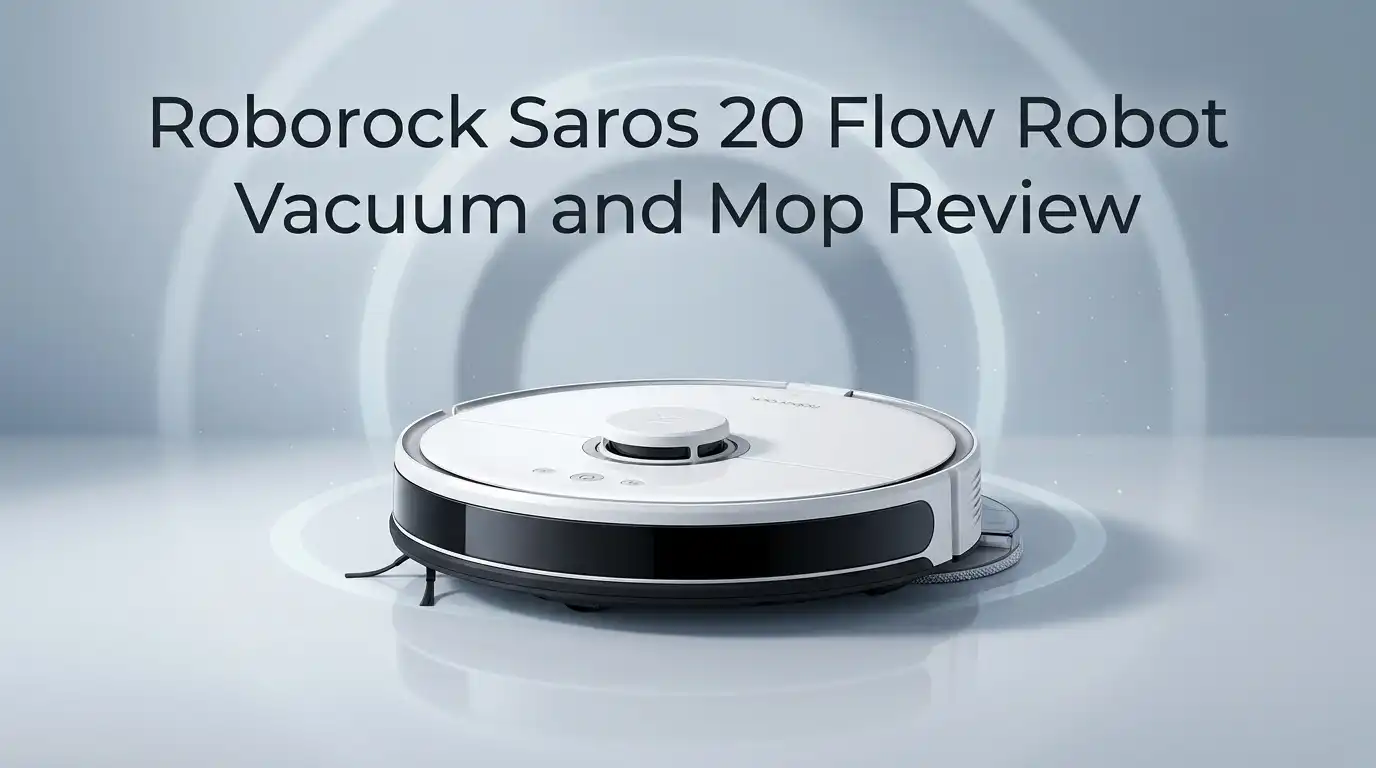
Roborock Saros 20 Flow Robot Vacuum and Mop Review 2026: Worth It?
The Roborock Saros 20 Flow arrived with big promises. A roller mop that washes itself while it works. Suction numbers that look like a typo.
A chassis that lifts itself over thresholds taller than a paperback book. At $1,699.99 list price, it sits at the very top of the robot vacuum market.
This review covers what the Saros 20 Flow actually does in a real home. You will get honest talk about the weak spots, including the one design change that has Roborock fans genuinely annoyed. Read on before you spend seventeen hundred dollars.
In a Nutshell:
- The roller mop is the real upgrade. The SpiraFlow 2.0 system spins at up to 240 RPM while 16 pressurized water outlets rinse it continuously. You get fresh water on the floor instead of recycled grime, and dried coffee stains disappear in one or two passes.
- Suction is rated at 36,000 Pa. That is among the highest claimed figures on the market. In practice, carpet deep cleaning and pet hair pickup both land well above average, and the DuoDivide main brush resists hair wrap almost perfectly.
- Threshold climbing is class leading. AdaptiLift Traverse 3.0 handles a two stage threshold totaling up to 3.46 inches. If your home has raised door sills or thick rugs, this robot goes where most others stall.
- The side brushes do not extend. This is the biggest complaint from owners. Corner and edge cleaning is noticeably weaker than on the Saros 10R, and the brushes keep spinning during wet cleaning.
- Battery life disappoints in large homes. The 6,400 mAh pack claims 301 minutes in Quiet mode, but several owners report full house runs stretching past eight hours with recharges.
- The dock does almost everything. Hot water washing at 212°F, warm air drying, detergent dosing, dust emptying into a 2.7L bag, and dirt detection that triggers an extra mop wash.
Roborock Saros 20 Flow Robot Vacuum and Mop

Last update on 2026-11-20 / Affiliate links / Images from Amazon Product Advertising API
The Saros 20 Flow is Roborock’s final flagship release of 2026 and the company’s first Saros model built around a roller mop instead of spinning pads. It launched in the United States in September after a preview at IFA in Berlin.
Think of it as the Saros 20 with a different cleaning philosophy. The standard Saros 20 uses two round pads that spin at 200 RPM. The Flow swaps those for a single wide roller that scrubs, rinses, and scrapes itself in a continuous loop. That loop is the whole pitch. A pad holds dirty water. A rinsed roller does not.
The robot stands 3.54 inches tall, uses RetractSense retractable LiDAR, and recognizes over 300 object categories through Reactive AI. It is a genuinely different machine, not a color refresh.
Unboxing Experience: What Arrives in the Box
The shipping carton is large and heavy. Expect something close to 18 inches on each side and enough weight that you will want a second pair of hands for stairs.
Inside, the dock sits in molded pulp packaging with the robot nested beside it. Roborock has moved away from foam, so unpacking produces far less mess than older models. You get the robot, the dock, a dust bag already installed, a bottle of floor detergent, a power cable, and a short printed guide.
The setup took me under fifteen minutes. You clip the ramp onto the dock, fill the 4L clean water tank, press the power button, and scan the QR code with the Roborock app. The first mapping run finished in about twelve minutes for roughly 1,100 square feet. No tools required at any point.
Design and Build Quality
The Saros 20 Flow looks expensive. The top panel is a smooth matte finish that hides dust better than the glossy Saros 10R lid. Panel gaps are tight. Nothing creaks when you lift it.
At 3.54 inches tall, it is half an inch taller than the standard Saros 20. That half inch matters. The roller mop assembly needs the space, and the trade is clearance under low furniture. It still slid under my sofa and kitchen toe kicks, but owners with very low cabinets should measure first.
The dock is tall and wide, with a hinged lid covering the 4L clean tank, the 3L dirty tank, and the detergent bay. Everything you touch weekly sits within easy reach. Build quality feels worth the price, which is not always true at this tier.
Top 3 Alternative for Roborock Saros 20 Flow


Last update on 2026-11-21 / Affiliate links / Images from Amazon Product Advertising API
DREAME X60 Max Ultra Complete Robot Vacuum and Mop

Last update on 2026-11-20 / Affiliate links / Images from Amazon Product Advertising API
Roborock Qrevo Curv 2 Flow Robot Vacuum and Mop

Last update on 2026-11-22 / Affiliate links / Images from Amazon Product Advertising API
Narwal Flow 2 Robot Vacuum and Mop Combo
SpiraFlow 2.0 Roller Mop Performance
This is where the Saros 20 Flow earns its money. The roller turns at up to 240 RPM while 16 water jets feed it clean water and a scraper blade strips the dirty water away. The result is a mop that stays damp and clean rather than slowly turning into a mud sponge.
On sealed hardwood, dried coffee rings vanished in a single pass. Dried juice needed two. The floor dried within three minutes with no visible streaking, which is better than most spinning pad systems manage.
The roller also extends outward to reach closer to baseboards. Combined with the 212°F dock wash, the pad never developed that sour smell older Roborock mops picked up after a few weeks. If mopping is your main reason for buying, this system is excellent.
Vacuum Power and Carpet Cleaning
The 36,000 Pa rating is a marketing number, but the real world results back it up reasonably well. On hard floors the robot cleared rice, cereal, flour, and kitty litter in one pass without scattering.
On medium pile carpet, performance stayed strong. Independent testing of the closely related Saros 20 measured 89 percent removal of embedded sand and 88 percent of flattened pet hair, both comfortably above category averages. My own carpet looked visibly refreshed after a single run.
The DuoDivide main brush has a split in the center that channels long hair toward the suction port. After three weeks with a shedding dog, I found zero hair wrapped around the roller. That alone saves you a monthly date with scissors. Bench airflow figures are only average, but debris pickup does not seem to suffer.
Obstacle Avoidance and Navigation
Reactive AI uses an RGB camera with AI processing to identify more than 300 categories of household clutter. It dodged shoes, phone cables, a dog bowl, and a pile of socks across repeated runs. Low light performance held up better than I expected, which is a known weak point for camera only systems.
Navigation uses RetractSense retractable LiDAR, so the turret drops down when the robot needs to squeeze under furniture. Mapping is fast and accurate, and room splitting rarely needed manual correction.
Here is the honest part. Path efficiency is average, not exceptional. The robot occasionally repeats sections or takes an odd route back to the dock. One early owner reported the lifting chassis raising at the wrong moment, leaving the robot beached. A firmware update has already addressed some of this behavior.
Threshold Climbing with AdaptiLift Traverse 3.0
AdaptiLift Traverse 3.0 is the standout mechanical feature. The chassis lifts while the wheels push, letting the robot walk up ledges that stop other machines cold.
Roborock claims a two stage threshold totaling 3.46 inches. In independent testing of the sibling Saros 20, the chassis cleared a single 57 millimeter step, a record for that lab. My own 1.5 inch door sill posed no challenge at all, and the robot crossed it without the usual three attempt shuffle.
The same system raises the body over thick rugs up to 30 millimeters. If your home is a patchwork of transitions, this feature is the single best reason to consider the Saros line. Multi level flooring is simply no longer a dealbreaker.
The RockDock Base Station
The dock does nearly all the maintenance. It washes the roller with water heated to 212°F, dries it with warm air at up to 145°F, empties debris into a 2.7L bag, refills the robot with warm water, and doses detergent automatically.
Tank capacity is generous at 4L clean and 3L dirty. In my home that covered about four full mopping runs before refill. The dust bag should last six to eight weeks in a pet free house.
The smartest touch is AI dirt detection. When the dock senses unusually dirty water coming back, it runs an extra wash cycle and sends the robot out for another mopping pass. You do not have to ask for it. The main gripe is that no plumbed version is offered outside China.
Battery Life and Runtime
Roborock lists a 6,400 mAh battery with up to 301 minutes in Quiet mode and a claimed maximum coverage near 3,746 square feet.
Reality is less generous. In standard vacuum and mop mode with the roller running, my runs lasted closer to 110 minutes before a recharge. That is fine for apartments and average homes. It is not fine for very large floor plans.
Several owners with homes above 2,000 square feet report full cleaning cycles stretching past eight hours once recharge pauses are counted. One user with a large property found his older Narwal finished the same job in half the time. Charging speed is decent but not best in class. Plan on overnight or midday runs if your home is big.
App Experience and Smart Home Control
The Roborock app remains one of the best in the category. You get room naming, custom suction and water levels per room, no go zones, no mop zones, carpet avoidance, and mopping direction control that follows your floorboards.
SmartPlan learns your habits and schedules deeper cleans for rooms it has skipped. The onboard Hello Rocky voice assistant responds to spoken commands without a phone. Matter support, Alexa, Google Home, and Siri Shortcuts are all included.
Remote camera viewing works well and doubles as a pet check tool. The interface is dense, and new users will spend an evening exploring menus. Once configured, it rarely needs touching again. Notifications are clear and not spammy, which I appreciated.
What the Saros 20 Flow Does Not Do Well
Now the uncomfortable truth. The side brushes do not extend. Roborock dropped the mechanical extending brush used on the Saros 10R in favor of two fixed arc style brushes. Corner cleaning suffers. Dust collects in room corners and along baseboard junctions that older Roborock models cleaned fine.
Worse, the side brushes do not lift or stop spinning during wet cleaning. Reviewers filmed the robot flinging ketchup across the floor instead of absorbing it.
Other faults: the robot is half an inch taller than the standard Saros 20, so very low furniture is off limits. Battery life underperforms in big homes. There is no plumbed dock option in the United States. Some owners also report the robot struggling to fit between chair legs that older models handled.
Pros and Cons
Pros
- The SpiraFlow 2.0 roller mop delivers genuinely excellent stain removal with continuous fresh water rinsing at 240 RPM.
- Threshold climbing up to 3.46 inches across two stages is the best in the category right now.
- The DuoDivide main brush scored perfectly on hair tangle resistance in independent testing.
- The RockDock handles washing, drying, emptying, refilling, and detergent dosing with almost no user input.
- Obstacle avoidance recognizes over 300 object types and performs well in dim rooms.
- The app offers deep customization, Matter support, and a usable onboard voice assistant.
Cons
- Side brushes do not extend, so corners and edges stay dustier than they should.
- Side brushes keep spinning during wet cleaning and can spread liquid messes.
- Battery life falls short in homes above 2,000 square feet.
- At 3.54 inches tall, it loses the slim advantage of other Saros models.
- No plumbed dock version is sold in the United States.
- The $1,699.99 price is hard to justify against cheaper roller mop rivals.
Maintenance and Running Costs
Daily maintenance is close to zero. The dock handles the roller and the dust bin. Your real jobs are refilling the clean tank, emptying the dirty tank, and swapping the dust bag.
Budget roughly once a week for the tanks in an average home. The dust bag lasts six to eight weeks. Detergent bottles last around two months with normal use.
Every few months you should pull the roller out and rinse it by hand, and check the dirty water channel for buildup. Roller mop systems do accumulate residue in the drainage path over time, and a yearly vinegar soak of the dirty tank prevents odor. Replacement parts including brushes, filters, bags, and rollers are widely available. Expect around $60 to $90 per year in consumables.
Price and Value: Is It Worth It?
Last update on 2026-11-20 / Affiliate links / Images from Amazon Product Advertising API
List price is $1,699.99, with street prices often falling closer to $1,499 during sales. That buys you the best roller mop Roborock has built and the strongest threshold climbing available.
The value question is harder. The Roborock Qrevo Curv 2 Flow offers roller mopping for several hundred dollars less. The Narwal Flow 2 competes closely on mopping and costs less too. The Dreame X60 Max Ultra matches the suction and adds faster charging.
You are paying a premium for the climbing chassis, the 212°F dock, and the Roborock app. If those three things solve a real problem in your home, the price makes sense. If you mainly want clean floors on a single level, cheaper options get you most of the way.
Who Should Buy the Saros 20 Flow
Buy this robot if your home has raised thresholds, mixed flooring, or thick rugs that defeat other machines. The AdaptiLift chassis is not marketing fluff, and nothing else climbs this well.
Buy it if mopping matters more to you than vacuuming. The roller system leaves hard floors cleaner than spinning pads, and the hot water dock keeps it hygienic without effort.
Buy it if you own pets. Hair tangle resistance is outstanding, and the automatic dirt detection catches muddy paw prints you would otherwise miss.
Skip it if your home is large and you need fast cycles. Skip it if corner dust drives you crazy, because the fixed side brushes will annoy you. Skip it if budget matters, since strong alternatives cost noticeably less.
Frequently Asked Questions
Is the Saros 20 Flow better than the standard Saros 20?
It depends on your floors. The Flow mops better thanks to the roller system and continuous rinsing. The standard Saros 20 has an extending side brush for corners and sits half an inch lower. Choose the Flow for mopping and the standard model for edge cleaning.
Does the roller mop work on carpet?
The roller lifts automatically when the robot detects carpet, so it will not soak your rugs. You can also set carpet avoidance in the app, or have the dock remove the mop entirely for vacuum only runs.
How loud is the Roborock Saros 20 Flow?
Normal cleaning sits at a conversational level and is easy to ignore. Max suction is noticeably louder. The dust emptying cycle is the loudest moment, lasting around ten seconds, so schedule runs away from nap times.
Can it handle pet hair and accidents?
Pet hair yes, with near perfect tangle resistance. Pet accidents no. Like all robot vacuums, it should not be trusted to clean up solid pet waste, and the obstacle camera does not always identify it correctly.
Does the Saros 20 Flow need a water line?
No. It uses onboard 4L clean and 3L dirty tanks that you fill and empty manually. A plumbed version exists in China but is not sold in the United States.
How often should I replace the roller mop?
Plan on a replacement every six to nine months depending on use. The hot water washing extends life considerably, but the fabric still wears down with daily scrubbing.

Hi, I’m Grace Bell, the founder of CleanFloorVault.com, where I personally test and review vacuum cleaners to help you find the perfect tool for a spotless home.