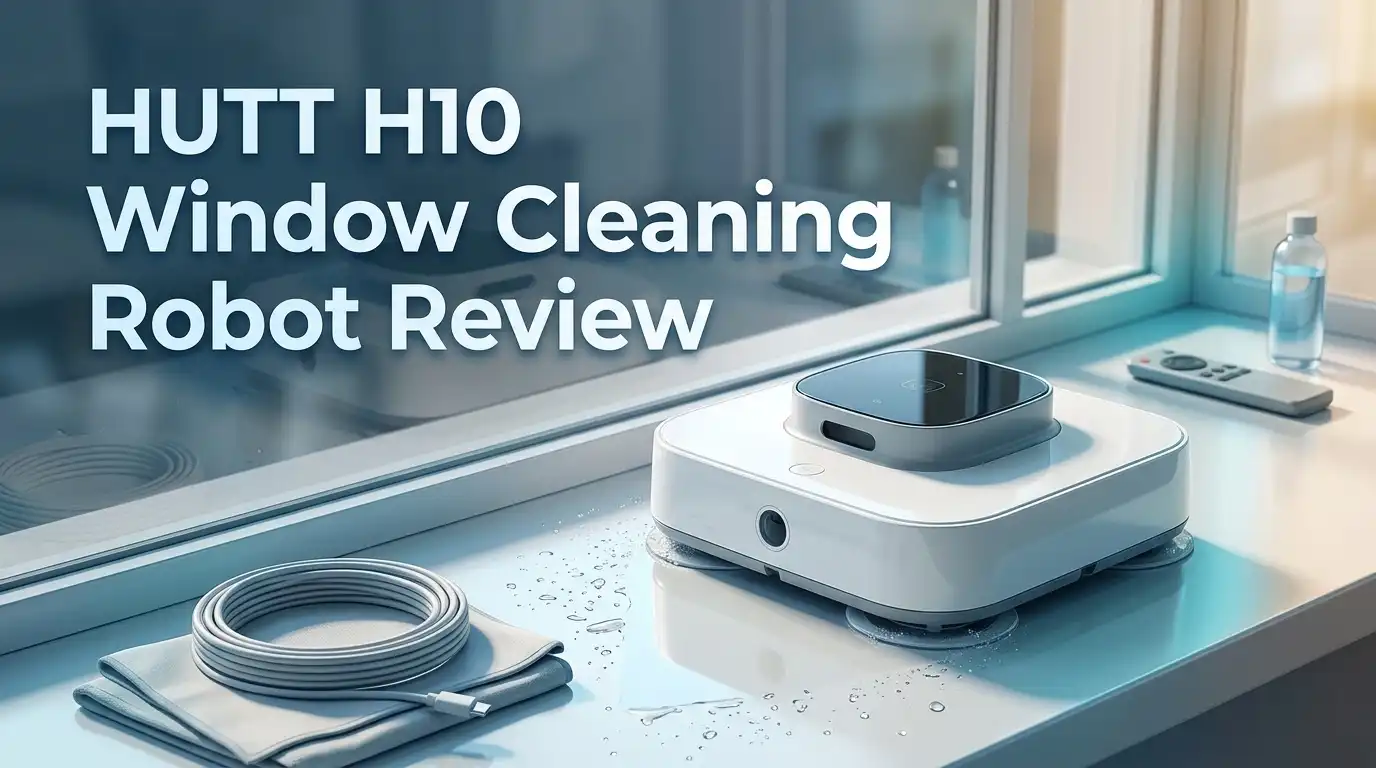
HUTT H10 Window Cleaning Robot Review 2026: Worth Buying?
Window cleaning is the chore almost nobody enjoys. You drag out the bucket, the squeegee, and that wobbly step stool, and an hour later your arms ache while the glass still shows streaks in afternoon light.
The HUTT H10 promises a different ending to that story. It sticks to your glass, sprays, scrubs, polishes, and leaves you free to drink coffee on the couch.
This review covers everything a buyer needs before spending real money. I looked at the unboxing experience, suction strength, navigation behavior, cleaning quality on dirty glass, noise, speed, and the parts that genuinely disappoint.
In a Nutshell:
- Suction is the headline feature. The HUTT H10 pulls roughly 6500Pa and holds a constant 55N of pressure against the glass through a 3D suspension beam. It does not slide, drift, or wobble on clean vertical surfaces, and it stays locked on even when you tug the power cord.
- The round plus square pad system is unusual. A rotating round pad spins at about 70 RPM and does the wet scrubbing. A flat square pad follows behind and polishes the glass dry. The result on large panes is genuinely clean glass with very few water marks.
- Corner coverage is the weak spot. Testers consistently report small uncleaned patches in tight corners and along some edges. On narrow windows under 60cm wide you will still need a cloth for the top edge.
- Safety backup works as advertised. A built in UPS battery keeps suction alive for 20 to 30 minutes during a power cut, and a 220kg rated safety rope comes in the box for outdoor use.
- It runs quiet but slow. Noise sits in the 65 to 74dB range depending on the test, which is dishwasher territory. A standard window takes around 11 minutes 30 seconds, so a full house is an afternoon project.
- It needs mains power at all times. The cable measures about five meters, which is short. Most people will need an extension lead.
What Is the HUTT H10 Window Cleaning Robot?

Last update on 2026-10-29 / Affiliate links / Images from Amazon Product Advertising API
The HUTT H10 is a corded robot that attaches to vertical glass using fan generated suction and cleans it without human help. It weighs roughly 1.3kg, which feels light in the hand but heavy enough to inspire a moment of doubt the first time you stick it on a third floor window.
What separates it from older models is the dual pad layout. One side carries a spinning round mop. The other side carries a flat square mop with a Velcro attachment. Most competitors pick one style or the other. HUTT put both on a single chassis.
The robot also uses a dual ultrasonic spray system that mists water directly onto the glass ahead of the pads. An 80ml visible tank shows the water level while the machine works. You control everything with one large button on the body or the bundled remote.
Unboxing the HUTT H10: What Arrives in the Box
The box is bigger than expected. Inside you find tight foam inserts, individually wrapped parts, and a carry case that doubles as long term storage. That carry case is a nicer touch than most brands bother with at this price.
The robot itself has a soft touch white shell that resists fingerprints well. Pick it up and the first instinct is to flip it over and look at the pads, which is exactly when the round plus square design clicks in your head.
You also get spare cloths, usually two round and two square covers, a safety rope, the power adapter, a remote, and a plastic refill bottle. The refill bottle is the worst item in the box. The opening is narrow, it spills at the tap, and the plastic is not transparent, so mixing glass cleaner with water inside it becomes guesswork.
Design and Build Quality
Build quality feels solid rather than premium. The plastic shell has no creaking panels, the seams line up, and the power cord is thick with proper strain relief at the connection point. Nothing about it feels fragile.
The underside holds the two cleaning heads, and the gap between the round head and the square head is narrow. That narrow gap becomes annoying fast, because fitting a fresh cover onto the round mop takes fiddling with your fingertips in a tight space.
The safety rope anchor is permanently fixed to the body. You cannot remove it. If you clean interior glass only, that rope and the cable both trail behind the robot and tangle around each other.
One small design miss worth mentioning: the LED indicators are bright. On interior glass panels or mirrors facing you, those lights become distracting during a long cleaning run.
Top 3 Alternative for HUTT H10 Window Cleaning Robot
No products found.
ECOVACS WINBOT W2 PRO Omni Window Cleaning Robot

Last update on 2026-10-28 / Affiliate links / Images from Amazon Product Advertising API
HOBOT 2S Window Cleaning Robot with Ultrasonic Water Spray

Last update on 2026-10-29 / Affiliate links / Images from Amazon Product Advertising API
HUTT A1 Auto Window Cleaning Robot
Suction Power and Safety Features
Suction is where the HUTT H10 earns real confidence. The brushless motor generates about 6500Pa, and the 3D suspension beam keeps 55N of pressure pushing the unit into the glass. Press your palm on the opposite side of the window and you barely feel vibration.
The safety setup has three layers. First, the suction itself holds strong even over window decals and small surface bumps. Second, the internal UPS battery keeps the fan running 20 to 30 minutes after power loss while beeping a warning. Third, the braided safety rope is rated for 220kg.
Testers who deliberately unplugged the robot mid clean report the same result every time: it pauses, holds position, beeps, and resumes once power returns. It does not continue cleaning on battery. It only holds on.
For anyone cleaning above the ground floor, that behavior matters more than any cleaning spec.
NAVI 7.0 Navigation and Path Planning
The NAVI 7.0 system measures the pane before it starts. The robot travels the borders, calculates dimensions, then runs a serpentine path with overlapping passes, much like a lawnmower crossing a yard.
A 14 sensor matrix handles edge detection, pressure monitoring, and obstacle sensing. In practice the edge detection is excellent. The robot recognizes window frames, mirror edges, and even frameless shower glass, where it rolls slightly past the boundary, detects open air, and corrects itself.
Obstacles get avoided rather than attacked. One reviewer tested it around a cat flap and a hinge, and the robot dodged both cleanly. It did, however, leave a five centimeter uncleaned strip above the cat flap.
Navigation is reliable but not clever. It will not map a whole house or remember past runs. It simply reads the pane in front of it and cleans it properly.
Dual Stage Cleaning Performance on Real Glass
On large panes the two pad system works well. The spinning round mop lifts pollen, dust, fingerprints, and city grime. The square polishing pad trails behind and removes the moisture before it dries into spots.
On normal household dirt, results look very good at a glance. Rain streaks, dog nose prints, and kitchen film all disappear in one pass. On heavily soiled outdoor glass, one pass is not enough. You either pre clean by hand or run the robot two or three times and wash the cloths in between.
Here is the honest limitation. Independent testers found small dirty patches in corners, and in one case roughly a square centimeter of glass the round mop physically could not reach.
The combination of two mop types does not beat single mop rivals. It simply matches them.
Water Tank, Spray System and Cleaning Solution
The 80ml tank is visible from the outside, so you watch the level fall in real time. That beats guessing with a sealed reservoir. A full tank covers roughly 45 minutes of work or about 50 to 60 square meters of glass in light soil conditions.
The dual ultrasonic nozzles produce a fine mist instead of droplets. You do not get water running down the pane and pooling on the sill.
Use plain water or a very weak glass cleaner mix. HUTT recommends a ratio around one part glass cleaner to ten parts water, because anything stronger clogs the nozzles. Soap is a bad idea. It gums up the microfiber and leaves streaks that take real effort to remove.
You are never forced to buy branded refill fluid, which saves money long term.
Noise Level and Cleaning Speed
Noise measurements vary by reviewer. HUTT claims 65dB, and one independent test recorded 74dB during operation. Either way it sounds like a quiet vacuum or a running dishwasher.
In the same room it is noticeable. One room away you can watch television without raising the volume. For a device with a suction fan running constantly, that is a respectable result.
Speed is the trade off. A standard window takes about 11 minutes 30 seconds from start to finish. That is slower than square crawler style robots and faster than HUTT models that use two round mops.
If you have twelve windows, plan on an afternoon with refills, pad swaps, and repositioning between panes. The robot saves your arms and your back, not your calendar.
Setup and Everyday Use
Setup takes about ten minutes the first time. You plug it in, clip the safety rope, fill the tank, attach the pads, and press the single button on top.
A long press engages suction and locks the unit to the glass. A short press starts cleaning. That is the entire required workflow. There is no app, no account, and no pairing.
The remote adds useful control. You can switch between wet and dry modes, toggle standard and intensive cleaning, steer manually with a directional pad, and spot treat a stubborn mark.
The manual is thin. It covers basics but skips details like which nozzle set suits which glass and what each blinking light pattern means. Expect to search online once or twice during the first week.
What the HUTT H10 Does Not Do Well
This is the section most reviews skip, so here it is plainly.
It fails on horizontal glass. Lay a mirror flat and the robot will not even attach. HUTT rates it for inclines up to roughly 20 degrees and admits performance is unreliable on glass roofs. One tester also could not get it working on a skylight.
It stops at gaps. A three millimeter divide between two mirror sections halted the machine completely. You must separate the panes and move the robot yourself.
It leaves marks at the start and end point. The round mop frequently prints a circular smudge where the robot first sticks, and roller drive marks sometimes show after a pass. Both wipe off easily, but both require you to touch the glass.
It also must stay plugged in, always.
Pros and Cons of the HUTT H10
Pros
- Very strong 6500Pa suction with 55N constant pressure keeps the robot locked to glass with zero sliding, even on tall outdoor panes.
- The round plus square dual stage system scrubs and polishes in one run, which cuts down water marks on large panes noticeably.
- Excellent edge detection on framed windows, mirrors, frameless shower glass, and even bathroom tile walls.
- A UPS backup battery and 220kg safety rope provide genuine peace of mind during power cuts.
- Runs on plain water, so there is no expensive proprietary cleaning fluid subscription.
- Quiet enough at 65 to 74dB to run while you work in the next room.
- Washable, reusable pads and a carry case included in the box.
Cons
- Corner cleaning is mediocre. Small patches in tight corners get missed on most runs.
- Fails completely on glass roofs and horizontal surfaces.
- The five meter cable is too short for most homes, so an extension lead is nearly mandatory.
- Slow at roughly 11 minutes 30 seconds per standard window.
- Fitting the round pad cover is fiddly because of the tight gap between heads.
- Heavily soiled glass needs multiple passes and cloth washing in between.
- The included refill bottle spills and is not transparent.
- Bright LEDs and a sparse instruction manual.
Maintenance and Pad Care
Pad care decides how long your results stay good. Both cover types are washable, and the square polishing cloth can be used on both sides before it needs a wash.
On lightly dusty interior glass you can clean several rooms before swapping. On dirty exterior glass, plan to change covers after about ten square meters. A dirty pad stops cleaning and starts smearing.
Machine wash them on a gentle cycle and let them air dry. They come out looking new. If you own a lot of windows, buy a six pack of replacements so you can swap mid session instead of waiting for laundry.
Rinse the nozzles occasionally if you use diluted glass cleaner. Residue builds up and weakens the spray pattern over time.
Total running cost stays low because nothing proprietary is required.
Price and Value in 2026
The HUTT H10 sits in the upper middle of HUTT’s own lineup, priced around 280 francs in European testing and in a similar bracket on Amazon.com depending on promotions.
That positioning creates an awkward question. HUTT’s cheaper DDC55PRO costs noticeably less and delivers cleaning results that are close. The dual mop design justifies some premium, but not a huge one.
Against outside rivals, the WINBOT W2 PRO Omni offers app control and a more polished experience at a higher price. Budget robots undercut the H10 but give up suction strength and edge reliability.
The value case is strongest for people with many large panes. If you own a few small windows, the money is hard to justify. If you own floor to ceiling glass or sliding doors, the time saved adds up quickly.
Who Should Buy the HUTT H10?

Last update on 2026-10-29 / Affiliate links / Images from Amazon Product Advertising API
Buy this robot if you have large, standard shaped windows, sliding glass doors, or big shower screens that you clean regularly. That is the exact scenario where it shines.
It suits people with mobility limits, anyone living above the ground floor, and households where leaning out of a window feels genuinely risky. The suction and safety rope remove the scariest part of the chore.
Skip it if you have a conservatory, a glass roof, skylights, or lots of small divided panes. The robot either cannot attach or stops at the dividers.
Also skip it if you expect professional results. A window robot gives you a good clean, not a perfect one. Set that expectation correctly and satisfaction follows.
Final Verdict: Is the HUTT H10 Worth It in 2026?
The HUTT H10 is a competent, safe, and quiet window robot that genuinely removes the worst part of a hated chore. Suction is excellent, edge detection is smart, and the safety features are more than marketing.
The famous round plus square design is interesting but oversold. It matches single mop competitors rather than beating them, and corner performance stays average.
My honest score is around 8 out of 10 for usefulness and 6.5 out of 10 for innovation. You are paying for strong suction and reliable navigation, not for a revolutionary cleaning method.
Buy it for big glass, realistic expectations, and the relief of never climbing a step stool again. Look at cheaper HUTT models if your windows are small or if your budget is tight. The difference in results will be smaller than the difference in price.
Frequently Asked Questions
Does the HUTT H10 work on glass roofs or skylights?
No. HUTT rates it for inclines up to roughly 20 degrees and states performance is poor on flat glass roofs. In testing it failed to attach to a horizontal surface at all, and one reviewer could not get it to work on a skylight either.
How long does the battery last on the HUTT H10?
The internal battery is a backup only, not a power source for cleaning. It holds suction for about 20 to 30 minutes after a power cut or accidental unplugging. The robot must stay connected to mains power to clean.
Can I use glass cleaner in the water tank?
Yes, but heavily diluted. HUTT advises roughly one part glass cleaner to ten parts water. Stronger mixes clog the ultrasonic nozzles. Plain water works fine for everyday dust and fingerprints, and soap should be avoided entirely.
Will the HUTT H10 clean window corners properly?
Partly. Edge detection is strong, but independent testers repeatedly found small uncleaned patches in tight corners. Expect to finish corners and a few edges with a cloth, especially on narrow windows.
Is the HUTT H10 safe for high rise windows?
Yes, with the included accessories. The 6500Pa suction, the UPS backup battery, and the 220kg rated safety rope cover the main failure risks. Always anchor the rope to something solid before placing the robot on exterior glass.
How noisy is the HUTT H10 during cleaning?
Measurements range from 65dB claimed by HUTT to 74dB in one independent test. That is comparable to a dishwasher or a quiet vacuum. It is audible in the same room but easy to ignore from an adjacent room.

Hi, I’m Grace Bell, the founder of CleanFloorVault.com, where I personally test and review vacuum cleaners to help you find the perfect tool for a spotless home.