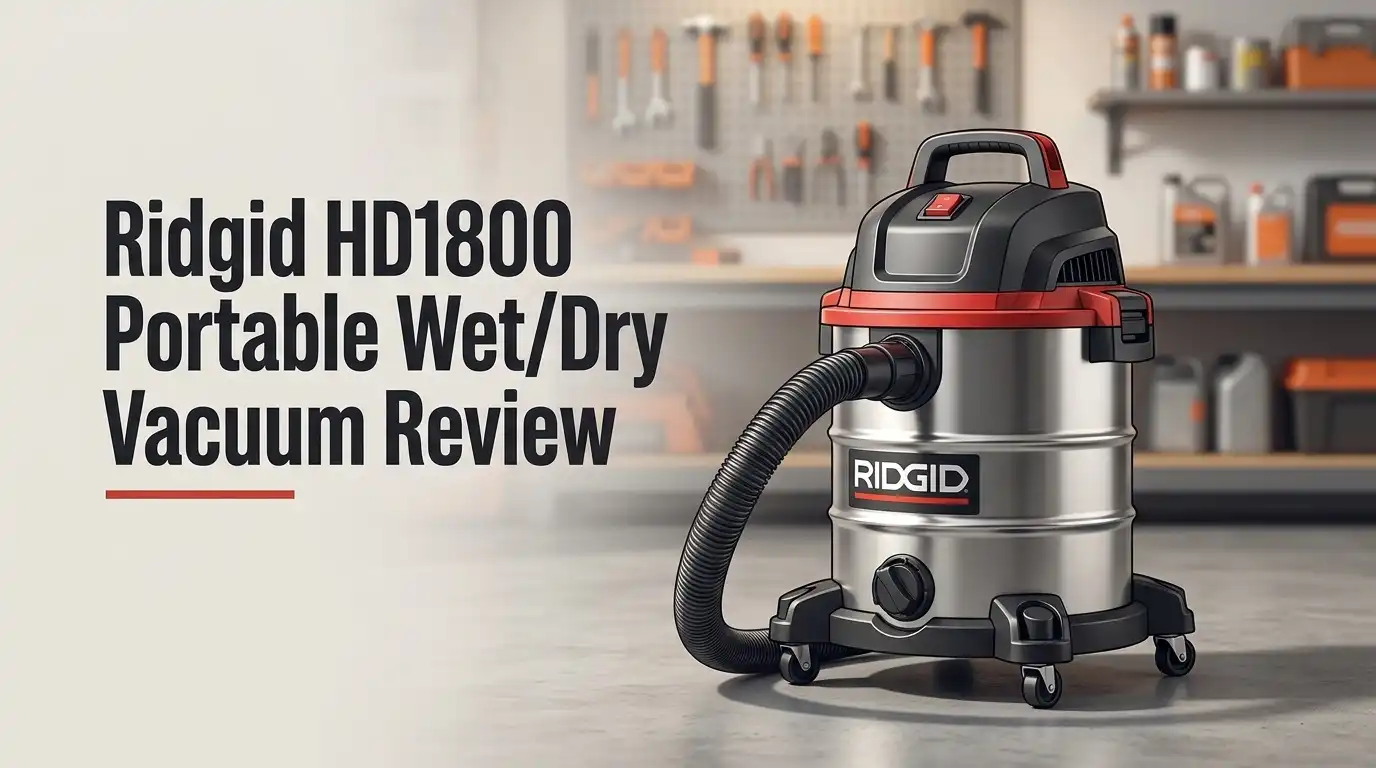
Ridgid HD1800 Portable Wet/Dry Vacuum Review 2026: Still Worth It?
Shop vacuums all look the same until you actually use one. Then you notice the differences fast. A weak motor leaves sawdust behind. A short hose makes you drag the whole unit across the garage. A cheap filter clogs in ten minutes.
The Ridgid HD1800 sits at the top of the Ridgid NXT lineup. It packs a 16 gallon drum, a 6.5 peak horsepower motor, and a cart that rolls over job site debris. People buy it for garage cleanups, flooded basements, and renovation dust.
But is it still a smart buy in 2026? I used this vacuum for drywall dust, wet spills, car interiors, and workshop cleanup. This review covers the good, the frustrating, and the stuff the box never tells you.
In a Nutshell:
- Serious suction for the price. The HD1800 delivers 334 air watts, 184 CFM, and 55 inches of sealed lift. That is enough to lift wet leaves, nails, screws, and standing water without a struggle.
- Capacity beats almost everything in its class. The 16 gallon drum means fewer trips to the trash can during big cleanups. Most homeowners will fill it maybe twice a year.
- The accessory kit is genuinely useful. You get a 7 foot locking hose, two extension wands, a floor tool with a wet shoe, a car nozzle, a crevice tool, and a diffuser. Everything locks instead of popping off.
- It is loud. This is the honest part. The motor screams at full power, and you will want hearing protection for long sessions. Quiet is not a feature here.
- Portable is a stretch. The vacuum rolls on a cart, but it weighs a lot and does not fit under a workbench. It is portable the way a wheelbarrow is portable.
- Best for garages, workshops, and renovation work. Small apartments and quick car detailing jobs are better served by a smaller vacuum.
Ridgid HD1800 Portable Wet/Dry Vacuum Overview


Last update on 2026-11-20 / Affiliate links / Images from Amazon Product Advertising API
The HD1800 is the 16 gallon flagship of the Ridgid NXT family. Ridgid built it for contractors first and homeowners second. That shows in every design choice.
The motor pulls 12 amps and runs on a 20 foot cord. Ridgid rates it at 6.5 peak horsepower, which is a laboratory number, not a continuous rating. The real story is the airflow figure of 184 CFM, and that number is excellent for a corded shop vac.
Inside the lid sits redesigned scroll technology. This is Ridgid’s way of routing air more efficiently through the motor housing. The result is stronger lift without a bigger motor.
The drum uses two piece heavy duty construction, so it resists cracking when you knock it against a stud or drop it off a tailgate.
Unboxing the Ridgid HD1800 Experience
The box arrives big and heavy. Expect roughly 40 pounds of shipping weight once you add the cart hardware and accessories.
Open the top flaps and you find the drum packed upside down with the motor lid already seated. All the accessories hide inside the drum. That is smart packing, but it means you cannot judge what you got until you pull everything out.
Assembly takes about fifteen minutes. You flip the drum, snap on the caster feet, push in the two rear wheels, and attach the handle with four screws. No tools are required for most of it, though a screwdriver helps with the handle.
The one annoying part is the wheel axles. They need a firm push until they click. First time buyers often think a part is missing when the wheel will not seat.
Build Quality and Design Details
Ridgid clearly spent money on the plastic here. The drum feels thick, and the lid latches pull down tight with a satisfying snap.
Drum keying is the feature nobody talks about but everybody benefits from. The lid only sits one way. That single design choice prevents the suction loss that comes from a misaligned motor cover.
You get a front to back carry handle on top plus two side handles on the drum. When the drum fills with water, those side handles matter a lot.
Storage is thoughtfully done. Accessories clip into the caster feet at the front. A caddy on the back holds the wands. The top handle doubles as a cord wrap.
The cart itself rolls on large rear wheels and two swivel casters. It tracks straight over cords and gravel.
Suction Power and Real World Performance
Numbers are nice, but floors tell the truth. I ran the HD1800 over a garage floor covered in sawdust, wood chips, and metal shavings. One pass cleared it.
The 2.5 inch hose diameter is the hero of this machine. Wider hoses resist clogs, and I never once had to clear a jam while picking up drywall chunks or insulation scraps.
Screws and small nails disappear with a loud clatter. Wet leaves pull in without hesitation. Fine powder, like joint compound dust, needs the fine dust filter installed or it blows straight through the exhaust.
Lift of 55 inches means the vacuum keeps pulling even when the hose is extended across a room. Suction drops slightly as the drum fills, which is normal for any shop vac.
Top 3 Alternative for Ridgid HD1800

Last update on 2026-11-20 / Affiliate links / Images from Amazon Product Advertising API
CRAFTSMAN CMXEVBE17595 16 Gallon 6.5 Peak HP Wet Dry Shop Vacuum

Last update on 2026-11-20 / Affiliate links / Images from Amazon Product Advertising API
DEWALT DXV16PA 16 Gallon 6.5 HP Wet Dry Vacuum with Blower and Muffler

Last update on 2026-11-20 / Affiliate links / Images from Amazon Product Advertising API
Vacmaster VJH1612PF 16 Gallon 6.5 Peak HP Heavy Duty Wet Dry Vac
Wet Pickup Performance and Water Handling
This is where a shop vac earns its keep. I tested the HD1800 on a flooded utility room floor and a spilled bucket of mop water.
Pull the filter out before wet pickup. Ridgid says you can leave it in, but a soaked filter dries slowly and smells bad. Removing it also speeds up water pickup noticeably.
The floor tool comes with a detachable wet shoe. Snap it on and the tool squeegees water into the nozzle instead of pushing it around. It works far better than a bare nozzle.
A 16 gallon drum full of water is extremely heavy. You cannot lift it. There is no drain port on this model, which means tipping the drum into a floor drain or scooping water out.
Filtration and the Qwik Lock Filter System
Ridgid includes the VF5000 fine dust filter with the HD1800. This three layer pleated filter traps fine powders, cold ashes, and mold spores.
The Qwik Lock design replaces the old wing nut. You slide the filter onto the cage and twist. It takes about four seconds, and your hands stay cleaner than they used to.
Filter care matters more than people expect. Tap it out after every heavy dust job. Rinse it with water, then let it dry completely for a full day before reinstalling.
Paired with a VF3502 dust bag, the filter stays clean far longer. Bags cost money, but they turn emptying the drum into a thirty second job instead of a dust cloud.
Hose, Wands and Attachment Quality
The 7 foot locking hose uses a DUAL FLEX design at both ends. That gives 180 degree movement where the hose meets the drum and where it meets the wand.
Locking connections are the biggest upgrade over older Ridgid vacuums. Twist the tool and it stays locked, so nozzles no longer fall off mid sweep.
The two extension wands click together for roughly five extra feet of reach. Combined with the hose, you get around twelve feet of working distance.
The attachment set covers most jobs: a floor tool for open areas, a car nozzle for seats and corners, and a crevice tool for tight gaps.
The honest complaint is hose length. Seven feet feels short in a two car garage. Many owners buy a 20 foot hose as their first upgrade.
Noise Levels: How Loud Is the HD1800?
Let me be direct. This vacuum is loud.
At full suction the motor produces a high pitched whine that fills a garage. Measured readings on machines in this class typically land in the mid 80 to low 90 decibel range at operator distance.
You can hold a conversation only by shouting. For a five minute cleanup, nobody cares. For a two hour renovation cleanup, your ears will care a lot.
Hearing protection is not optional for long sessions. Cheap foam plugs solve the problem completely.
The diffuser accessory helps slightly when the blower port is in use, but it does not reduce vacuum noise. If quiet operation ranks high on your list, look at the DeWalt STEALTHSONIC line instead. Ridgid tuned this machine for power, not silence.
Portability, Weight and Storage Footprint
Last update on 2026-11-20 / Affiliate links / Images from Amazon Product Advertising API
The word portable in the product name deserves a reality check. The HD1800 moves on wheels, not in your hand.
Assembled, the unit stands tall enough that it will not slide under a standard workbench. Plan on a dedicated corner of the garage or a shelf of floor space.
The cart design does make rolling easy. Large rear wheels climb over extension cords and door thresholds without tipping. The swivel casters let you spin it in place.
Carrying it up stairs is a two person job once you factor in the drum size and awkward shape.
For truly portable work, like cleaning a car at a friend’s house, a 4 gallon or 6 gallon Ridgid serves better. This machine is a stay at home workhorse.
Blower Function and Extra Versatility
Flip the hose from the suction inlet to the blower port on the side and the HD1800 becomes a leaf blower.
Airflow at the blower port is strong. It clears grass clippings off a driveway, blows leaves off a patio, and dries a wet car surface in minutes.
The included diffuser softens the blast so you spread debris instead of launching it in every direction. It threads onto the hose end in seconds.
This is a nice bonus, not a replacement for a real blower. The cord limits your range to 20 feet plus an extension, and you are dragging a 16 gallon drum behind you.
Still, for workshop cleanup it is genuinely handy. Blowing dust off a bench beats wiping it.
What the Ridgid HD1800 Does Not Do Well
Every honest review needs this section. Here is where the HD1800 falls short.
No drain port. Competing 16 gallon models include a bottom drain. Dumping 16 gallons of water by hand is a real hassle.
No HEPA filter included. The VF5000 handles fine dust well, but it is not certified HEPA. Allergy sensitive users need to buy a separate filter.
The 7 foot hose is too short for the drum size. A big vacuum deserves a long hose.
No onboard power outlet or tool activated start. Dust extractors with automatic start cost more, but woodworkers often want that feature.
Noise remains the loudest complaint from owners. Some report motor whine getting sharper after heavy use. Filter clogging also causes suction loss that people mistake for motor failure.
Pros and Cons of the Ridgid HD1800
Pros
- Strong suction with 334 air watts, 184 CFM, and 55 inches of lift that handles wet and dry messes equally well
- Large 16 gallon drum reduces emptying trips during drywall, renovation, and garage cleanup projects
- 2.5 inch locking accessories resist clogs and stay attached during use
- Excellent onboard storage for hose, wands, nozzles, and the 20 foot cord
- Qwik Lock filter swaps in seconds without tools or wing nuts
- Blower port adds real value for driveways, patios, and workbenches
- Sturdy two piece drum survives job site abuse
Cons
- Very loud at full power, so hearing protection is needed for long sessions
- No bottom drain port, which makes emptying water difficult
- Short 7 foot hose compared to the size of the machine
- Heavy and bulky, so it is not truly portable
- Filter is not certified HEPA out of the box
- Assembly wheels can be stiff to seat on first setup
Maintenance Tips to Keep Suction Strong
Most suction complaints trace back to maintenance, not the motor. Three habits keep this vacuum performing like new.
First, clean the filter after every dusty job. Tap it against a trash can, then rinse it if it is a washable type. Let it dry fully for 24 hours before reinstalling.
Second, use dust bags for fine material. Bags catch powder before it reaches the pleats. Your filter then lasts months instead of weeks.
Third, empty the drum before it reaches the top. A drum filled past the halfway mark reduces airflow and strains the motor.
Check the hose for clogs if suction drops suddenly. Drop a screwdriver through it and see if it falls out the other end. Also inspect the lid gasket for debris that breaks the seal.
Price, Warranty and Overall Value
The HD1800 typically sells around 149 to 199 dollars depending on sales and bundles. That places it right alongside Craftsman, Vacmaster, and DeWalt 16 gallon models.
Ridgid backs this vacuum with a limited lifetime warranty when you register the product. That warranty is one of the strongest arguments for choosing Ridgid over cheaper brands.
Replacement parts stay widely available. Filters, bags, hoses, and nozzles sit on shelves at most home improvement stores.
Value depends on how you use it. If you clean a garage twice a year, a 9 gallon model saves money and space. If you renovate, woodwork, or manage a job site, the extra capacity pays for itself quickly.
Resale value also holds well. Used Ridgid vacuums move fast on local marketplaces.
Who Should Buy the Ridgid HD1800?
This vacuum fits a specific user. Knowing whether that is you saves disappointment.
Buy it if you own a garage or workshop, handle renovation debris, deal with occasional water cleanup, or want one machine that covers everything. Contractors and serious do it yourself homeowners get the most from it.
Skip it if you live in an apartment, want quiet operation, need a vacuum you can carry upstairs often, or mainly detail cars. Smaller models handle those jobs better and store easier.
Woodworkers with dust collection needs should consider a dedicated dust extractor with automatic tool start instead.
For general heavy cleanup at a fair price, the HD1800 remains one of the strongest choices available in 2026.
Final Verdict on the Ridgid HD1800
The Ridgid HD1800 earns its reputation. Suction is strong, capacity is generous, and the build quality holds up to abuse that would crack cheaper drums.
The locking accessory system and Qwik Lock filter solve two of the oldest shop vac annoyances. Onboard storage keeps everything together instead of scattered across a garage floor.
The drawbacks are real but predictable. It is loud, it is heavy, the hose is short, and there is no drain port. None of those problems stop it from doing its job well.
Rating: 4.4 out of 5.
If you want maximum cleanup power for under 200 dollars and you have the floor space, this vacuum delivers. Just buy hearing protection and a longer hose at the same time.
Frequently Asked Questions
Is the Ridgid HD1800 good for fine drywall dust?
Yes, with the right setup. Install the included VF5000 fine dust filter and add a VF3502 dust bag. The bag catches powder before it reaches the filter pleats. Without a bag, fine dust clogs the filter quickly and suction drops within minutes.
How loud is the Ridgid HD1800?
It is loud. Expect readings in the mid 80 to low 90 decibel range at normal operating distance. Short cleanups are fine. For sessions longer than twenty minutes, wear ear plugs or earmuffs.
Can the HD1800 pick up water?
Yes. Remove the filter first for best results and faster pickup. Attach the wet shoe to the floor tool. Remember that the drum has no drain port, so you will need to tip the drum to empty it.
What filter does the Ridgid HD1800 use?
It ships with the VF5000 fine dust filter. The VF4000 standard filter and VF6000 five layer filter also fit. Choose based on the debris you handle most often.
How long is the warranty?
Ridgid offers a limited lifetime warranty on wet dry vacuums after product registration. Register within 90 days of purchase and keep your receipt.
Does the HD1800 come with a dust bag?
The standard package includes the filter but not always a dust bag. Bags sell separately in multi packs and are worth buying immediately if you work with fine dust.
Is the hose long enough for a two car garage?
Not really. The 7 foot hose plus two wands gives about twelve feet of reach. Most owners upgrade to a 20 foot hose for larger spaces.

Hi, I’m Grace Bell, the founder of CleanFloorVault.com, where I personally test and review vacuum cleaners to help you find the perfect tool for a spotless home.