
eufy L60 Robot Vacuum Review 2026: Worth Buying?
Robot vacuums promised us free time. Most of them delivered dust bins that needed emptying every other day instead.
The eufy L60 tried to fix that problem with a self empty station, laser mapping, and 5,000 Pa of suction at a price that undercut almost every big brand.
I have used this machine across tile, hardwood, and low pile carpet. I have also cleaned its brush, fought with its dock, and watched it lose a map. This review covers all of it, including the parts eufy would rather not mention.
In A Nutshell:
- Cleaning power is the star. The L60 pushes 5,000 Pa of suction and scored near the top of independent carpet deep clean tests. It beat machines costing two or three times more at pulling embedded sand and crumbs out of carpet fibers.
- The self empty station is the reason to buy it. Debris goes into a 2.5L bag, and eufy claims up to 60 days of hands free cleaning. The dock also cuts hair off the brush roll, which is rare at this price.
- Battery life is the weak spot. eufy rates it at 120 minutes on the quietest setting. Real use gives you closer to 700 square feet per charge, which sits below the category average.
- It does not avoid obstacles. The L60 uses infrared sensors only. There is no camera and no AI recognition, so socks, cables, and pet accidents are real risks.
- Mopping is an afterthought. Only the Hybrid model mops, and it drags a damp pad. It wipes dust. It does not scrub.
- The L60 is discontinued in 2026. Buy it only at a deep discount. Otherwise the eufy C10 or C28 make more sense.
eufy L60 Robot Vacuum With Self Empty Station

Last update on 2026-09-25 / Affiliate links / Images from Amazon Product Advertising API
This is the version most people bought, and the one I recommend if you find it in stock. The package includes the robot, the self empty station, one dust bag, a spare filter, and a cleaning tool.
The robot measures 3.9 inches tall. That height matters. It will not fit under many sofas or bed frames, and eufy’s newer models are much slimmer.
Suction sits at 5,000 Pa across four modes. Quiet, Standard, Turbo, and Max all work through the app, and BoostIQ raises power automatically when the robot rolls onto carpet.
Navigation comes from a spinning laser turret on top. eufy calls it iPath Laser Navigation. It builds an accurate floor plan in one pass and supports multi level maps, room labels, and virtual barriers.
The dust bin inside the robot holds 400ml. The station empties it into a 2.5L sealed bag. That ratio is why the 60 day claim holds up in a normal home without pets shedding heavily.
Threshold climbing is rated at 20mm. In my testing it cleared standard door thresholds and the edge of a thick rug without help, though it occasionally struggled with a raised metal transition strip.
The value here is genuine. You get laser mapping and a self emptying dock for the price many brands charge for a random bounce vacuum.
Unboxing Experience And First Impressions
The box arrived heavier than expected, mostly because of the station. eufy packs everything in molded pulp trays rather than foam, which feels tidy and recycles easily.
The robot sits on top under a fabric sleeve. Peel it back and you get a matte white disc with a glossy black lid and a clear laser tower. It looks more expensive than it costs.
Setup took me eleven minutes. Clip the side brush into place, peel the plastic film off the bumper, attach the ramp to the station, and plug it in.
The app pairing is the only fussy step. The L60 needs a 2.4GHz Wi Fi network. My router broadcasts one merged band, so I had to split the bands before it connected.
First mapping run took about eight minutes for roughly 900 square feet. The robot drove the perimeter, then filled in the middle. The finished map was accurate enough that I only renamed rooms rather than redrawing walls.
My first honest reaction was surprise at the noise of the dock. The empty cycle is loud, close to a handheld vacuum, and it lasts around ten seconds. You learn to schedule cleans when nobody is napping.
Design And Build Quality
The L60 feels solid rather than premium. Panels fit together tightly, the lid closes with a firm click, and nothing creaks when you lift it by the edge.
The top plate hides two physical buttons under a hinged cover. One starts a clean, one sends the robot home. Holding both resets the Wi Fi.
The station deserves credit for its shape. It sits lower than most self empty docks, so it tucks against a baseboard without dominating the room.
Materials are practical. The glossy black lid on the robot collects dust and fingerprints fast. The station’s matte finish hides marks much better.
The bumper is spring loaded and covers the front third of the body. It absorbs impacts well, though the robot does hit furniture legs with more force than camera based rivals.
Underneath you find a single side brush, a floating main brush with rubber fins and bristles, two cliff sensors, and a small caster wheel. The brush drops out with a simple tab, no screwdriver required.
Filter access is easy too. The dust bin pops out from the rear, and the filter lifts straight from the bin. Everything you need to clean is reachable in under a minute, which matters more than it sounds over two years of ownership.
Suction Power And Cleaning Performance

Last update on 2026-09-25 / Affiliate links / Images from Amazon Product Advertising API
This is where the L60 earns its reputation. Independent lab tests ranked its raw airflow second among nearly ninety robot vacuums, and my kitchen floor agreed.
On hard floors it picked up flour, rice, oats, and coffee grounds in a single pass. The floating brush stays in contact with the surface, so it does not scatter debris ahead of itself the way rigid brushes do.
Carpet performance is the real headline. In deep clean testing the L60 placed inside the top ten of a ninety machine field, pulling embedded sand out of carpet pile that cheaper vacuums barely touched.
BoostIQ handles the transition automatically. I watched it ramp up within a second of hitting my living room rug, then drop back on tile.
Edge cleaning is decent but not perfect. The single side brush flicks debris into the suction path along walls, though it leaves a thin line in sharp corners. Two passes fix it.
Pet hair is a mixed story. The L60 collects hair very well. It also wraps that hair around the main brush, which is exactly why eufy built the detangling system into the dock.
One honest limitation: the L60 cannot handle large debris like cereal chunks on high pile carpet without pushing some of it around first.
Top 3 Alternative for eufy L60 Robot Vacuum

Last update on 2026-09-25 / Affiliate links / Images from Amazon Product Advertising API
eufy Auto Empty C10

Last update on 2026-09-25 / Affiliate links / Images from Amazon Product Advertising API
eufy Robot Vacuum Omni C28

Last update on 2026-09-25 / Affiliate links / Images from Amazon Product Advertising API
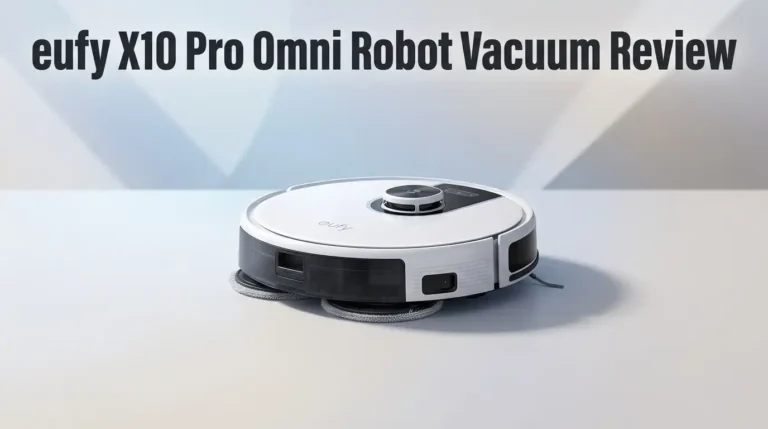
eufy X10 Pro Omni
Self Empty Station And Hair Detangling
The station does two jobs, and the second one is the clever part. First it sucks the robot’s 400ml bin into a 2.5L sealed bag. Then it runs a cutting mechanism that slices hair off the main brush and pulls it into the same bag.
I tested this with seven inch strands of human hair on purpose. The brush came out clean. That result still impresses me, because brush hair removal is the single most annoying robot vacuum chore.
Bag life depends on your home. Two people and no pets got me close to eight weeks. Add a shedding dog and expect three to four weeks instead.
The bags seal when you remove them, so dust does not puff back at you. Replacements are cheap and widely available, which keeps running costs low.
Now the drawbacks. The empty cycle is genuinely loud, and it runs after every clean by default. There is no way to fully mute it, only to schedule around it.
Docking reliability is the bigger complaint, and it is common. Several owners report the robot bumping the station repeatedly without connecting. Mine did this twice in three months.
The fix is usually simple. Wipe the charging contacts, reseat the ramp firmly, and make sure the dock location in the app matches reality.
Laser Navigation And Mapping
The spinning laser gives the L60 navigation quality that used to cost double. It maps fast, cleans in straight rows, and rarely misses a section.
Efficiency numbers back this up. The L60 ranked inside the top ten for square meters cleaned per minute in independent testing, which means less time running and less battery burned.
Room editing works well in the app. You can split rooms, merge them, name them, and send the robot to clean the kitchen alone by voice.
Virtual barriers and no go zones both work, and multi level maps let the robot handle two floors if you carry it upstairs.
Now the honest part. The mapping software has bugs that eufy never fully solved. Owners report maps disappearing roughly once a month, forcing a fresh mapping run.
I also saw the robot pause and reposition for two or three minutes at the start of some cleans. During that shuffle it sometimes ignored no go zones entirely before settling down.
Obstacle avoidance is the clearest gap. Infrared sensors detect walls and furniture, not objects on the floor. The L60 will eat a charging cable and tangle itself in a sock. Pick up before every run, and never use it in a home with an untrained puppy.
App Experience And Smart Features
The eufy Clean app is clean and fast. The home screen shows the live map, battery level, and a large clean button.
Scheduling supports different days, different rooms, and different suction levels. I run Standard on weekdays and Turbo on Saturdays without touching anything.
Useful extras include room specific cleaning, zone cleaning by drawing a box, spot cleaning, and a consumables tracker that tells you when the filter and brush need attention.
Voice control works through Alexa and Google Assistant. Simple commands like starting, stopping, and returning to base respond reliably. Room specific voice commands work about eight times out of ten.
Cleaning history logs area covered, duration, and a map of the path. It is satisfying data and genuinely helpful for spotting missed rooms.
The app has rough edges. Firmware updates occasionally reset preferences, and the map loss bug traces back to software rather than hardware.
There is no camera, so there is no remote viewing and no AI object naming. Some people will call that a privacy benefit, and after eufy’s past security headlines, that argument has weight.
Notifications are well judged. The app tells you when the robot is stuck or the bag is full without spamming you about every routine clean.
Battery Life And Runtime
Here is the L60’s weakest number. The official rating is 120 minutes on the quietest setting, which sits below the market average.
Real use is lower. On medium power the robot used roughly half its charge to clean 355 square feet. Extrapolated, that gives around 700 to 720 square feet per charge.
Strong suction costs battery. The same motor that wins deep clean tests drains the cell faster than gentler competitors.
Recharge and resume softens the problem. The robot returns to the dock, charges to a set level, then goes back to exactly where it stopped.
For apartments and small homes this is a non issue. A 900 square foot run finishes in one pass with charge to spare.
For a 2,000 square foot house, expect the robot to need two or three charge cycles. A full clean can stretch across four hours of wall clock time.
Charging from empty takes roughly five hours. That is slow, and it is the reason multi cycle cleans drag on.
If you want a whole floor cleaned in one uninterrupted run, the L60 is not your machine. Look at models rated for 180 minutes or more.
Mopping On The L60 Hybrid
Only the Hybrid version mops, and expectations need managing. The system is a water tank that clips to the back and a microfiber pad that velcros underneath.
Water flow has three levels in the app. The pad stays damp and drags behind the robot while it vacuums.
What it does well: removing light dust film, faint footprints, and fresh liquid spots on sealed hard floors. Rooms smell fresher afterward.
What it does not do: scrub. There is no pressure, no vibration, and no rotating pads. Dried coffee, sauce, and sticky patches survive easily.
The pad does not lift for carpet. You must remove it manually before a carpeted room, or set no mop zones and accept damp rug edges.
The tank also needs manual filling and emptying every run, and the pad needs rinsing in the sink. That undoes some of the hands free promise the station delivers.
Independent testing scored the L60’s mopping at the bottom of the scale, and that matches my experience. Treat mopping as a small bonus, not a feature you rely on.
If mopping matters to you, the C28 or X10 Pro Omni handle it properly with washing and drying stations.
Noise Levels And Living With It
The robot itself is reasonable. Quiet mode reads around 55 decibels, similar to a dishwasher across the room. You can hold a phone call while it works nearby.
Standard mode rises to the mid 60s. Turbo and Max climb higher, and Max on carpet is loud enough that I only use it when I am out of the room.
The dock is the noisy part. The empty cycle spikes sharply for about ten seconds, and the hair cutting cycle adds a grinding sound on top of it.
Placement helps. Mine lives in a hallway rather than the living room, and the difference is significant.
Day to day living with the L60 is mostly pleasant. Schedule it for 9am on weekdays and floors stay consistently clean without thought.
Bumping is a habit you notice. Without camera avoidance, the robot taps chair legs and door frames more than premium models do.
Rug tassels are a known enemy. The brush grabs them and the robot stops with an error.
My routine became simple: a thirty second floor sweep for cables and socks before each run. That one habit removed almost every error I had.
Maintenance And Running Costs
The L60 asks for less upkeep than most robots, but not zero. Here is the real schedule from six months of use.
Dust bags need replacing every four to eight weeks depending on pets. A pack of bags costs very little and lasts most of a year.
The filter needs tapping out monthly and replacing every two to three months. Rinsing is possible, though it must dry fully for 24 hours first.
The main brush needs a look every two weeks. The dock cuts most hair away, but fine threads and long strands still wrap the end caps.
The side brush bends over time and benefits from replacement every six months. Cliff sensors need a dry wipe monthly or the robot starts hesitating on dark floors.
The laser turret needs a gentle dust off. A dirty lens causes the mapping confusion many owners blame on software.
Annual consumables cost sits around 40 to 60 dollars, which is normal for this category.
One 2026 concern: since the L60 is discontinued, part availability will shrink over the next few years. eufy still sells spares and supports the product, but plan for that timeline.
What The eufy L60 Does Not Do Well
Every review should have this section, so here is the blunt list.
Obstacle avoidance does not exist in any meaningful form. Infrared sensors see walls. They do not see cables, shoes, toys, or pet waste. This is the single biggest reason to spend more elsewhere.
Battery efficiency is below average. Large homes need multiple charge cycles, and full charging takes about five hours.
Mopping on the Hybrid is weak. It wipes rather than scrubs, the pad does not auto lift, and the tank needs manual handling.
Software has recurring bugs. Map loss, slow startup repositioning, and occasional no go zone failures show up across many owner reports.
Docking failures are common enough to mention twice. Contacts and the ramp need periodic attention.
The 3.9 inch height blocks it from cleaning under a lot of modern furniture.
The dock empty cycle is loud, and you cannot disable it.
And the largest practical issue for 2026: the L60 is out of production. Buying one means buying a machine with a finite support horizon and no future feature updates.
Pros And Cons
Pros
- Excellent suction at 5,000 Pa with top ten carpet deep clean results
- Self empty station holds 2.5L and delivers up to 60 days of hands free use
- Hair detangling built into the dock, which is rare at this price
- Accurate laser mapping with fast, efficient row by row cleaning
- Multi level maps, virtual barriers, no go zones, and room labels all included
- BoostIQ raises power on carpet automatically
- Simple, fast app with reliable scheduling and voice control
- Recharge and resume completes larger homes across cycles
- Low profile dock fits neatly against a wall
- No camera, which some buyers prefer for privacy
- Cheap consumables and easy access to every cleaning point
- Outstanding value when discounted below 250 dollars
Cons
- No camera or AI obstacle avoidance, so it hits and eats floor clutter
- Battery covers only about 700 square feet per charge
- Five hour recharge time slows multi cycle cleans
- Mopping on the Hybrid is light duty only and needs manual pad handling
- Mop pad does not lift for carpet
- Map loss and startup repositioning bugs persist in the software
- Docking failures reported by many owners
- Dock empty cycle is loud and cannot be turned off
- 3.9 inch height limits under furniture access
- Discontinued in 2026, so stock and long term parts are limited
- Brush still tangles hair between dock cycles
- Corner cleaning needs a second pass
Who Should Buy The eufy L60
The L60 suits a specific buyer very well. If you live in an apartment or a home under 1,200 square feet with mostly hard floors and some carpet, this machine handles daily cleaning without complaint.
Pet owners benefit most from the dock. The hair cutting system removes the chore that makes people abandon robot vacuums entirely.
Tidy households do great with it. If your floors stay clear of cables, socks, and toys, the lack of obstacle avoidance never becomes a problem.
Budget shoppers who find a discounted unit get real value. At 250 dollars or less, the cleaning performance per dollar is hard to match.
Skip it if you have crawling babies, a puppy, or a naturally cluttered floor. Objects will get eaten.
Skip it if you want serious mopping. A damp drag pad will disappoint you.
Skip it if your home exceeds 2,000 square feet and you want single run cleaning.
And in 2026, think twice if you are paying full price. The eufy C10 offers a slimmer body and current support for similar money, while the C28 delivers far stronger suction and proper mop washing for a moderate step up.
Final Verdict
The eufy L60 was one of the best value robot vacuums of its generation, and the cleaning hardware still holds up in 2026. Suction, carpet performance, laser mapping, and the hair detangling dock all punch well above the price.
The compromises are equally clear. No obstacle avoidance, modest battery, weak mopping, and buggy software keep it out of the premium conversation.
My rating sits at 4 out of 5 for cleaning and 3 out of 5 for smarts. That averages to a strong recommendation with conditions attached.
If you find an L60 with the self empty station at a steep discount, buy it and clear your floors before each run. You will get excellent results for years.
If you are paying anywhere near original retail, do not. The C10 gives you a current model with a slimmer body, and the C28 gives you far more suction plus real mopping automation.
The L60’s legacy is simple. It proved that laser mapping and self emptying docks did not need to cost 800 dollars. Every budget robot vacuum sold today owes something to that.
Frequently Asked Questions
Is the eufy L60 still available in 2026?
eufy discontinued the entire L60 series, including the Self Empty Station and Hybrid versions. New units are no longer restocked. You may still find remaining retail inventory or certified refurbished units, but availability is limited and shrinking.
Does the eufy L60 mop?
Only the Hybrid version mops. It uses a water tank and a damp microfiber pad that drags behind the robot. It removes light dust and fresh spots but cannot scrub dried stains, and the pad does not lift for carpet.
How long does the eufy L60 battery last?
eufy rates it at 120 minutes on the quietest setting. Real world use gives around 700 square feet per charge on medium power. Recharge and resume lets it finish larger homes across multiple cycles, with about five hours needed for a full charge.
Does the eufy L60 avoid obstacles?
No. It uses infrared sensors that detect walls and large furniture only. Cables, socks, small toys, and pet waste will be hit or pulled into the brush. Clear your floors before every clean.
How often do you empty the eufy L60 dust bag?
The station holds 2.5L, which lasts up to 60 days in a home without heavy shedding. Homes with pets typically need a new bag every three to four weeks.
Does the dock really remove hair from the brush?
Yes, and it works well. A cutting mechanism inside the station slices hair off the main brush and vacuums it into the bag. Testing with seven inch hair strands showed clean results, though fine threads still need occasional manual removal.
What is the best replacement for the eufy L60?
The eufy Auto Empty C10 is the closest match for L60 Self Empty Station buyers, with a slimmer 2.85 inch body. The eufy Omni C28 is the better upgrade if you want 15,000 Pa suction and automated mop washing and drying.
Is the eufy L60 good for pet hair?
Yes. The 5,000 Pa suction collects pet hair effectively, and the dock removes tangles automatically. The main limitation is battery life in larger homes and the lack of obstacle avoidance around pet bowls and toys.

Hi, I’m Grace Bell, the founder of CleanFloorVault.com, where I personally test and review vacuum cleaners to help you find the perfect tool for a spotless home.