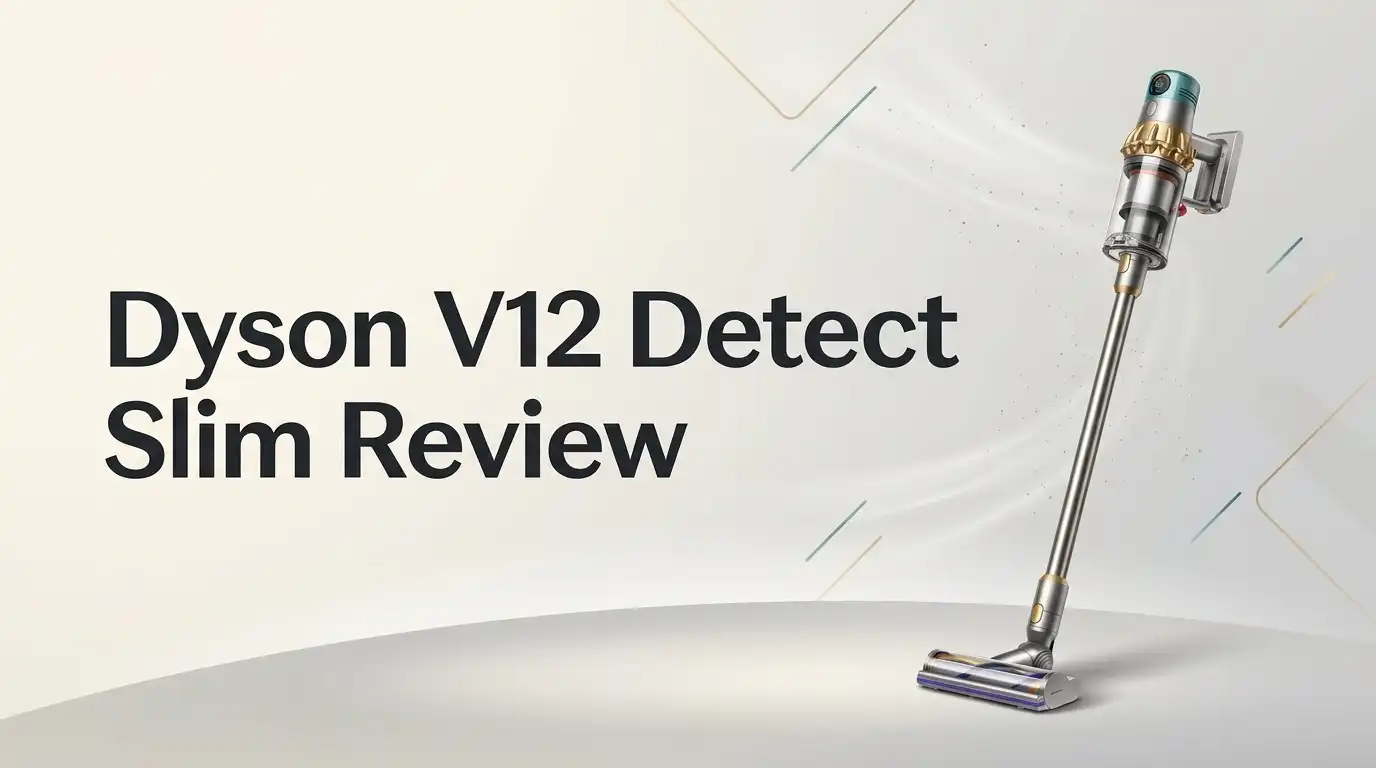
Dyson V12 Detect Slim Review 2026: Still Worth It?
The Dyson V12 Detect Slim has been around for a few years now, and it still sits on most shortlists for lightweight cordless vacuums.
That alone says something. Plenty of newer machines promise bigger numbers, yet this one keeps selling because it nails the part most people actually care about, which is picking up dirt without wearing out your arm.
I spent weeks using this vacuum across hardwood, low pile carpet, a shedding dog’s favorite rug, stairs, and a car interior. This review covers what impressed me, what annoyed me, and who should skip it entirely. No sugar coating, because a $500 vacuum deserves honest scrutiny.
In a Nutshell:
- Weight is the headline feature. At 5.2 pounds, the V12 Detect Slim is roughly 1.6 pounds lighter than the V15 Detect. That difference feels enormous when you clean ceiling corners or carry it up two flights of stairs.
- Cleaning performance punches above its spec sheet. Independent lab testing recorded a 98.6% debris removal rate across hardwood, low pile, and high pile carpet. The 150 AW suction rating looks modest next to flagship models, yet real results stay excellent.
- The laser is genuinely useful, not a gimmick. The green beam on the Fluffy head reveals fine dust on hard floors that your eyes miss completely. You will be horrified by what you find the first week.
- The dust bin is small. At 0.35 liters, you will empty it often during a full house clean. This is the single biggest daily annoyance.
- Battery runs 51 minutes in Eco mode with the Motorbar head, dropping to roughly 7 minutes on Boost. The click in battery swaps out, so a spare doubles your range.
- Price remains high. You pay a premium for lightness and build quality, and budget rivals now deliver similar suction for half the money.
Dyson V12 Detect Slim Review 2026

Last update on 2026-11-21 / Affiliate links / Images from Amazon Product Advertising API
The V12 Detect Slim is Dyson’s answer to a simple complaint. People loved Dyson suction but hated the weight.
So Dyson shrank the motor, shrank the bin, shrank the body, and kept the intelligence features from the flagship line. The result weighs 5.2 pounds fully assembled and delivers 150 air watts of suction.
What makes it interesting in 2026 is the price drop. It launched near $650 and now regularly trades closer to $450 during sales. That changes the value math considerably.
You get laser dust detection, a piezo particle sensor, an LCD screen, and whole machine filtration in a package light enough for one handed use. For apartments, condos, and homes with mostly hard flooring, this remains one of the smartest buys Dyson makes.
The Unboxing Experience
Dyson has unboxing down to a ritual. The box opens flat, and every component sits in its own molded cardboard slot with no plastic clamshells to fight. You lift out the main body first, then the wand, then a tray holding the tools.
The first thing you notice is how light the body feels in hand. It genuinely surprises you if your last vacuum was an older Dyson or an upright. The build feels solid, with no rattles or creaky plastic.
Assembly takes about ninety seconds. The wand clicks into the body, the cleaner head clicks into the wand, and you are done. No tools required. The docking station needs wall screws, which is the only fiddly part. Dyson includes a paper quick start guide, and honestly you will not need it.
Design and Build Quality
The V12 keeps the familiar Dyson silhouette but trims it everywhere. The body is narrower, the bin is shorter, and the whole machine balances near your wrist rather than pulling forward. This matters more than any spec number.
The biggest design change is the power button. Older Dysons used a trigger you had to squeeze continuously, which tired your hand on long cleans. The V12 uses a simple press button on top of the handle. Press once for on, press once for off. Your fingers stay relaxed.
Materials feel premium throughout. The purple and nickel finish resists fingerprints reasonably well. The wand is aluminum, the bin is clear polycarbonate, and everything locks together with satisfying clicks. After months of use, mine shows no cracks, wobble, or loose fittings.
Top 3 Alternatives for Dyson V12 Detect Slim

Last update on 2026-11-20 / Affiliate links / Images from Amazon Product Advertising API
Dyson V15 Detect Cordless Vacuum

Last update on 2026-11-20 / Affiliate links / Images from Amazon Product Advertising API
Dyson V8 Cordless Vacuum

Last update on 2026-11-21 / Affiliate links / Images from Amazon Product Advertising API
Tineco Pure ONE S70 Cordless Vacuum Cleaner
Suction Power and Cleaning Performance
On paper, 150 air watts sounds middling. In practice, the V12 cleans like a much bigger machine. Lab testing across four debris types and three floor types produced a 98.6% total removal rate by weight, which lands near the top of the cordless category.
Hardwood is where it shines brightest. The Fluffy head with its soft roller sweeps up rice, cereal, sugar, and pet hair in a single pass. Nothing scatters ahead of the head, which is a common failing on cheaper vacuums.
Carpet performance is strong but not perfect. The Motorbar head handles larger debris easily. Fine particles like sugar embedded deep in high pile carpet take extra passes, and some grains still survive. If your home is wall to wall plush carpet, you want more suction than this. For low pile rugs and area rugs, it does fine.
Does the Laser Really Find Hidden Dust?
Yes, and it is slightly unsettling. The Fluffy Optic head projects a green laser at a precise angle across the floor just ahead of the brush. Fine dust that is invisible under normal lighting suddenly casts shadows and lights up.
The effect works best in dim rooms. In bright daylight near a window, the beam washes out and becomes hard to read. Dyson recommends dimming the lights, which is a fair ask for a deep clean but awkward for quick tidying.
Practically, the laser changes how you vacuum. You stop guessing and start seeing. You will go over spots twice that you previously ignored. It is not essential technology, yet it is the feature owners mention most often when asked what they like.
The Piezo Sensor and LCD Screen Explained
Inside the bin inlet sits a piezoelectric sensor. Dust particles strike it, the vibrations get measured, and the machine sorts them into four size categories. The LCD screen on top displays a live bar chart of what you pick up.
In Auto mode, this data actually does something useful. The vacuum raises suction when it detects heavy dust and drops it when the floor is clean. That saves battery without you thinking about it.
The particle count itself is mostly entertainment. Knowing you just inhaled 4,200 particles under 10 microns is interesting once, then becomes background noise. The screen earns its place by showing remaining runtime in minutes and seconds, plus clear maintenance alerts when the filter needs washing or a blockage occurs.
Battery Life and Charging Reality
Dyson advertises up to 60 minutes. That figure assumes a non motorized tool in Eco mode. Real world testing with the Motorbar head attached produced 51 minutes in Eco, roughly 20 minutes in Medium, and about 7 minutes in Boost.
For most homes, Eco mode handles everyday dust just fine on hard floors. You only need Boost for ground in messes, and you only need it in short bursts.
Recharging takes around four hours from empty, which is average. The important detail is the removable click in battery. You can buy a spare, keep it charged, and swap mid clean in about three seconds. That turns a 50 minute machine into a 100 minute machine for anyone with a larger home.
The Dust Bin Problem
Here is the honest downside. The bin holds 0.35 liters. That is roughly a third smaller than the V15 Detect and feels tiny if you clean a whole house in one session.
During a full floor clean of a three bedroom home with a shedding dog, I emptied it twice. Pet hair compresses poorly and fills the bin fast. Fine dust fills it slower, so results vary by household.
Emptying itself is clean and simple. You slide a red lever down, the base opens, and the shroud pushes debris out in one motion. Your hand never touches the dirt. Still, a bin this small on a flagship priced vacuum is a real compromise, and it is the thing owners complain about most.
Filtration and Air Quality
The V12 uses a fully sealed filtration system with a post motor filter made from 1.6 meters of folded PTFE material. Dyson claims it captures 99.99% of particles down to 0.3 microns and expels cleaner air than it takes in.
For allergy sufferers, this matters more than suction numbers. A vacuum that stirs dust back into the room makes symptoms worse. Sealed systems prevent that leakage at the joints and seams.
Maintenance is easy. The filter pulls out from the rear, rinses under cold water, and goes back in once fully dry. Dyson suggests washing it monthly. Do not skip this. A clogged filter kills suction and triggers an onscreen warning until you deal with it.
Noise Levels During Use
Measured from about three feet away, the V12 produces between 52 and 59 decibels depending on power mode. Eco sits near the sound of a refrigerator hum. Boost climbs toward normal conversation volume.
That makes it roughly 20 decibels quieter than a typical corded upright. You can hold a phone call while vacuuming in Eco, and you can clean early in the morning without waking the house.
The tone also helps. Dyson tuned the acoustics so the sound reads as a smooth whoosh rather than a harsh whine. Pets tolerate it better than most vacuums, which anyone with a nervous dog will appreciate.
Pet Hair and Long Hair Performance
This is a strong area. The Motorbar head uses conical bristles that actively migrate hair off the brush bar and into the bin. In testing, it removed 100% of placed long hair strands with almost no tangling.
On a rug with deeply embedded dog fur, two passes on max power lifted about 95% of the hair. A few stray strands survived, which is normal for any cordless machine.
The included Hair Screw tool handles the rest. Its cone shaped brush spins hair off sideways instead of letting it wrap. Use it on stairs, car seats, sofas, and pet beds. For households with long haired humans and shedding animals, these two tools remove the worst part of vacuum ownership, which is cutting hair off a brush bar with scissors.
What the Dyson V12 Detect Slim Does Not Do Well
No vacuum is perfect, and a fair review names the flaws plainly.
The bin is too small for whole home cleaning in one pass. Thick plush carpet exposes the suction limits, and the V15 or Gen5 clearly beat it there. The laser becomes useless in bright sunlight. Boost mode drains the battery in minutes, so it is a spot treatment tool only.
The vacuum does not stand on its own, so you need wall space for the dock or you lean it awkwardly in a corner. Replacement filters and batteries cost real money. Finally, the price remains high against competitors that now deliver comparable suction for considerably less. You are paying for weight savings, build quality, and brand engineering, not for raw power.
Pros and Cons
Pros
- Very light at 5.2 pounds, easy to hold overhead and carry upstairs
- Outstanding cleaning results with a 98.6% debris removal rate in testing
- Laser head reveals invisible dust on hard floors
- Power button replaces the tiring squeeze trigger
- Removable battery allows instant swapping for longer sessions
- Sealed filtration captures 99.99% of particles down to 0.3 microns
- Excellent hair handling with almost no brush bar tangling
- Quiet operation between 52 and 59 decibels
Cons
- Small 0.35 liter bin requires frequent emptying
- Struggles with fine debris deep in high pile carpet
- Laser is hard to see in bright daylight
- Boost mode lasts only about 7 minutes
- Expensive next to rising budget competition
- Needs wall mounting since it does not stand freely
Dyson V12 Detect Slim vs V15 Detect
These two get compared constantly, so here is the simple version. The V15 Detect delivers 230 air watts against the V12’s 150, and its bin holds roughly double the volume. If you have thick carpet throughout a large house, the V15 is the better machine.
The V12 wins on handling. It is 1.6 pounds lighter, narrower, and far more comfortable during long cleans or above shoulder work. Many owners who tried both ended up keeping the V12 purely because they actually enjoy using it.
Think of it this way. The V15 is the deep cleaning machine you pull out weekly. The V12 is the one you grab three times a day without thinking. Frequency of use beats peak power for most households.
Who Should Buy the Dyson V12 Detect Slim?
Buy it if your home has mostly hard floors with area rugs. Buy it if you have stairs, since the light body makes stair cleaning tolerable instead of miserable. Buy it if wrist strain, shoulder pain, or general arm fatigue has made your old vacuum sit in the closet.
It also suits smaller homes and apartments perfectly, where the limited bin capacity never becomes an issue.
Skip it if your floors are wall to wall plush carpet. Skip it if you clean a large house end to end in one session and hate emptying bins. Also skip it if budget is tight, because solid cordless vacuums now exist at half this price with 80% of the performance.
Final Verdict
The Dyson V12 Detect Slim remains an easy recommendation in 2026 for the right buyer. It cleans almost as well as machines twice its weight class, it feels great in the hand, and the laser genuinely improves hard floor results.
The flaws are real and worth repeating. The bin is small, plush carpet exposes its limits, and the price still stings. None of those break the machine, but they do narrow who should buy it.
For hard floor homes, apartments, stair heavy houses, and anyone who values comfort over raw specs, this is the best balanced cordless Dyson available. It scores a solid 9 out of 10. You will use it more often than any heavier vacuum you have owned, and that is the whole point.
Frequently Asked Questions
How long does the Dyson V12 Detect Slim battery last?
Expect about 51 minutes in Eco mode with the Motorbar head attached, roughly 20 minutes in Medium, and close to 7 minutes in Boost. Dyson’s advertised 60 minutes applies only to non motorized tools. The battery clicks out, so a spare doubles your cleaning time instantly.
Is the Dyson V12 good for pet hair?
Yes. The Motorbar head removed about 95% of embedded dog fur in two passes, and the conical bristles keep hair from wrapping around the brush bar. The included Hair Screw tool handles pet beds, stairs, and furniture without tangling.
Is the Dyson V12 better than the V15?
Not in power. The V15 has more suction and a bigger bin. The V12 is lighter, easier to maneuver, and more comfortable for frequent use. Choose based on your flooring and how much weight bothers you.
How often should I wash the filter?
Dyson recommends rinsing the filter under cold water once a month. Let it dry completely for 24 hours before putting it back. The LCD screen alerts you when the filter needs attention.
Does the V12 work on thick carpet?
It works, but not brilliantly. Fine debris deep in high pile carpet survives multiple passes. For homes with thick carpet everywhere, a higher suction model serves you better.
Can you use the Dyson V12 as a handheld?
Yes. Remove the wand and attach the crevice tool, combination tool, or Hair Screw tool directly to the body. At 5.2 pounds total, the handheld configuration feels light enough for car interiors, sofas, and shelves.

Hi, I’m Grace Bell, the founder of CleanFloorVault.com, where I personally test and review vacuum cleaners to help you find the perfect tool for a spotless home.