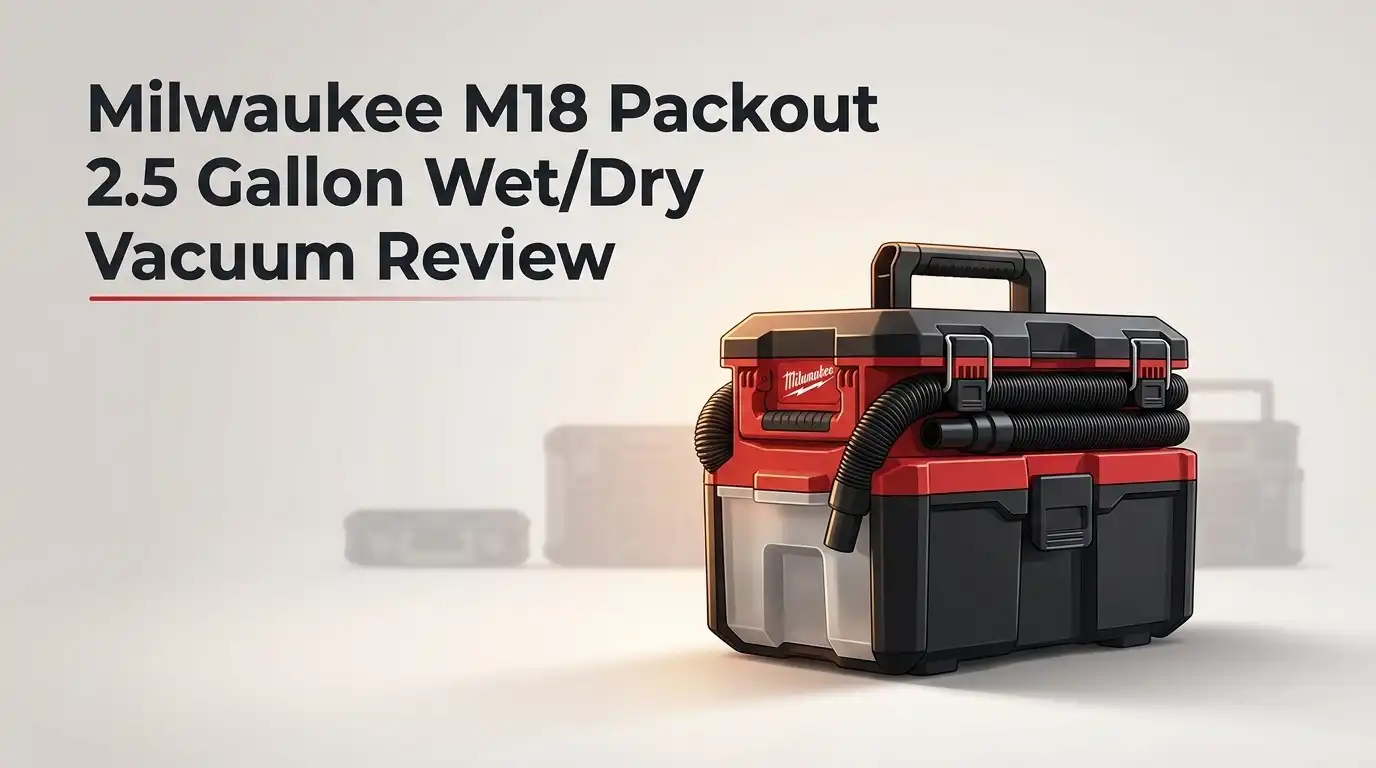
Milwaukee M18 Packout 2.5 Gallon Wet/Dry Vacuum Review 2026
Cleanup time ruins a good project. You finish the work, you feel proud, and then you stare at a floor covered in sawdust, drywall crumbs, and coffee you spilled two hours ago. Dragging a full size shop vac across the garage feels like punishment. Unrolling an extension cord feels worse.
Milwaukee built this little red and black box for that exact moment. It runs on M18 batteries you probably already own. It clicks onto your Packout stack. It weighs about 12 pounds. It promises serious suction in a package the size of a toolbox.
But does it actually earn a spot in your kit? I spent real time with this vacuum, pushed it through messy jobs, and found both the good parts and the annoying ones. Here is the honest breakdown.
In a Nutshell:
- Suction is strong for the size. The POWERSTATE brushless motor pulls 50 CFM with 47 inches of water lift. That beats most 18V and 20V competitors in the small tank class. It will not match a corded 6 gallon shop vac, but it handles sawdust, metal shavings, pet hair, and small spills without complaint.
- Portability is the real selling point. At roughly 12 pounds and 17.1 inches wide, you can set it on a car seat, carry it up a ladder, or stack it on a Packout rolling box. No cord means no outlet hunting.
- Battery life is the weak spot. Milwaukee claims 30 minutes on high with an 8.0Ah HIGH OUTPUT pack and 50 plus minutes on low. Smaller packs drain fast. Plan on having a spare battery charged.
- It runs quiet at 87 dB(A). That is roughly half the perceived noise of a traditional jobsite vac. You can hold a conversation while it runs.
- The price stings. It retails around $199 as a bare tool. No battery. No charger. That is the biggest barrier for casual users.
- The 2.5 gallon tank fills quickly. Big demo cleanups will have you emptying it over and over.
Milwaukee M18 Packout 2.5 Gallon Wet/Dry Vacuum

Last update on 2026-11-19 / Affiliate links / Images from Amazon Product Advertising API
This vacuum carries the model number 0970 and sits in Milwaukee’s FUEL lineup. It uses a POWERSTATE brushless motor paired with REDLITHIUM battery packs. Milwaukee calls it the most powerful small capacity 18V wet/dry vacuum, and the numbers back that claim reasonably well.
The tank holds 2.5 gallons of wet or dry debris. The body measures 17.1 inches wide, 10.5 inches deep, and 12.8 inches tall. It weighs about 12 pounds bare. A certified HEPA filter comes in the box, which matters for drywall dust and silica work.
The headline feature is Packout integration. Slats on the top and bottom let it lock into the modular storage system. You roll your whole kit to the job, pull the vacuum off the stack, and clean up. Milwaukee backs it with a five year limited warranty.
The Unboxing Experience
The box is plain cardboard with the usual red Milwaukee graphics. Nothing fancy. Inside, the vacuum sits in a molded cardboard tray with the accessories tucked around it.
Lifting it out, the first thing you notice is heft in a good way. It feels dense and solid, not hollow. The latches snap with a satisfying click. The plastic has a slightly textured finish that resists scuffs.
You get the vacuum, a six foot flexible hose, a crevice tool, a utility nozzle, a power tool adapter, and the HEPA filter already installed. No battery. No charger. That catches some buyers off guard.
Setup takes about three minutes. You unwrap the hose from its onboard channel, push it into the suction port, clip in a battery, and flip the switch. It is genuinely plug and play.
Build Quality and Everyday Durability
Milwaukee did not cut corners on the shell. The impact resistant polymer takes drops and bumps without cracking. I knocked it off a workbench onto concrete, and it shrugged it off with a scuff.
The latches are the part I watched closely, since latches fail first on most toolboxes. These feel stiff and positive. After months of daily opening, they still hold tension.
The carry handle sits flush on top and folds out of the way for stacking. It is wide enough for gloved hands. The rubber feet grip well on both smooth concrete and carpet.
One small gripe: the lid gasket collects fine dust. You need to wipe it occasionally or the seal loses a bit of grip. That is normal for the category, but worth knowing.
Top 3 Alternative for Milwaukee M18 Packout 2.5 Gallon Wet/Dry Vacuum


Last update on 2026-11-19 / Affiliate links / Images from Amazon Product Advertising API
DEWALT 20V MAX Cordless and Corded Wet Dry Vacuum DCV581H

Last update on 2026-11-19 / Affiliate links / Images from Amazon Product Advertising API
Milwaukee 0880 18V Cordless Wet/Dry Vacuum

Last update on 2026-11-19 / Affiliate links / Images from Amazon Product Advertising API
RIDGID 36138 3 Gallon Wet/Dry Vacuum
Suction Power and Airflow Tested
Numbers first. Milwaukee rates this unit at 50 CFM airflow and 47 inches of water lift. Marketing materials mention up to 70% more suction than previous small 18V models.
In practice, it pulls embedded pet hair out of car carpet with steady pressure. Metal shavings, rust flakes, and acorns from a footwell vanished in one pass. Drywall dust disappears quickly, which is where the HEPA filter earns its keep.
Here is the honest part. It does not match a full size corded Ridgid or Shop Vac. On deep pile carpet or heavy gravel, you feel the limit. You will make multiple passes.
Think of it as a precision cleanup tool, not a demolition vacuum. For car interiors, workbenches, cabinet installs, and tight spaces, the suction is genuinely impressive for the footprint.
Battery Runtime and Real World Numbers
This is where expectations need adjusting. Milwaukee publishes 30 minutes on high mode with an 8.0Ah HIGH OUTPUT pack, and 50 plus minutes on low mode.
Most people do not own an 8.0Ah battery. With a 5.0Ah pack, high mode gives you roughly 15 to 18 minutes. That drops further in cold weather or with older cells.
The high and low switch helps a lot. Low mode handles dry dust and light debris fine, and it stretches runtime significantly. I leave it on low for about 70% of tasks.
Plan accordingly. If you clean a whole job site, carry two batteries. For quick car detailing or a single room, one pack covers it. Battery dependence is the honest tradeoff for cord freedom.
HEPA Filtration and Dust Control
The included filter is a certified HEPA unit, model 49 90 1900. It captures fine microparticles rather than spraying them back into your air.
Milwaukee lists OSHA objective data compliance for select silica dust producing applications. If you cut concrete or grind masonry, that documentation matters for job site paperwork.
The filter is washable. You rinse it, dry it fully, and reinstall. Never put a damp filter back in. That kills suction and grows mildew inside the tank.
For heavy dust work, add the fleece dust bags, model 49 90 2016. They keep the filter cleaner and make emptying far less messy.
One complaint: filter cleaning is frequent with drywall dust. Suction drops noticeably as the filter loads. Budget for spare filters if you do finishing work regularly.
Wet Pickup Performance
The wet side works well within its limits. Pull the filter out, switch on the vacuum, and it draws liquid steadily through the hose.
I used it on a coolant spill, a flooded utility sink area, and rainwater in a truck bed. It handled all three. The float shutoff kicks in reliably when the tank fills.
Remember the capacity. Two and a half gallons of water fills fast, and water is heavy. A full tank adds roughly 20 pounds, so carrying it to a drain becomes a two hand job.
There is no drain port. You lift the lid and pour. On a larger vacuum, a drain plug saves your back. Here you tip and dump.
Dry the tank afterward. Standing water inside a sealed box creates odor within days.
Noise Level and Comfort
Milwaukee rates the sound power level at 87 dB(A), and describes it as twice as quiet as traditional job site vacuums. That claim holds up.
The pitch is lower and less whiny than a corded shop vac. You can run it inside a car cabin without your ears ringing. Conversation at normal volume is possible a few feet away.
For indoor work in occupied homes, this matters a lot. Clients notice noise. A quieter vacuum means fewer complaints during a kitchen install or a bathroom remodel.
Low mode drops the noise further and is pleasant to use for extended periods. I still recommend hearing protection for long sessions, but casual cleanup needs none.
Packout Stacking and Portability
The Packout slats on the top and bottom are the core of this product’s identity. The vacuum locks into rolling boxes, crates, and organizers with the standard red latches.
You build a tower, roll it to the work area, and detach the vacuum in two seconds. No separate trip. No cord hunting. For mobile detailers and trim carpenters, this workflow is a genuine time saver.
Off the stack, the 12 pound weight makes one hand carrying easy. I set it on a passenger seat, on a stair tread, and on scaffolding without worry.
If you do not own Packout gear, you lose a large chunk of the value. The vacuum works fine standalone, but the price only makes sense inside the ecosystem.
Hose, Accessories, and Onboard Storage
The six foot hose measures 1.5 inches in diameter. It stays flexible in cold weather and does not kink easily. Six feet feels short on larger jobs, though.
Onboard storage is thoughtful. The hose wraps into a molded channel around the body. The crevice tool and utility nozzle clip into dedicated slots. Nothing rattles loose in transport.
The crevice tool is the star for car work. It reaches seat rails and console gaps easily.
What is missing? A brush head for upholstery and a wide floor nozzle. Both are sold separately. For a $199 tool, including one of them would have been fair.
The power tool adapter lets you connect the hose directly to sanders and saws for dust extraction at the source.
Blower Port and Dust Extraction Mode
Flip the hose to the rear port and the vacuum becomes a blower. Airflow is decent for clearing sawdust off a bench, blowing debris out of a garage corner, or drying a small wet patch.
It will not clear a driveway of wet leaves. Treat it as a focused air nozzle, not a leaf blower.
Dust extraction mode is more useful. Connect the included adapter to a random orbit sander or a circular saw, and the vacuum pulls debris as you cut. Dust collection at the source keeps your lungs and your workspace cleaner.
Auto start is not included. You turn the vacuum on manually and leave it running. Competing systems with tool activated start have an edge here, and I missed that feature.
What This Vacuum Does Not Do Well
Honest reviews need this section. First, the tank capacity. Two and a half gallons disappears fast during real demolition. You will empty it repeatedly on a renovation.
Second, runtime. Without a large HIGH OUTPUT battery, you get short sessions. Budget for a spare pack.
Third, the price. At around $199 bare, it costs more than double some corded alternatives with larger tanks.
Fourth, no drain port and no auto start. Both are expected on premium vacuums in 2026.
Fifth, filter loading. Fine dust clogs the HEPA element quickly, and suction fades until you clean it.
Sixth, the short hose. Six feet forces you to move the vacuum often.
None of these are deal breakers. They are limits you accept for the portability.
Pros and Cons
Pros
- Excellent suction for a compact 18V unit at 50 CFM and 47 inches of water lift
- Full Packout compatibility for stacking and rolling with your existing kit
- Quiet operation at 87 dB(A), suitable for occupied homes and car interiors
- Certified HEPA filter included with OSHA objective data for select silica applications
- Lightweight at roughly 12 pounds with a comfortable top handle
- Smart onboard storage keeps the hose and both nozzles attached
- Built in blower port and power tool dust extraction adapter
- Five year limited warranty from Milwaukee
Cons
- High price at around $199 for the bare tool, with no battery or charger included
- Short runtime unless you own a large capacity REDLITHIUM pack
- Small 2.5 gallon tank fills quickly on bigger messes
- No drain port for wet pickup
- No tool activated auto start function
- Six foot hose feels short on open floors
- Filter clogs fast in heavy drywall dust
- Value drops sharply if you do not use Packout storage
Price and Value in 2026
The bare tool sits near $199 at most retailers. Add a 6.0Ah battery and charger and you approach $350 for a complete setup.
That is a lot for 2.5 gallons. A corded 6 gallon shop vac costs under $80 and never needs charging.
So who gets value here? People already deep in the M18 system. If you own four batteries and a Packout tower, the vacuum slots in cheaply and becomes the most convenient tool you own.
If this would be your first M18 purchase, the math looks rough. The 20V class alternatives cost roughly half, with weaker suction.
Watch for holiday bundles. Milwaukee frequently pairs this vacuum with a free battery during seasonal promotions, which transforms the value equation.
Who Should Buy This Vacuum
Mobile detailers benefit most. The vacuum rides on the Packout cart with towels and chemicals, then lifts onto the car seat for interior work.
Electricians, plumbers, and HVAC technicians get strong value too. Small, frequent cleanups in tight spaces match this tool perfectly.
Finish carpenters and cabinet installers will like the quiet operation and HEPA filtration in client homes.
Serious DIYers with an existing M18 collection will enjoy it, especially for garage and vehicle work.
Skip it if you mainly clean large shops, do heavy demolition, or need long continuous runtime. A corded unit serves you better and costs far less.
Also skip it if you own no M18 batteries. The entry cost outweighs the benefit for occasional use.
Maintenance Tips for Longer Life
Empty the tank after every wet job. Standing liquid breeds odor and corrodes contacts.
Rinse the HEPA filter under cool water when suction drops. Let it air dry for 24 hours before reinstalling. A damp filter chokes airflow and can mildew.
Use fleece dust bags for drywall and concrete dust. They extend filter life dramatically and make disposal clean.
Wipe the lid gasket with a damp cloth weekly. Dust on the seal reduces suction without any obvious symptom.
Store batteries at partial charge in moderate temperatures. Heat kills lithium cells faster than use does.
Check the float shutoff mechanism occasionally for debris. A stuck float lets water reach the motor.
Keep a spare filter in your Packout box. Replacement during a job beats losing suction halfway through.
Final Verdict
The Milwaukee M18 Packout 2.5 Gallon Wet/Dry Vacuum does exactly what it promises. It delivers real suction, quiet operation, and freedom from cords in a package you can carry with one hand.
It is not a replacement for your big shop vac. The tank is small, the runtime is limited, and the price is high.
But convenience has value. This vacuum gets used because it is easy to grab, and a tool you actually use beats a better tool sitting in the corner.
Rating: 8 out of 10 for M18 owners. 6 out of 10 for everyone else.
If you already live in the Milwaukee ecosystem, buy it. If you do not, start with a corded unit and revisit this later.
Frequently Asked Questions
Does the Milwaukee Packout vacuum come with a battery?
No. The standard listing is a bare tool. You get the vacuum, hose, crevice tool, utility nozzle, power tool adapter, and HEPA filter. You supply your own M18 REDLITHIUM battery and charger. Some seasonal kits include a battery, so check the listing carefully before ordering.
How long does the battery last on this vacuum?
Milwaukee rates it at 30 minutes on high mode and 50 plus minutes on low mode using an 8.0Ah HIGH OUTPUT pack. With a 5.0Ah battery, expect roughly 15 to 18 minutes on high. Low mode nearly doubles that figure for lighter cleanup tasks.
Can it pick up water safely?
Yes. Remove the filter first, then vacuum liquid normally. A float shutoff stops suction when the tank fills. There is no drain port, so you lift the lid and pour the water out. Dry the tank afterward to prevent odor.
Is the filter really HEPA certified?
Yes. The included filter is a certified HEPA element, model 49 90 1900. It is washable and reusable. Milwaukee also lists OSHA objective data compliance for select silica dust producing applications, which helps on regulated job sites.
Does it work with all Packout boxes?
Yes. The top and bottom slats match the standard Packout interface. It stacks with rolling boxes, crates, organizers, and tool boxes across the full modular lineup.
How loud is it compared to a regular shop vac?
It runs at 87 dB(A) sound power level, which Milwaukee describes as twice as quiet as traditional job site vacuums. You can talk nearby without raising your voice much. Low mode is quieter still.
Can I use it as a blower?
Yes. Move the hose to the rear port and it blows air instead of pulling it. The force suits clearing sawdust from benches and corners. It is not powerful enough for yard work.

Hi, I’m Grace Bell, the founder of CleanFloorVault.com, where I personally test and review vacuum cleaners to help you find the perfect tool for a spotless home.