VEVOR 5.3 Gallon Ash Vacuum Review 2026: Worth It?
Wood stoves give warmth. They also give you a gray mess every few days. A regular shop vacuum chokes on fine ash within minutes, and a dustpan just sends powder across the room.
That is the gap the VEVOR 5.3 Gallon Ash Vacuum tries to fill, and it does so at a price that undercuts most of the shelf.
This model sits in the middle of the ash vacuum market. It has a 1200W motor, a steel tank, casters, and a two stage filter system. VEVOR sells it for roughly $55, which puts it below the usual American brands by a wide margin.
In a Nutshell:
- Strong value for the price. You get 5.3 gallons, casters, and an 1200W motor for about $55. The four gallon VEVOR costs roughly $11 less but loses the wheels and five feet of reach. The upgrade pays for itself the first time you clean a large firebox.
- Reach is a real strength. A 13 foot power cord plus a 5 foot hose gives you about 18 feet of working radius. That keeps the canister parked in a doorway instead of sitting in your ash pile.
- Filtration works the way it should. A washable outer polyester bag grabs coarse ash, and an inner HEPA element catches fine dust. Both stages wash clean, so a winter of use costs nothing in replacement parts.
- Cold ash only, no exceptions. VEVOR states plainly that the fire must be fully out and the ash fully dry. This is stricter than rivals who advertise warm ash pickup, and it is the honest rule.
- The spec sheet has holes. VEVOR publishes no suction rating, no noise figure, and no flame rating for the filter. You buy partly on faith.
- Capacity is optimistic. The 5.3 gallon figure is tank volume, not ash volume. Expect closer to three usable gallons once the filter assembly takes its space.
VEVOR 5.3 Gallon Ash Vacuum: Quick Overview


Last update on 2026-11-19 / Affiliate links / Images from Amazon Product Advertising API
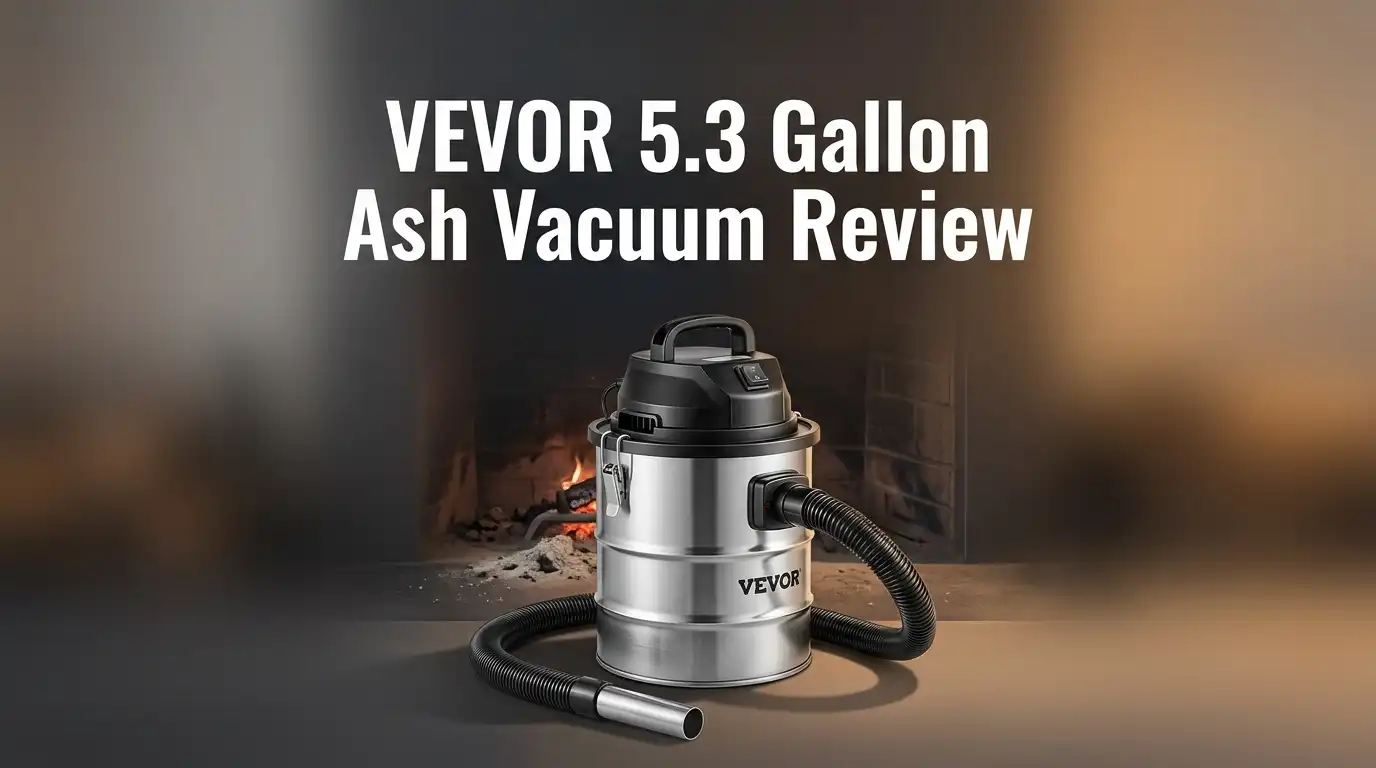
The VEVOR 5.3 Gallon Ash Vacuum is a corded canister unit built for fireplaces, pellet stoves, wood stoves, fire pits, and grills. The body uses SPCC steel. The hose carries a heat resistant lining. Four casters sit under the base so you can roll it across a hearth room.
The motor draws 1200W, which equals 10 amps on standard American household current. That matches the output of several pricier competitors. VEVOR lists the unit at 9 pounds with dimensions of 14.6 by 14.6 by 16.5 inches.
The design is simple on purpose. One switch, one hose port on the side, one blower outlet on top. There is no digital display and no variable speed dial. For ash cleanup, that simplicity is a feature rather than a shortcut.
Unboxing Experience: What Arrives in the Box
The box arrives compact and surprisingly light. Pull the tape and you find the steel canister nested in molded foam, with the hose coiled inside the drum itself. VEVOR packs the accessories in a small plastic bag taped to the lid.
Inside you get the canister, the motor head, the 5 foot hose, the caster base, a crevice nozzle, a straight metal tube, and the filter bag already seated around the HEPA element. A folded instruction sheet sits on top.
Assembly takes about four minutes. The casters press into the base with firm thumb pressure. Two side clamps lock the motor head to the drum, and they snap shut with a solid metallic click.
First impression: the steel feels thinner than a shop vacuum drum but thicker than the plastic units in this price band. The paint finish is even. The hose is stiff out of the box and needs a day to relax.
Build Quality and the Steel Tank
The SPCC steel body is the main safety argument for this machine. Plastic canisters exist in this category and they are the reason metal models advertise the fact. One stray ember inside a plastic drum can melt a hole. Steel cannot.
The hose carries a heat resistant lining rather than standard vinyl. That protects against residual warmth, though it does not make the unit safe for live coals.
Fit and finish sit where the price suggests. The clamps hold firmly but feel light under the thumb. The caster base is plastic and is the part most likely to crack after a few seasons of being dragged over a brick hearth. Treat the wheels gently and they last.
The motor housing has an overheat shutoff. Several owners report it triggering during long sessions, which is annoying but better than a burned out motor.
Top 3 Alternatives for VEVOR 5.3 Gallon Ash Vacuum

Last update on 2026-11-19 / Affiliate links / Images from Amazon Product Advertising API
PowerSmith PAVC101 10 Amp Ash Vacuum

Last update on 2026-11-19 / Affiliate links / Images from Amazon Product Advertising API
PowerSmith PAVC102 10 Amp 4 Gallon Ash and Shop Vacuum

Last update on 2026-11-19 / Affiliate links / Images from Amazon Product Advertising API
Snow Joe ASHJ202E 5 Amp 4.8 Gallon Ash Vacuum
Suction Power: How the 1200W Motor Performs
1200W is input power, not suction. VEVOR publishes no pascal rating and no water lift figure, so the wattage is all you get to judge by. On a 120 volt outlet, 1200W equals the 10 amp rating that PowerSmith prints on its own machines.
In practice the suction handles fine powder ash easily. It lifts small charcoal fragments and pellet clinkers without stalling. Larger chunks of unburned wood will jam the nozzle rather than travel up the hose.
Here is the honest limitation. Suction drops noticeably once the bag reaches roughly half capacity. Fine ash blocks airflow fast. You will hear the motor pitch rise and feel the pull weaken.
Shake the bag out midway through a big job and full power returns. That habit matters more than the wattage number on the box.
Dual Stage Filtration Explained
This is the part that separates an ash vacuum from a shop vacuum with a sticker on it. Wood ash packs into the folds of a pleated filter within minutes. Airflow collapses, the motor screams, and the nozzle picks up nothing.
VEVOR solves it with two stages. The outer washable polyester bag catches the bulk. The inner HEPA element only ever sees the fine dust that slips through. That division keeps the pleated filter breathing.
Both stages wash in plain water. Let them dry fully before reinstalling, because damp ash turns to cement inside the folds.
What is missing is a flame rating. Some rivals print flame retardant or fire resistant on their filter specs. VEVOR does not. The filter is the only part of the ash path that is not metal, so that omission matters.
Tank Capacity: Is 5.3 Gallons Real?
Short answer: no, not as usable ash volume. VEVOR prints a bare number without saying whether it measures the drum or the fill space.
Compare this with PowerSmith, which publishes both figures for its PAVC101. That unit lists a 5.2 gallon canister and a 3 gallon ash capacity. The filter assembly occupies the top third of the drum, so the space you can actually fill is much smaller than the headline figure.
Apply the same ratio here and the VEVOR likely holds around three gallons of ash. That is still a third more than the four gallon VEVOR sibling, which is the comparison that matters.
Practical result: a standard fireplace needs emptying every three or four cleanings. A busy pellet stove needs it weekly.
Reach: Cord Length and Hose Length
Reach is where this model quietly beats most rivals. The 13 foot power cord and 5 foot hose combine for roughly 18 feet of working radius. Many competitors offer around 12 feet.
That difference sounds small. It is not. Eighteen feet lets the canister sit in the hallway or behind a chair while you work inside the firebox. Twelve feet forces the drum to sit right beside the ash, where you kick it.
The 5 foot hose is the weaker half of that pair. It is short enough that you still lean awkwardly into a deep stove. A longer hose would serve better than a longer cord.
Tip: the hose accepts standard 1.25 inch extensions, so an aftermarket length solves the problem cheaply.
Blower Mode: A Genuine Second Use
Move the hose from the side port to the top air outlet and the vacuum becomes a blower. VEVOR suggests leaves and light snow.
This feature earns its keep. An ash vacuum otherwise works a few weeks a year and then sits in a garage corner. Blower mode gives it summer work clearing patios, workshop benches, and grill grates.
Set expectations correctly. This is not a leaf blower replacement. Output is modest, and wet leaves stay where they are. Dry debris on a hard surface moves fine.
One practical warning. Run the blower only with a clean filter. Blowing air through an ash loaded bag pushes fine dust straight back into the room, and that dust is alkaline enough to irritate your eyes.
Cold Ash Only: The Safety Rule You Must Follow
VEVOR writes it plainly. Use only for dry ash after the fire is fully extinguished. No temperature number, no margin, no exceptions.
That is stricter language than most rivals use, and it is the correct advice. Several competitors advertise warm ash capability, then bury a limit of 104 degrees Fahrenheit in the fine print. Ash at 104 degrees is cold ash by any practical measure.
Wood embers hide under a gray surface for 48 hours or longer. They look dead. They are not.
Wait a full day after the last flame before vacuuming, minimum. Stir the ash and watch for orange. A live ember inside a sealed drum full of fine fuel is a genuine fire risk, and a steel body alone does not remove it.
Noise Levels and Daily Use
VEVOR publishes no decibel rating. Based on comparable 1200W units, expect something near 79 decibels, which is roughly the volume of a kitchen blender.
This machine is loud. Nobody in the next room will ignore it. Hearing protection is not required, but you will not hold a conversation over it.
The sound changes as the bag fills. A clean filter gives a steady low roar. A loaded filter produces a higher whine, which is actually a useful signal that the bag needs emptying.
Daily handling is where the casters prove their value. Nine pounds empty becomes considerably more with three gallons of ash inside. Rolling beats lifting every time, though the small wheels struggle on thick carpet and catch on hearth edges.
What This Ash Vacuum Does Not Do Well
Authentic reviews cover failures, so here they are.
It is not a shop vacuum. It handles dry powder only. Wet ash, spilled pellets mixed with moisture, or drywall dust will clog it or damage the motor.
The spec sheet hides information. No suction rating, no noise figure, no flame rating, no fill indicator, and no named safety certification. Competitors publish at least some of these.
The casters are the weak link. Plastic wheels on a plastic base, dragged over brick, crack eventually.
Suction fades fast as the bag fills. You will empty it more often than the gallon figure suggests.
Customer support is slow. VEVOR operates largely online, and replacement filters can take time to arrive. Order a spare bag when you buy the machine.
Cleaning and Maintenance Routine
Maintenance is simple but not optional. Unclip the motor head, lift out the filter assembly, and empty the drum into a metal container outdoors. Never into a plastic trash bin.
Slide the polyester bag off the HEPA element. Shake it out, then rinse under a tap until the water runs clear. Squeeze gently rather than scrubbing, because the fabric weave is what catches the ash.
Tap the HEPA element against a hard surface to release trapped dust. Rinse it only when needed, roughly once a month during heavy use.
Both parts must dry completely before reassembly. Twenty four hours in a warm room is enough. Installing a damp filter traps ash into a hard crust that no amount of rinsing removes, and that ruins the element permanently.
Who Should Buy the VEVOR 5.3 Gallon Ash Vacuum
Last update on 2026-11-19 / Affiliate links / Images from Amazon Product Advertising API
This machine suits the homeowner with one busy fireplace or a pellet stove who wants ash gone in five minutes without a dust cloud. It fits anyone who considers $55 the right amount to spend on a tool used twenty times a year.
It also suits a grill owner. The blower mode and the steel body handle charcoal residue well, and the unit stores easily in a garage.
Skip it if you need warm ash capability, if you want published suction data, or if you expect a decade of service. The PowerSmith models cost more and justify it with detailed specs and a longer track record.
Skip it too if you burn daily through a long winter. Heavy duty use will find the limits of this build quickly.
Final Verdict
The VEVOR 5.3 Gallon Ash Vacuum delivers most of what an ash vacuum needs to do, at a price that makes the compromises easy to accept. Steel body, two stage washable filtration, 18 feet of reach, and casters for about $55 is honest value.
The flaws are real but predictable. Fading suction as the bag fills, optimistic capacity claims, a thin spec sheet, and plastic casters that will not last forever.
My take: buy it if ash cleanup is a weekly chore rather than a daily one. The upgrade over the four gallon VEVOR is worth every dollar, because casters and extra reach change how often you actually use the thing.
A tool you reach for beats a better tool you leave in the garage.
Frequently Asked Questions
Can the VEVOR ash vacuum pick up hot ash?
No. VEVOR states the fire must be fully extinguished and the ash fully dry. Wait at least 24 hours after the last flame, and stir the ash to check for hidden embers before you start.
How often do you need to empty the tank?
Expect usable ash capacity near three gallons rather than the listed 5.3. A standard fireplace needs emptying every three or four cleanings. Suction fades noticeably at the halfway mark, so shaking the bag out midway helps.
Are the filters washable or replaceable?
Both. The outer polyester bag and the inner HEPA element wash in plain water. Dry them fully for 24 hours before reinstalling. Replacements are available, though delivery can take time.
Does it work on pellet stoves?
Yes. The 1200W motor lifts pellet ash and small clinkers without trouble. The 5 foot hose is slightly short for deep burn pots, so an extension helps.
Is the blower function actually useful?
Yes, for dry debris on hard surfaces. Move the hose to the top outlet and it clears patios, workshop floors, and grill grates. It will not move wet leaves.
How loud is this ash vacuum?
VEVOR publishes no figure. Comparable 1200W units measure around 79 decibels, similar to a kitchen blender. It is loud but tolerable for short sessions.

Hi, I’m Grace Bell, the founder of CleanFloorVault.com, where I personally test and review vacuum cleaners to help you find the perfect tool for a spotless home.