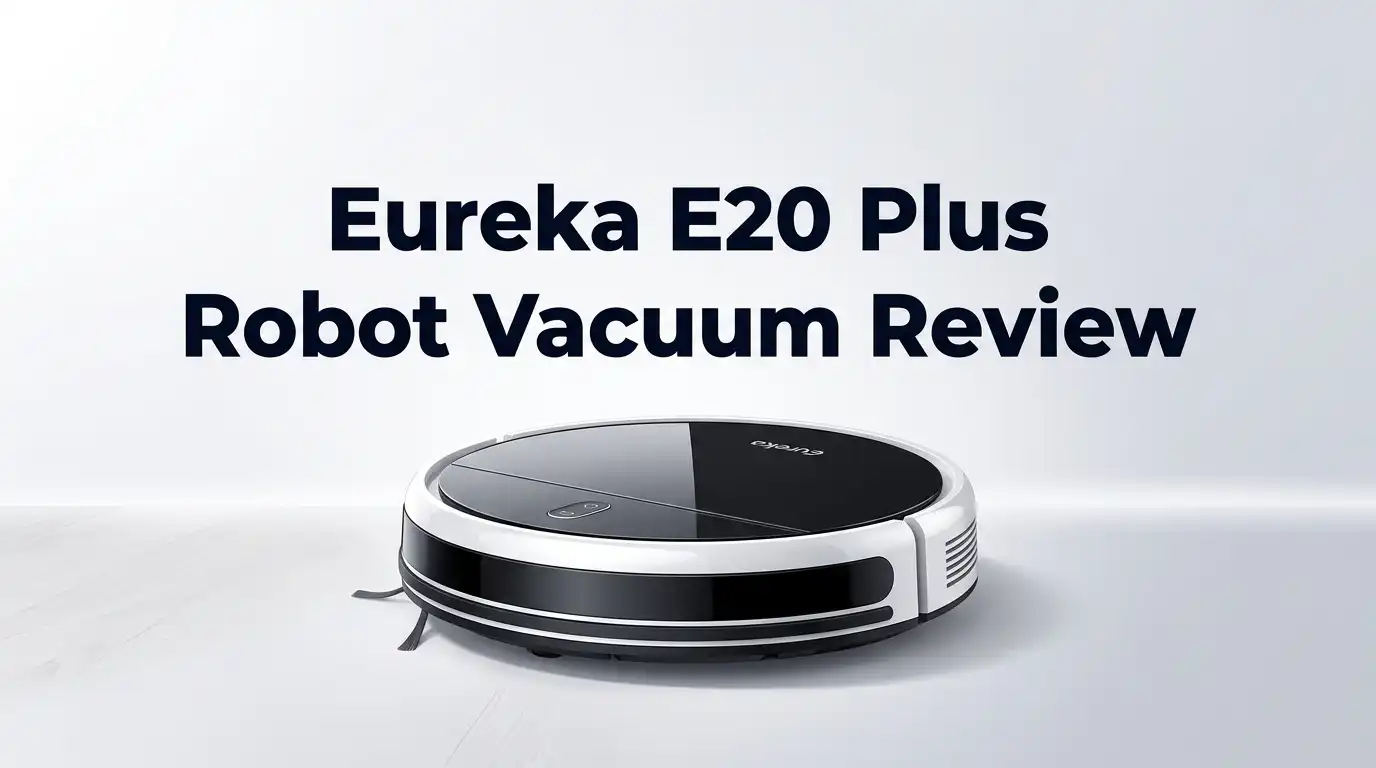
Eureka E20 Plus Robot Vacuum Review 2026: Still Worth It?
The Eureka E20 Plus arrived at a strange moment. Robot vacuums now cost anywhere from $200 to $1,800, and the middle of that range has become crowded. Eureka placed the E20 Plus right in that middle, priced near $449 most weeks, and gave it one feature almost nobody else offers at this level: a bagless self emptying base station.
That single choice changes the math. You never buy dust bags again. Over three years, that saves real money. But a clever base station does not clean your floors, so the question stays simple.
Does the E20 Plus actually vacuum well? Does the mop do anything useful? And does it still hold up in 2026 now that Eureka sells a newer Evo model?
In a Nutshell:
- Vacuuming is the strength here. The 8000 Pa motor pulls up coffee grounds, rice, cereal, and pet hair without repeated passes. On low pile carpet it lifts embedded dust that weaker 3000 Pa bots leave behind. This is a genuinely capable vacuum, not a dust pusher.
- Mopping is the weakness. The mop pad is static. It gets dragged across the floor with zero scrubbing motion. Fresh spills and light dust come up fine. Dried juice, sauce, and sticky footprints do not.
- The bagless base station is the headline feature. A 2L transparent bin holds roughly 45 days of debris, and a 13 cone cyclone separates about 98% of dust before it reaches the filter. You spend $0 per year on bags.
- Navigation is genuinely smart. DuoDetect AI dual line lasers spot shoes, cables, and pet bowls and steer around them. It is not perfect. Loose socks remain its nemesis.
- The app looks great but edits maps poorly. Splitting and merging rooms took several tries and sometimes failed to save. Everything else in the app works smoothly.
- Best fit: pet owners and busy households on mostly hard floors who want strong suction and hate buying consumables. Poor fit: anyone who needs serious mopping or wants a mop that washes itself.
Unboxing the Eureka E20 Plus


Last update on 2026-11-19 / Affiliate links / Images from Amazon Product Advertising API
The box is smaller than expected. Eureka ships the base station and robot in a single carton with molded cardboard trays, and the whole thing weighs about 8 kg. You lift out the manuals first, then a small accessory tray holding two side brushes, a spare mop pad, a spare HEPA filter, and a cleaning tool with a hidden blade for cutting hair.
The robot sits underneath in a cloth sleeve. It feels solid. The top plate has a soft matte finish that hides fingerprints well, and the LiDAR turret sits proud of the body like a small hat.
Assembly takes about four minutes. The main roller brush, mop bracket, and filters all come preinstalled. You clip on two side brushes, peel off the protective tape strips, plug in the base, and set the robot on the charging contacts. That is the entire job.
The nicest surprise is the base station itself. At 9.9 x 7.1 x 17.4 inches, it is one of the most compact docks in this price class, and it does not look like an appliance shoved against your wall.
Design and Build Quality
The E20 Plus measures 13.78 inches wide and 3.82 inches tall. That height matters. It clears many sofas and beds, though it will not fit under the very lowest furniture the way ultra slim 3.35 inch models do.
The dustbin pulls out from the side rather than the top, which is a small but welcome touch. The water tank is built into the same unit, so you fill and empty one component instead of two. A five stage filtration path sits inside, ending in a HEPA filter.
Underneath you get two side brushes and a V shaped rubber roller. Rubber matters more than people realize. Bristle rollers trap hair; rubber fins release it.
The base station earns points for thoughtful design. A pull up handle on top lets you carry the whole dust container to the trash with one hand. The rear has a cable channel for tidy routing. The transparent bin looks slightly gross when full, which is honestly a good reminder to empty it.
Setup, App, and Smart Home Control
Setup follows the usual path. You download the Eureka app, create an account, scan the QR code on the robot, and join your 2.4 GHz network. The whole process took under five minutes, followed by a firmware update.
Then comes the first run, and here Eureka does something odd. Most robots perform a quick exploratory lap to build a map. The E20 Plus launches straight into a full clean instead, taking around 50 minutes before it hands you a finished map.
The map itself is accurate. Editing it is the frustrating part. My hallway, bedroom, and half a bathroom were merged into one giant room. Fixing that required merging, exiting, redrawing, exiting again, and repeating steps that failed to save.
Once the map is correct, everything else works nicely. You get suction levels, water levels, no go zones, room specific schedules, and carpet detection. Alexa and Google Assistant both work for voice commands.
Top 3 Alternative for Eureka E20 Plus

Last update on 2026-11-19 / Affiliate links / Images from Amazon Product Advertising API
Eureka E20 Evo Plus

Last update on 2026-11-19 / Affiliate links / Images from Amazon Product Advertising API
Roborock Q5 Max+

Last update on 2026-11-19 / Affiliate links / Images from Amazon Product Advertising API
eufy Omni C20
Suction Power and Real Cleaning Results
Eureka rates the E20 Plus at 8000 Pa, double the previous generation. Marketing numbers rarely translate directly, so I ran messy tests instead.
Coffee grounds were the standout result. Fine particles usually scatter or blow past the brush. The E20 Plus rolled over the pile and took nearly all of it in one pass, with no dusty halo left behind.
Rice went almost as well. The two side brushes flung a few grains sideways on the first approach, which is normal physics for spinning brushes, but the robot circled back and collected most strays.
On low pile carpet it pulls visible grit out of the fibers. Carpet Boost detects the surface and ramps power automatically, and you can hear the motor change pitch.
Edges and corners are decent rather than excellent. The side brushes sweep debris inward well along baseboards, but tight 90 degree corners still hold a small triangle of crumbs. That is true of nearly every round robot.
Mopping Performance and Its Limits
This is where honesty matters. The E20 Plus mops in the loosest sense of the word.
The mop pad attaches to a flat plate at the rear. The plate does not vibrate, spin, or press down. The robot simply drags a damp cloth behind itself. There is no scrubbing pressure at all.
For light daily maintenance, that is acceptable. Dust film, light paw prints, and fresh water spills come up. Floors look a little fresher afterward.
For anything dried on, it fails. Dried coffee rings, sauce splatter, and sticky juice stayed exactly where they were. I went over one spot three times and still needed a paper towel.
The 10 mm mop lift works reliably, raising the pad when carpet is detected so rugs stay dry. That prevents the musty smell cheap mopping bots cause.
You also wash the pad by hand every time. There is no mop washing or drying in this dock.
The Bagless Self Emptying Base Station
This feature justifies much of the price. Most self emptying docks swallow disposable bags that cost $15 to $30 per pack. Over three years that adds up to real money and real landfill waste.
Eureka skips bags entirely. The dock uses a 13 cone multi cyclonic separator that spins dust out of the airflow before it reaches the filter. Eureka claims 98% separation, and in practice the filter stayed visibly clean for weeks.
The 2L transparent container holds roughly 45 days of debris in an average home. Pet households will empty it sooner, maybe every three weeks.
Emptying is easy. Press the release, lift the container by its handle, carry it to the bin, and open the flap. Do it slowly. Loose dust can puff back at you, which is the one real downside of bagless designs compared to sealed bags.
Running cost for dust disposal: zero dollars per year.
Navigation and Obstacle Avoidance
The E20 Plus pairs LiDAR mapping with DuoDetect AI dual line lasers on the front bumper. The lasers project structured light and read distortion, which gives the robot a rough 3D sense of what sits ahead.
It works well. During an obstacle course of shoes, plush toys, a charging cable, and a ball, the robot slowed, examined each item, traced a neat outline around it, and continued. No rescue calls.
Its path planning is tidy too. It cleans in straight parallel lines, finishes one room, then moves to the next rather than wandering randomly.
Socks remain its one true enemy. With a single sock it manages. With several scattered across a floor, it eventually snagged one near a wheel and stopped for help.
It also cannot see in the dark as well as camera free claims suggest, though laser navigation handles unlit rooms better than camera based systems do.
Battery Life, Coverage, and Noise
A 5200 mAh battery delivers up to 180 minutes in Quiet mode. In practice, mixed suction cleaning gave me around 110 to 130 minutes, which is plenty for most homes under 2,000 square feet.
Recharge and resume works properly. If the battery drops mid job, the robot docks, charges, and returns to the exact spot it left.
Noise is where I have a complaint. Eureka lists 65 dB in Quiet mode. No mode on this machine is actually quiet. Standard suction registers as clearly audible conversation blocking noise, and Max mode sounds like a small handheld vacuum in the next room.
The dock emptying cycle is the loudest moment by far. It lasts about 10 to 12 seconds and is genuinely startling the first time. Schedule cleans for when you are out, not during a nap or a video call.
Pet Hair and the Anti Tangle Brush
Pet owners should read this section twice, because tangled hair is the number one reason robot vacuums get abandoned in closets.
The V shaped rubber roller pushes hair toward the center intake instead of letting it wrap around the ends. Eureka claims a 14% improvement in anti wrap performance over the previous brush.
After weeks of testing in a home with three pets, the roller needed no manual hair cutting. That is unusual and genuinely impressive. Long human hair still wound lightly around the side brush posts, which took about 20 seconds to clear with the included tool.
The bagless dock also suits pet homes well. Hair compresses tightly in the cyclone chamber, so the bin holds more than you expect.
One caution: if anyone in your home has strong allergies, empty the bin outdoors. Opening a full transparent container releases a small dust cloud.
Maintenance and Long Term Running Costs
Ownership is refreshingly cheap. Here is the real maintenance routine.
Weekly, wipe the LiDAR turret and cliff sensors with a dry cloth. Rinse the mop pad after every mopping run and let it air dry, or it will smell.
Monthly, tap out the HEPA filter and check the side brushes for hair. Every two to three months, rinse the filter in cold water and dry it fully for 24 hours before reinstalling.
Replacement parts are inexpensive. Third party kits with brushes, filters, and mop pads sell for around $20 and cover a full year.
Because there are no bags, your annual consumable cost is roughly $20 to $30. Compare that to bagged competitors, where bags alone run $40 to $60 per year on top of brushes and filters.
The dock holds no water tanks, so there is no clean water reservoir to refill or dirty water tank to scrub either.
What the Eureka E20 Plus Does Not Do Well
An honest review needs a section like this, so here it is plainly.
Mopping is barely a feature. A static dragged pad cannot replace a real mop, and Eureka markets this as a two in one machine when it is really a strong vacuum with a damp cloth attached.
Map editing is clumsy. Room splitting failed to save more than once and required repeating steps.
It is loud. There is no truly quiet mode, and the dock emptying cycle is jarring.
Loose fabric defeats it. Socks, thin rugs with tassels, and dangling cords still cause stoppages.
No mop washing or drying. You rinse the pad by hand every single time.
No object recognition photos. You cannot see what the robot avoided, unlike camera based rivals.
None of these are dealbreakers on hard floors. All of them matter if you expected an all in one flagship experience at a mid range price.
Pros and Cons
Pros
- Strong 8000 Pa suction that clears fine debris like coffee grounds in a single pass
- Bagless base station means zero spending on dust bags for the life of the machine
- Compact dock footprint at under 10 inches wide, unusually small for a self emptying model
- V shaped rubber roller resists hair tangling remarkably well in pet homes
- DuoDetect AI dual line lasers avoid shoes, cables, and toys with high accuracy
- Five stage filtration ending in HEPA keeps allergens contained for 45 days
- Up to 180 minutes of runtime with reliable recharge and resume
- Works with Alexa and Google Assistant for voice commands
Cons
- Static mop pad provides no scrubbing action and fails on dried stains
- Map editing in the app is slow and sometimes does not save changes
- Every suction mode is noticeably loud, including Quiet mode
- Dock emptying cycle is startlingly loud for 10 to 12 seconds
- Gets tangled when multiple socks or loose fabric sit on the floor
- Mop pad must be washed by hand after every run
- Emptying the bagless bin releases a small puff of dust
- First run skips a quick mapping pass and takes about 50 minutes
Price and Value in 2026
Last update on 2026-11-19 / Affiliate links / Images from Amazon Product Advertising API
List price sits at $499.99, but the E20 Plus rarely stays there. Street pricing hovers near $449, and sale events have pushed it into the $350 to $380 range.
At $449, it competes with the Roborock Q5 Max+ and various eufy models. Against those, it wins on raw suction and on consumable cost. It loses on mopping quality.
At $360 or below, it becomes a clear bargain. You are getting flagship style laser obstacle avoidance and a bagless dock for the price of a basic bagged competitor.
There is also a newer sibling to consider. The Eureka E20 Evo Plus advertises 10000 Pa and adds anti tangle side brushes, though independent testing suggests the real world suction gain is smaller than the spec sheet implies.
My honest take: buy the E20 Plus on sale, treat the mop as a bonus, and you will be happy. Pay full retail expecting a mopping machine, and you will not.
Who Should Buy the Eureka E20 Plus
Buy it if you have mostly hard floors with some low pile rugs, you own pets that shed, and you want a self emptying robot without an ongoing bag subscription. Buy it if apartment space is tight and a giant dock will not fit. Buy it if strong vacuum suction matters more to you than mop quality.
Skip it if your floors need actual scrubbing, if you have a toddler creating dried on messes daily, or if you want a dock that washes and dries the mop for you. In those cases, spend more on a machine with spinning or vibrating mop pads and an all in one station.
Skip it too if noise sensitivity is high in your home, because this robot announces itself clearly.
For the right household, the E20 Plus is one of the smartest value picks available in 2026. For the wrong one, its limits show up on day two.
Frequently Asked Questions
Does the Eureka E20 Plus need dust bags?
No. The base station is fully bagless. Debris collects in a transparent 2L container that you empty by hand roughly every 45 days. This saves around $40 to $60 per year compared to bagged robot vacuums.
How strong is the suction on the E20 Plus?
Eureka rates it at 8000 Pa maximum, which is double the previous generation. In testing it cleared coffee grounds, rice, cereal, and embedded carpet dust effectively. Carpet Boost raises power automatically when the robot detects a rug.
Can the Eureka E20 Plus mop properly?
Only lightly. The mop pad is static and gets dragged behind the robot with no scrubbing motion. It handles dust and fresh spills but fails on dried or sticky messes. Treat it as a damp wipe rather than a mop.
Does the mop lift on carpet?
Yes. The mop plate raises 10 mm when carpet is detected, keeping rugs dry during mixed cleaning runs. This works reliably on low and medium pile carpet.
How long does the battery last?
The 5200 mAh battery delivers up to 180 minutes in Quiet mode. Real world mixed mode runs last around 110 to 130 minutes. The robot recharges and resumes automatically if it runs low mid clean.
Is the Eureka E20 Plus good for pet hair?
Yes. The V shaped rubber roller resists hair wrapping, and in weeks of testing with three pets it never needed manual hair cutting. The large bagless bin also handles heavy shedding well.
Is it loud?
Yes, noticeably. Even Quiet mode is clearly audible at around 65 dB, and the automatic dock emptying cycle is loud for about 10 to 12 seconds. Schedule cleans for when nobody is home.
Does it work with Alexa and Google Assistant?
Yes. The Eureka app connects to both platforms for voice commands. Siri support was listed as arriving through a future software update.
How is it different from the Eureka E20 Evo Plus?
The Evo Plus advertises 10000 Pa suction and adds anti tangle side brushes, while dropping the dual line laser obstacle avoidance found on the E20 Plus. Choose the E20 Plus for smarter obstacle handling.
Can it climb over thresholds?
It handles standard thresholds and door strips up to about 20 mm. Taller transitions between rooms may stop it, so a small ramp helps in older homes.

Hi, I’m Grace Bell, the founder of CleanFloorVault.com, where I personally test and review vacuum cleaners to help you find the perfect tool for a spotless home.