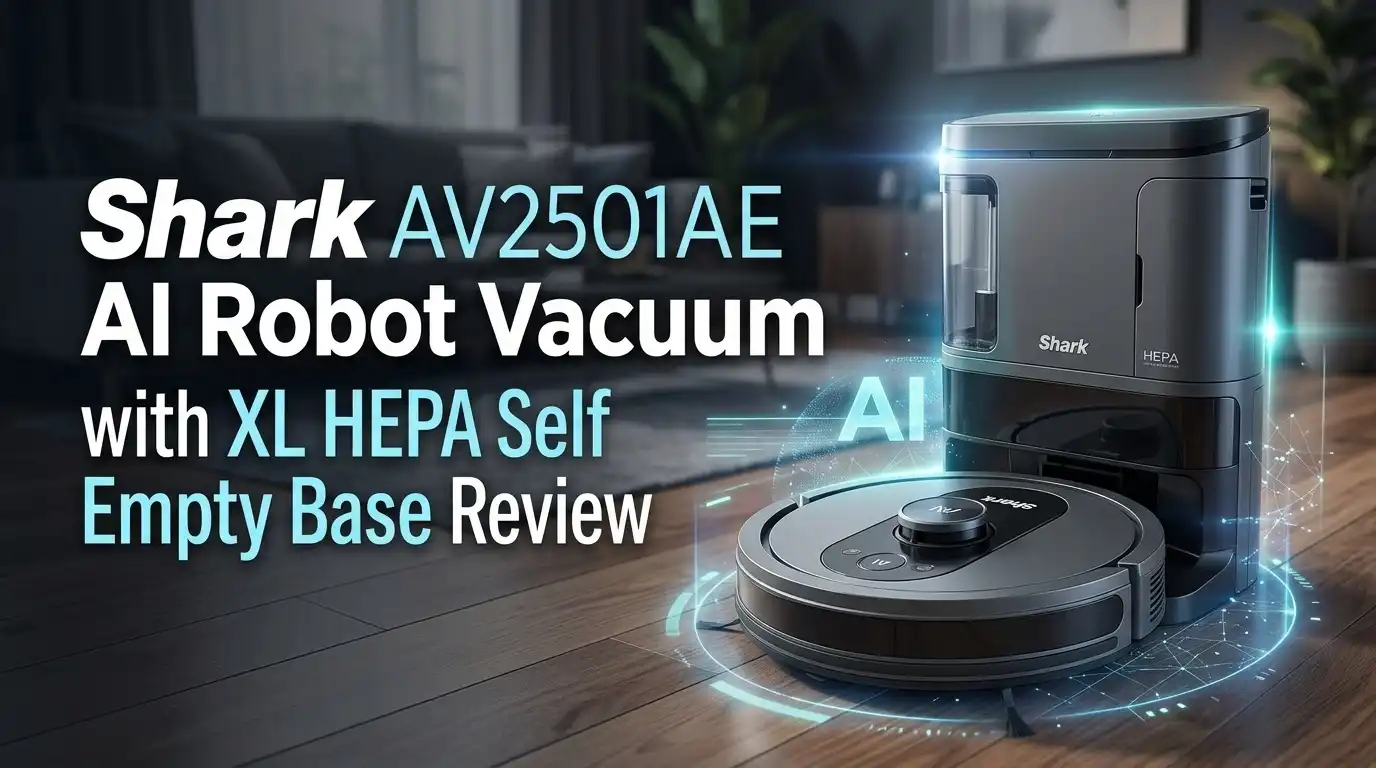
Shark AV2501AE AI Robot Vacuum with XL HEPA Self Empty Base Review
Robot vacuums promise freedom from daily chores. Most of them deliver only half of that promise. The Shark AV2501AE sits in an interesting spot.
It carries a bagless XL base, laser mapping, and a price that keeps dropping during sales events. It also carries a few flaws that owners talk about openly.
I spent weeks living with this machine across hardwood, tile, and medium pile carpet. Two shedding pets helped with testing. This review covers the unboxing, the real cleaning results, the base station, the app, and the parts that frustrated me.
In A Nutshell:
- LiDAR navigation is the headline feature. The spinning laser turret on top maps rooms in straight lines and reaches close to full coverage. This was the first Shark robot to use laser mapping instead of a camera, and it shows in the tidy cleaning paths.
- The XL HEPA base holds roughly 60 days of debris and uses no bags. You dump the bin into the trash and slide it back. No recurring bag costs is a genuine money saver over several years.
- Suction and pickup rank above average for the price. Sand buried in carpet, kitty litter on tile, and cereal all disappeared in testing. The dual brush design handles hard floors very well.
- Battery life is below average at about 80 minutes. Recharge and resume saves the day in larger homes, though a single job may take two trips.
- It gets stuck. Often. The algorithm pushes into tight gaps under chairs and around cables. No go zones become mandatory, not optional.
- This is not true AI obstacle avoidance. It will not dodge socks, charging cords, or pet accidents. Pick up your floor first.
Shark AV2501AE AI Robot Vacuum with XL HEPA Self Empty Base

Last update on 2026-11-20 / Affiliate links / Images from Amazon Product Advertising API
The AV2501AE is a vacuum only robot. It does not mop. Shark built it around a top mounted laser scanner, a dual brush roll system, and a tall bagless dock that empties the robot automatically. The black and bronze finish looks sharper in person than in product photos.
Shark positions this as a pet hair specialist. The marketing holds up better than most. The brush roll resists wrapping, and the base pulls hair out of the bin instead of leaving it packed inside.
The robot measures roughly 13.7 inches across and sits low enough to slide under many sofas. Build quality feels solid rather than premium. The plastics are thick, the bumper has good travel, and nothing rattles during a run. For a machine that often sells under 300 dollars, that counts as a win.
Unboxing Experience
The box arrives heavy. Most of that weight comes from the base station, not the robot. Shark packs everything in molded cardboard instead of foam, which makes recycling easier and feels more modern than older Shark packaging.
Inside you get the robot, the XL self empty base, the power cable, two side brushes, and a spare filter. A quick start card sits on top. The full manual hides underneath the base.
Setup took me under ten minutes. You clip on the side brushes, plug in the dock, place the robot on the contacts, and download the SharkClean app. The robot chimes and announces itself out loud, which surprised me the first time.
One small annoyance appears immediately. The base needs a solid wall, flat floor, and clear space on both sides. Tight corners will not work.
Design and Build Quality
The robot wears a circular shell with a raised laser turret in the center. That turret adds height, so the machine will not fit under very low furniture. Measure your sofa clearance before buying.
The top plate hides the dust bin. You lift it, pull the bin straight out, and rinse the filter. Everything you touch regularly sits in one place, which makes maintenance simple.
Underneath you find two side brushes, two drive wheels, and the dual brush roll. The second brush is the part owners praise most. One roll grabs debris while the other handles fine dust.
The dock stands as a slim rectangle. It does not create an overhang garage like some rivals. That slim profile helps in apartments, and the black finish blends into baseboards well.
LiDAR Navigation and Mapping
This is where the AV2501AE earns its keep. The laser scanner builds a map on the first run and refines it on the second. My house needed two passes before the map stabilized, which matches what other testers report.
Once mapped, the robot cleans in neat rows. Coverage reached nearly 100 percent in both small and large rooms during testing. It rarely missed patches or repeated the same lane twice.
No go zones work accurately here. You draw a box on the map, and the robot respects it. Camera based Shark models were far less precise with this feature.
Room labeling lets you send the robot to clean only the kitchen or only the bedroom. Scheduling by room works too. These premium features normally appear on vacuums costing twice as much.
Top 3 Alternative for Shark AV2501AE AI Robot Vacuum

Last update on 2026-11-20 / Affiliate links / Images from Amazon Product Advertising API
roborock Q5 Max+ Robot Vacuum with Self Empty Dock

Last update on 2026-11-20 / Affiliate links / Images from Amazon Product Advertising API
eufy L60 Robot Vacuum with Self Empty Station

Last update on 2026-11-20 / Affiliate links / Images from Amazon Product Advertising API
Shark PowerDetect Self Empty Robot Vacuum AV2820AE
Suction Power and Cleaning Performance
Airflow tested above average for this price bracket. That strength showed in the deep clean test, where sand pressed into medium pile carpet came out at a rate matching far pricier robots.
On hard floors the result was cleaner still. Kitty litter, rice, and crushed cereal vanished in one pass. Even the lower power setting pulled debris off tile without complaint.
Carpet performance is good but not flawless. Solid chunky debris on low pile carpet sometimes gets pushed forward before the brush catches it. A second pass fixes this.
Edges and corners rely on the side brushes. They flick dirt toward the center well, though a thin line of dust can remain in sharp 90 degree corners. No round robot fully solves that problem.
Pet Hair and Anti Tangle Brush Roll
Pet owners are the target buyer here, so I tested with two shedding cats. The redesigned brush roll resisted wrapping during every run. Short pet hair simply passed through into the bin.
Long human hair is a different story. Strands still gathered at the brush ends after a week. Shark calls the system anti tangle, and it works better than older models, but it is not maintenance free.
Plan on a quick brush check every two weeks if anyone in your home has long hair. The brush pops out without tools, and scissors are rarely needed.
Pet hair on carpet came up cleanly. The dual brush setup lifts fibers and releases trapped hair better than single roller designs. For homes with dogs or cats, this remains one of the stronger budget options.
XL HEPA Self Empty Base Explained
The dock holds up to 60 days of debris. That figure assumes a modest home with light soil. My real world experience landed closer to five or six weeks with pets.
The bagless design is the big advantage. You pull out the base bin, tip it into the trash, and slide it back. No bags to buy, no subscriptions, no waiting for deliveries.
A HEPA filter sits inside the base to trap fine dust during emptying. This matters for allergy sufferers, because the emptying process is the dustiest moment in any robot vacuum cycle.
Emptying is loud. It lasts only a few seconds, but the noise startles pets and sleeping people. Schedule your cleans for daytime hours if that bothers you.
Battery Life and Recharge and Resume
Shark rates the battery at about 80 minutes on the lowest power setting. That number sits below average for 2026 standards, where many rivals push past three hours.
Higher suction modes drain faster. Expect closer to 50 or 60 minutes in real use with mixed flooring.
Recharge and resume rescues the shortfall. The robot drives back to the dock, charges, and returns to the exact spot where it stopped. The map keeps track, so nothing gets skipped.
Charging takes several hours, not minutes. A large single floor home may need the better part of a day to finish one complete clean. Smaller homes and apartments will finish in one go without issue.
If speed matters more than price, look at models with larger batteries.
SharkClean App and Smart Features
The app handles scheduling, mapping, no go zones, suction levels, and room targeting. All the features you expect are present and functional.
The experience is clunky. The app occasionally stalls, requires a restart, or loses connection with the robot. Firmware updates have improved things since launch, yet it still trails the smoothest competitors.
Real time robot tracking on the map is missing. You cannot watch the vacuum move across your floor plan, which feels like an odd omission on a laser mapping machine.
Voice control works with Alexa and Google Assistant. Saying start cleaning the kitchen works reliably once the map is labeled correctly.
Wi Fi drops happen now and then. Reconnecting takes a minute, though it interrupts the hands free feeling you paid for.
Noise Levels During Cleaning
Normal cleaning sits at a comfortable volume. You can hold a conversation in the same room, and television audio stays audible over the robot.
Higher suction modes raise the pitch noticeably. On carpet in max mode, the machine becomes hard to ignore.
The self empty cycle is the loudest moment by far. It sounds like a shop vacuum running for 15 seconds. Pets usually need a few days to accept that sound.
Hard floors produce less noise than carpet because the brush roll meets less resistance. Running a scheduled clean while you are at work remains the best approach.
Overall the noise profile matches other self emptying robots in this class. Nothing here is unusual, but anyone sensitive to sudden loud sounds should know what to expect.
Maintenance and Running Costs
Maintenance demands more attention than premium rivals. The dust bin filter needs rinsing every couple of weeks. The base filter needs cleaning monthly.
Side brushes bend over time and need replacing roughly twice a year. The main brush roll lasts longer but still wears out.
Replacement parts are widely available and cheap. Third party kits with brushes and filters cost very little, which keeps long term ownership affordable.
The bagless base eliminates the biggest recurring expense found on competing self emptying robots. Bag based systems can cost 50 dollars or more per year.
Sensors need an occasional wipe. Dusty cliff sensors cause the robot to stop mid clean and refuse to return home, which is the most common complaint owners report online.
What The Shark AV2501AE Does Not Do Well
Honest reviews list the failures. Here are the real ones.
It gets stuck. The algorithm pushes into tight gaps instead of backing away early. Chair legs, floor registers, and low cabinet gaps all trapped it during testing.
There is no real obstacle avoidance. Despite the AI name, it will drive over socks, cables, and pet messes. The name is marketing language, not machine learning.
It does not mop. This is a vacuum only model.
The app remains the weakest link. Bugs, missing live tracking, and occasional disconnections hold back an otherwise strong product.
Low pile carpet with chunky debris can defeat it on the first pass. Tall thresholds over 0.7 inches stop it completely.
Pros and Cons
Here is the balanced summary.
Pros
- Accurate LiDAR mapping with near complete room coverage
- Bagless XL base holds about 60 days of debris with no bag costs
- Above average suction on both carpet and hard floors
- Dual brush design handles pet hair very well
- HEPA filtration in the base traps allergens during emptying
- Frequent discounts make the value hard to beat
- Room targeting, scheduling, and no go zones all work properly
Cons
- Gets stuck in tight spaces more often than rivals
- No camera based obstacle avoidance despite the AI branding
- Battery life of around 80 minutes is below average
- App feels buggy and lacks live robot tracking
- Self empty cycle is loud
- Vacuum only, with no mopping function
- Long hair still needs manual removal from the brush
Price and Value in 2026
The AV2501AE typically sells around 290 dollars, with sale prices dipping near 270 dollars during major shopping events. Older list prices as high as 650 dollars appear in retailer comparisons, so the discounts look dramatic.
At under 300 dollars, the value proposition is strong. You get laser mapping, a bagless 60 day base, and HEPA filtration, a combination that cost double a few years ago.
Shark builds robots that are good enough at low prices. That philosophy defines this model. It will not beat a flagship on obstacle avoidance or battery life.
Compare it against the Roborock Q5 Max+ and the eufy L60 before buying. All three sit in the same bracket with different strengths.
Who Should Buy This Robot Vacuum
Buy this if you own pets, live in a home under about 1,500 square feet, and want automatic emptying without recurring bag costs. Those three conditions describe the ideal owner perfectly.
Allergy sufferers also benefit from the sealed HEPA base, since emptying no longer fills the air with fine dust.
Skip it if your floors stay cluttered. Cables, toys, and shoes will trap this robot repeatedly. Buy a model with camera obstacle avoidance instead.
Skip it also if you want mopping in the same machine. Shark sells 2 in 1 models for that purpose.
Large multi level homes will find the battery limiting, though recharge and resume makes it workable with patience.
Final Verdict
The Shark AV2501AE remains a smart budget pick in 2026. Cleaning performance is genuinely good, the laser mapping is accurate, and the bagless XL base solves the chore most people hate.
The flaws are real and worth repeating. It gets stuck, the app frustrates, and the AI name oversells what the sensors actually do.
Judged on price, it delivers more than it costs. Judged against flagship robots, it falls behind on navigation smarts and runtime.
My rating sits at 4 out of 5 for value buyers and closer to 3.5 for anyone expecting premium behavior. Clear your floors, set your no go zones, and this machine will quietly handle your daily dust for years.
Frequently Asked Questions
Does the Shark AV2501AE mop floors?
No. This model is a vacuum only robot. Shark sells separate 2 in 1 models with mopping pads if you need both functions in one machine.
How long does the self empty base last before emptying?
Shark claims up to 60 days. Homes with pets usually reach five or six weeks. The bin is bagless, so you simply tip it into the trash.
Does it avoid cables and socks?
No. The robot uses laser and infrared sensors to detect larger objects only. Small items on the floor will be driven over or pulled into the brush.
How tall is the robot?
The robot sits around 3.5 inches tall including the laser turret. Measure furniture clearance before buying, since the turret adds height compared with flat top models.
Can it handle thick carpet?
It performs well on low and medium pile carpet. Very thick or high pile carpet reduces performance and drains the battery faster.
Does it need Wi Fi to work?
No. You can press the button on the robot to start a clean. Wi Fi unlocks mapping, scheduling, no go zones, and voice control through the app.

Hi, I’m Grace Bell, the founder of CleanFloorVault.com, where I personally test and review vacuum cleaners to help you find the perfect tool for a spotless home.