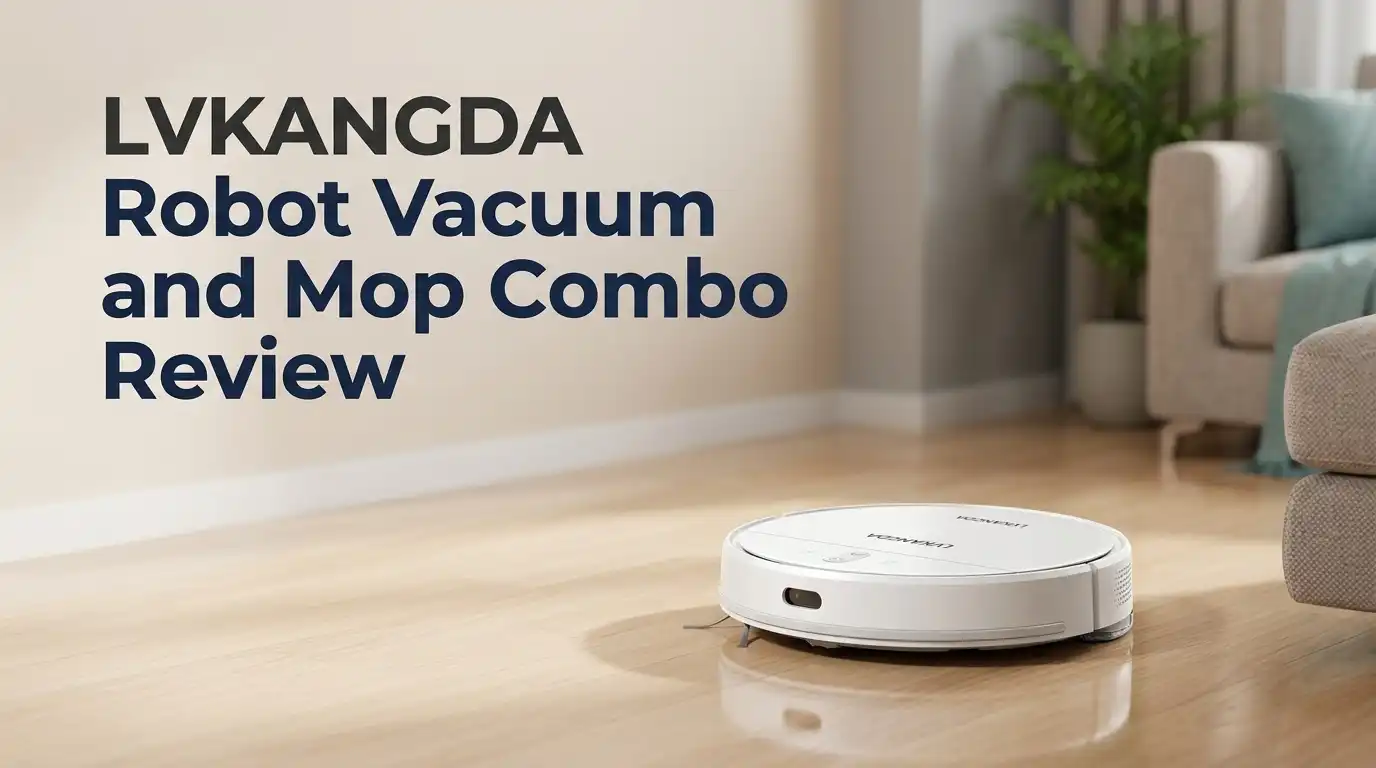
LVKANGDA Robot Vacuum and Mop Combo Review 2026: Worth Buying?
Robot vacuums used to feel like expensive toys. They bumped into chairs, missed corners, and needed rescuing twice a week. That era is over. The LVKANGDA D17S MAX arrives with 12,000 Pa of suction, laser mapping, a self emptying base, and a brush that literally cuts hair off itself. On paper it reads like a flagship machine at a mid tier price.
But spec sheets lie all the time. I wanted to know how this robot behaves on real floors, in a real home, with real pet hair and dried coffee spills. So I ran it for weeks across hardwood, tile, and low pile carpet. I tracked what it nailed and what frustrated me.
This review covers the unboxing, the app setup, the cleaning tests, the noise, the running costs, and the honest weak spots. No marketing fluff. If this robot is right for your home, you will know by the end. If it is wrong for you, you will know that too.
In a Nutshell:
- Suction is genuinely strong. The 12,000 Pa rating is not just a number on a box. The D17S MAX pulled embedded grit out of low pile carpet and cleared pet hair from hardwood in a single pass. Carpet boost kicks in automatically when it senses pile above 10 mm.
- The self emptying base buys you freedom. LVKANGDA claims 90 days between bag changes. In a two person home with one shedding dog, that estimate held up for roughly eight to ten weeks, which is still excellent.
- Navigation is accurate, obstacle avoidance is average. The dToF LiDAR builds clean maps fast and saves up to 5 floors. But it has no camera based object recognition, so loose cables and socks still get eaten.
- Mopping is light duty. The 300 ml tank and flat pad handle dust films and fresh spills well. Dried sauce and sticky juice need a second run or a human.
- Value is the real story. You get LiDAR mapping, auto emptying, and an auto hair cutting brush for far less than the premium brands charge. The tradeoffs are the mop system and the app polish, not the core cleaning.
What Is the LVKANGDA D17S MAX?

Last update on 2026-10-28 / Affiliate links / Images from Amazon Product Advertising API
The D17S MAX is a 2 in 1 robot vacuum and mop with a self emptying charging dock. LVKANGDA is a newer name in the robot cleaning space, and the brand competes by stacking premium features into a lower price bracket.
The robot carries a 250 ml dustbin and a 300 ml electronic water tank. That means it vacuums and mops in the same run. A 3200 mAh battery powers up to 160 minutes of cleaning in quiet mode, which covers homes around 200 square meters.
Navigation runs on dToF LiDAR, the same laser technology used by far pricier machines. It spins, scans 360 degrees, and draws a room by room map in minutes. You then control everything through the Tuya Smart app, which also connects to Alexa and Google Assistant.
The headline feature is the auto hair cutting system, which I will test later in this review.
The Unboxing Experience
The box arrives heavier than expected, mostly because of the dock. Inside, everything sits in molded cardboard inserts rather than foam, which I appreciated. Less plastic waste, less mess on the living room floor.
You get the robot itself, the self emptying base station, one dust bag already installed, a spare side brush, a mop pad with its mounting bracket, a cleaning tool with a small blade, and the power cord. The manual is thin but readable, with clear diagrams for dock placement.
First impressions of build quality are solid. The top plate has a matte black finish that hides fingerprints reasonably well. The LiDAR turret sits in a raised bump, so the robot stands about 3.9 inches tall. That height matters if you planned to send it under a low sofa.
Peel off the protective film strips before the first run. There are more of them than you think, including two inside the dustbin.
Setup and App Pairing
Setup took me under fifteen minutes from box to first clean. You place the dock against a wall, leave about 1.5 feet of clearance on each side and 4 feet in front, then plug it in and set the robot on the contacts.
The Tuya Smart app handles pairing. You download it, create an account, hold the two buttons on the robot until it beeps, and select your 2.4 GHz network. The robot does not support 5 GHz, which trips up a lot of people with combined network names.
Once connected, run a quick mapping pass. The robot explores without cleaning and produces a floor plan in roughly eight minutes for a medium apartment. You then split rooms, name them, and draw no go zones.
The app works, but it is clearly generic Tuya software rather than a custom build. Menus feel cluttered compared to the polished apps from bigger brands.
Suction Power Tested on Real Messes
I scattered flour, rice, coffee grounds, and a handful of dog hair across three surfaces. The D17S MAX ran each test in standard mode first, then in max mode.
On hardwood, it cleared rice and coffee grounds in one pass. Flour left a faint haze that a second pass removed. On tile with grout lines, performance stayed almost identical, which is a good sign because grout traps fine powder.
Low pile carpet is where the 12,000 Pa rating earns its keep. The robot detected the carpet, raised suction automatically, and lifted embedded hair that my upright vacuum had missed a day earlier. Medium pile carpet was harder. Deep debris needed two or three passes.
Edge cleaning sits around average. The single side brush sweeps debris inward well on straight walls but leaves a small amount in sharp 90 degree corners.
Top 3 Alternative for LVKANGDA Robot Vacuum and Mop Combo

Last update on 2026-10-26 / Affiliate links / Images from Amazon Product Advertising API
roborock Q7 M5+ Robot Vacuum and Mop

Last update on 2026-10-26 / Affiliate links / Images from Amazon Product Advertising API
eufy Omni C20 Robot Vacuum and Mop Combo


Last update on 2026-10-26 / Affiliate links / Images from Amazon Product Advertising API
Shark PowerDetect Robot Vacuum and Mop Combo
dToF Laser Navigation and Mapping
Mapping is the strongest part of this robot. The dToF LiDAR sensor measures distance using light travel time, and it works in complete darkness. I tested a night run with every light off and the robot navigated exactly as it did at noon.
Route planning follows neat row by row lines rather than random bouncing. Coverage in my test rooms sat consistently above 90 percent, with the gaps appearing under chairs and around table legs.
Multi floor mapping is handled well. The robot stores up to 5 maps in the cloud. Carry it downstairs, press clean, and it recognizes which floor it is on within seconds. This feature alone usually costs extra on competing models.
You can set virtual walls, no go zones, and no mop zones for carpeted rooms. Room specific cleaning works through the app or through a voice command.
Mopping Performance on Hard Floors
The mopping system is simple. A flat microfiber pad clips onto a bracket at the rear, and an electronic pump feeds water from the 300 ml tank at three selectable flow rates.
A pre wet function moistens the pad before the robot leaves the dock. That small touch prevents the dry first minute that plagues cheaper mopping robots. On sealed hardwood and tile, it lifted dust films, light footprints, and fresh liquid drips cleanly.
Then come the limits. The pad does not vibrate, spin, or apply downward pressure. Dried tomato sauce, sticky juice, and set in pet paw marks survived three passes. You will still reach for a real mop on those.
The pad also does not lift when the robot crosses carpet. You must either remove the pad or set a no mop zone. Forget that step once and you will have damp carpet edges.
How the Self Emptying Base Works
After each cleaning session, the robot docks and a motor in the base pulls debris out of the 250 ml onboard bin into a sealed bag. The cycle lasts about twelve seconds and is loud, somewhere near a shop vacuum burst.
LVKANGDA rates the bag at 90 days. My real world result landed closer to eight to ten weeks with a medium shedding dog and two adults. Homes with multiple pets or long hair should plan on six weeks.
The sealed bag design matters for allergy sufferers. You pull a tab, the bag closes itself, and dust stays contained during disposal. No cloud of debris in your face.
Replacement bags are the main consumable cost. Third party packs exist, which helps, but stock availability for this brand is less reliable than for major labels.
The Auto Hair Cutting System Tested
This is the feature I was most skeptical about. Most robots advertise anti tangle brushes that simply reduce wrapping. The D17S MAX goes further and actively cuts hair.
After any task longer than 30 minutes, the robot spins in place and runs the main brush forward and backward through eight alternating cycles. The motion shears wrapped hair into short pieces, and 5 kPa of suction pulls them into the bin.
I deliberately fed it long human hair plus a week of dog hair. After two weeks, the roller had only a thin strand or two near the end caps. My previous robot needed scissors every single week.
This is a genuine time saver for pet owners and long haired households. It does not eliminate maintenance entirely, but it turns a weekly chore into a monthly glance.
Battery Life and Real Coverage
The 3200 mAh battery delivers up to 160 minutes in quiet mode. That number drops fast as you raise suction. In my testing, max mode with mopping active ran closer to 85 minutes.
Quiet mode covered my entire test space with charge to spare. Max mode on carpet drained the battery about twice as quickly, which is normal physics rather than a flaw.
Recharge and resume works properly. When charge drops to 15 percent, the robot returns to the dock, charges to 80 percent, then drives straight back to the exact spot it paused. I interrupted a run three times and it never lost its place.
Full recharge from empty takes around four and a half hours, so a large home may need an afternoon rather than a single morning session.
Noise Levels in Daily Use
Quiet mode measures as a low hum you can talk over. I ran it during a video call and nobody mentioned it. Standard mode is noticeably louder but still background level, comparable to a dishwasher.
Max mode is a different story. The motor whine becomes intrusive and you will want to be in another room. On carpet, where boost engages automatically, expect that louder profile even if you selected standard.
The self emptying cycle is the loudest moment by far. It lasts only a few seconds, but it will wake a light sleeper or startle a nervous pet. Do not place the dock near a bedroom door or a baby monitor.
Scheduling solves most of this. Set runs for mid morning when the house is empty and noise stops being a consideration.
Maintenance and Running Costs
Ongoing care is lighter than most robots but not zero. The dust bag needs replacing every six to twelve weeks depending on your home. Filters should be rinsed monthly and swapped roughly every three months.
The mop pad needs washing after every mopping run. Skip this and you spread dirty water around. Empty the water tank if you will not mop for several days, otherwise you risk mineral buildup in the pump.
Sensors and the LiDAR window need a dry wipe every few weeks. Dust on the cliff sensors causes the robot to hesitate at thresholds.
Parts availability is a real consideration. LVKANGDA is a smaller brand, so finding genuine brushes and bags in two years is less certain than with Roborock or eufy. Buy a spare kit early if you plan to keep it long term.
What the LVKANGDA Does Not Do Well
Honest reviews name the weak spots, so here they are. Obstacle avoidance relies on bumper sensors and LiDAR, not a camera or structured light. Charging cables, socks, and small toys get tangled regularly. You must tidy the floor before every run.
The mop is pressure free and does not lift over carpet. That rules it out as a deep cleaning mop and makes mixed flooring homes do extra setup work.
The Tuya app functions but feels generic. Firmware updates arrive less often than with established brands, and customer support response times vary widely in user reports.
Medium and high pile carpet remain a weakness. The robot can also struggle to climb thresholds taller than about 0.8 inches. Finally, the 3.9 inch height blocks it from many low sofas and bed frames.
Pros and Cons
Pros
- 12,000 Pa suction removes embedded carpet grit and heavy pet hair in one or two passes
- dToF LiDAR mapping works in total darkness and stores up to 5 floor maps for multi level homes
- Auto hair cutting brush keeps the roller clear and removes a weekly manual chore
- Self emptying dock with a sealed bag runs roughly eight to twelve weeks between changes
- Recharge and resume returns to the exact pause point with no missed areas
- Strong price to feature ratio compared to premium flagship machines
- Alexa and Google Assistant support plus detailed no go zone controls
Cons
- No camera based obstacle recognition, so cables and socks still cause tangles
- Mop pad applies no pressure and cannot scrub dried stains
- Mop does not lift automatically over carpet, requiring manual pad removal
- Tuya app feels generic with cluttered menus
- Self emptying cycle is loud enough to disturb sleep or pets
- Medium and high pile carpet needs multiple passes
- Long term parts availability is less certain than with major brands
Who Should Buy the LVKANGDA D17S MAX
This robot suits a specific buyer very well. If you live in a home with mostly hardwood, tile, or low pile carpet, and you own a shedding pet, the suction plus the hair cutting brush solve your biggest daily problem.
It also makes sense for multi level homes because the 5 map memory usually costs extra elsewhere. Carry it upstairs and it simply knows where it is.
Budget conscious buyers who want LiDAR and auto emptying without paying flagship prices will find strong value here. You are essentially buying premium navigation hardware with mid tier mopping attached.
Skip it if your floors are mostly thick carpet, if you need serious scrubbing power for kitchen messes, or if you cannot keep floors clear of cables and small objects. Those buyers should look at models with camera based avoidance and spinning mop pads.
Final Verdict: Is It Worth It in 2026?
The LVKANGDA D17S MAX earns a recommendation with clear conditions attached. The vacuuming is genuinely strong, the mapping is accurate and fast, and the auto hair cutting system is the standout feature that competitors at this price do not match.
The mopping is the compromise. Treat it as a daily dust film refresher rather than a replacement for scrubbing, and you will not feel disappointed. Treat it as a real mop and you will.
Obstacle avoidance is the second compromise. Tidy floors before a run and the robot performs beautifully. Leave cables out and you will be untangling it.
For pet owners with hard floors and a realistic budget, this is one of the better value robots available right now. For everyone else, the alternatives listed earlier deserve a look first.
Frequently Asked Questions
Does the LVKANGDA D17S MAX work without WiFi?
Yes, partially. You can press the physical clean button and the robot will run a full auto cycle using LiDAR navigation. However, scheduling, room selection, no go zones, suction adjustment, and map saving all require the Tuya Smart app and a 2.4 GHz WiFi connection.
How often do I need to change the dust bag?
LVKANGDA rates the bag at 90 days. Real world results land closer to eight to ten weeks in a home with one medium shedding pet. Homes with multiple pets or long haired residents should expect roughly six weeks between changes.
Can it clean carpet and hard floor in the same run?
Yes. The robot detects carpet above 10 mm and boosts suction automatically. However, if the mop pad is attached, you must set a no mop zone over carpeted rooms in the app. The pad does not lift on its own.
Is the auto hair cutting system actually effective?
In testing, yes. After two weeks of mixed human and dog hair, the main brush held only a few strands near the end caps. It does not remove all maintenance, but it changes brush cleaning from a weekly task to a monthly check.
Will it get stuck on cables and rugs?
Cables are its main weakness because it has no camera based object recognition. Clear charging cords and loose items before each run. Rug edges are handled well on low pile, but thick rug tassels can tangle the side brush.
Does it work with Alexa and Google Assistant?
Yes. Once the robot is linked in the Tuya Smart app, you can connect it to both Alexa and Google Assistant. Voice commands cover starting, pausing, returning to the dock, and cleaning specific named rooms.

Hi, I’m Grace Bell, the founder of CleanFloorVault.com, where I personally test and review vacuum cleaners to help you find the perfect tool for a spotless home.