Roborock Saros 20 Review 2026: Worth Buying?
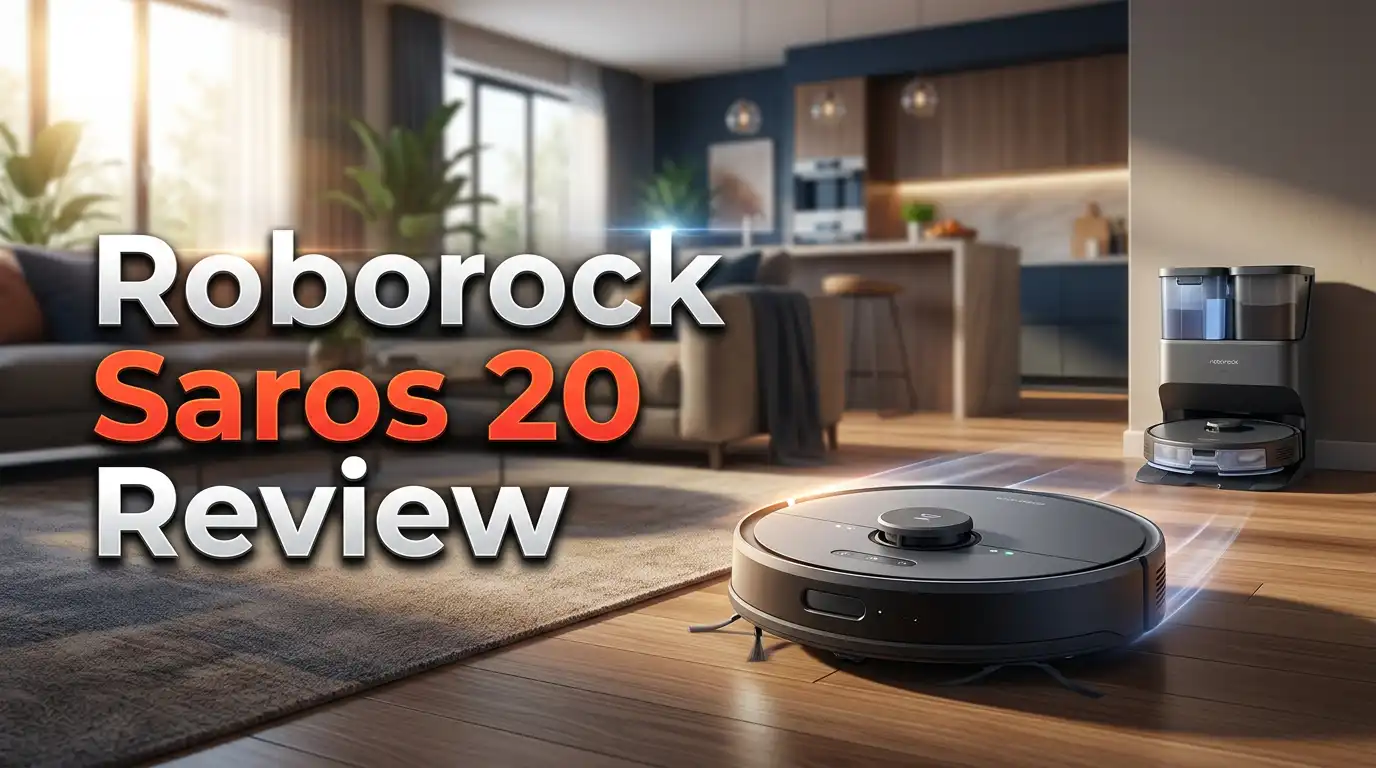
Robot vacuums keep getting smarter every year, but 2026 feels different. The Roborock Saros 20 arrived in March 2026 with 36,000 Pa of suction, a chassis that lifts itself over thresholds, and a dock that washes mop pads with boiling water. On paper, it reads like a small appliance from the future.
I spent weeks reading test data, user reports, and lab results to separate marketing claims from real performance. The short version? This machine cleans beautifully, climbs better than anything else on the market, and still has a few quirks that might annoy you.
This review covers everything. The unboxing moment, the suction tests, the mopping scores, the battery disappointment, and the honest list of things this robot simply does not handle well. By the end, you will know if $1,599.99 belongs in your cart or somewhere else.
In a Nutshell:
- Suction leads the category. The Saros 20 pushes 36,000 Pa, the highest rating available in early 2026. In carpet deep clean tests it pulled out 89% of embedded sand versus a 78% average, and 88% of flattened pet hair versus 82%.
- Mopping finally impresses. Dual pads spin at 200 RPM with adaptive pressure up to 13 newtons. It scored 116 points on dried stain removal against a 94 point average, and it did so while leaving less water behind than most rivals.
- Threshold climbing sets a record. The AdaptiLift Chassis 3.0 crossed a 57 mm single barrier in independent testing, beating the MOVA Z60 and Dreame X60. Roborock officially rates it for tiered thresholds up to 88 mm.
- The dock does almost everything. It washes pads at 212°F, dries with 131°F hot air, empties the bin into a bag, dispenses detergent, removes mop pads automatically, and charges fast.
- Battery and dust bin are weak spots. Coverage lands near 1,038 square feet per charge versus a 1,170 average. The 260 mL bin sits well under the 377 mL category norm.
- Price stayed flat at $1,599.99. That matches last year’s Saros 10R launch price while adding 14,000 Pa more suction and far better obstacle recognition.
Roborock Saros 20 Robot Vacuum and Mop

Last update on 2026-10-17 / Affiliate links / Images from Amazon Product Advertising API
The Saros 20 replaces the Saros 10R as Roborock’s mainstream flagship. It keeps the ultra slim 3.13 inch body that made the 10R popular and adds serious muscle underneath.
Core specs include 36,000 Pa suction, the DuoDivide anti tangle main brush, StarSight 2.0 solid state navigation, and Reactive AI 3.0 obstacle recognition trained on more than 300 object types. There is no LiDAR turret on top, which is how the body stays so low.
The mopping system uses two spinning pads that lift 20 mm for carpet and extend sideways for edges. The RockDock handles washing, drying, emptying, and refilling.
Think of it as Roborock throwing every feature it owns into one chassis. The result is dense, capable, and genuinely fun to watch work.
Unboxing Experience and First Setup
The box is heavy. Roborock ships the dock and robot together, and the whole package weighs enough that you will want a second pair of hands moving it from the doorstep.
Inside, everything sits in molded cardboard rather than foam, which feels nicer and recycles easier. You get the robot, the RockDock base, a disposable dust bag already installed, a sample bottle of detergent, two mop pads, a cleaning tool, and a slim manual.
Setup takes about fifteen minutes. You peel protective film, clip the pads on magnetically, plug in the dock, and pair through the Roborock app. The app walks you through a mapping run.
First impression? The robot feels solid and surprisingly dense for something barely three inches tall. The glossy top panel also loves fingerprints, so keep a cloth nearby.
Design, Build Quality, and the Slim Profile
Roborock kept the Saros design language clean. The robot is a simple disc with no turret, no antenna, and no raised bump. That flat top is the whole point.
At 3.13 inches tall, it slides under sofas, bed frames, TV stands, and kitchen cabinet overhangs that taller robots bounce off. Reviewers who tested it beside the Dyson Spot+Scrub Ai noted the Dyson is nearly an inch taller and kept getting wedged under dishwashers.
The dock is tall and slab shaped. It is not ugly, but it is not invisible either. You need real wall space for it.
Build quality feels premium throughout. Panels fit tightly, the bin clicks in cleanly, and the mop pads attach without fuss. Nothing here feels cheap at this price.
Top 3 Alternative for Roborock Saros 20


Last update on 2026-10-16 / Affiliate links / Images from Amazon Product Advertising API
Dreame X60 Max Ultra Complete

Last update on 2026-10-16 / Affiliate links / Images from Amazon Product Advertising API
ECOVACS DEEBOT X11 OMNICYCLONE

Last update on 2026-10-16 / Affiliate links / Images from Amazon Product Advertising API
Roborock Saros 10R
Suction Power and Vacuuming Performance
The headline number is 36,000 Pa. That currently tops the market by a slim margin over the Dreame X60 Max Ultra Complete at 35,000 Pa.
Real world results back it up. In carpet deep clean testing, where sand gets pressed into medium pile carpet, the Saros 20 extracted 89% of the debris against a 78% category average. Flattened pet hair pickup hit 88% versus 82%.
Hard floor results were equally strong. One tester measured 98% to 99% pickup on sprinkles, shredded cheese, and basil under kitchen cabinets, plus roughly 97% on kitty litter and litter dust.
Here is the nuance. Bench measured airflow came in at 15 CFM against a 17 CFM average, and raw sealed suction tested lower than expected. The pascal rating does not tell the whole story, yet actual pickup stays excellent.
Mopping Performance and Stain Removal
Roborock mopping used to be the weak link. Not anymore.
The Saros 20 uses two round pads spinning at 200 RPM with adaptive downforce reaching 13 newtons. Heavier mess means more pressure. The robot also detects wet floors and switches to mop only mode so it does not suck up liquid.
On the dried coffee stain test, it scored 116 points against a 94 point average. More impressive, it left only 0.8 grams of excess water compared to the 0.95 gram norm. Less water means fewer streaks.
One pad extends sideways to reach baseboards and cabinet kicks. Round pads also handle 90 degree corners better than roller mops, which must pull the whole roller in to turn.
Combined mopping score: 25.2 points against a 20.3 average. That is a genuine leap forward.
AdaptiLift Chassis 3.0 and Threshold Climbing
This is the feature people will talk about. The AdaptiLift Chassis 3.0 uses a legged tri wheel system that physically raises the robot body.
Roborock officially rates it for two tier thresholds totaling 3.46 inches, with a first tier of 1.77 inches and a second of 1.69 inches. Independent testing pushed harder and the Saros 20 cleared a 57 mm single step barrier, setting a new record and beating the MOVA Z60 and Dreame X60.
The same system lifts over high pile carpet up to 1.18 inches thick. It also tilts over bath mat corners instead of dragging them around the bathroom.
Owners consistently report this as the standout feature. If your home has sunken rooms, thick transition strips, or chunky rugs, this chassis solves a problem nothing else solves as reliably.
Obstacle Avoidance and StarSight Navigation
The Saros 20 runs StarSight 2.0, a solid state time of flight system paired with an RGB camera and side mounted sensors. Reactive AI 3.0 recognizes more than 300 object types down to roughly 2 centimeters.
Lab testing scored it above average, avoiding 17 of 24 objects against a 16 of 24 norm. Home testing went even better, with one reviewer reporting a 100% avoidance rate across multiple days in a busy apartment.
It identifies shoes as shoes, cords as cords, and bags as bags. It cleans tight against shoes but keeps a safe buffer from cables.
Navigation efficiency is the softer spot. It measured 0.67 square meters per minute against a 0.70 average. Reliable, but not fast. Some users also report it struggles between closely spaced chair legs and bar stools.
RockDock Base Station and Self Maintenance
The dock is where premium money goes. Roborock’s latest RockDock washes mop pads with 212°F water, hot enough to break down grease and kitchen grime that lukewarm rinses leave behind.
After washing, it dries pads with 131°F hot air so they never go sour. It empties the dust bin into a disposable bag, refills the robot’s tank with warm water, and dispenses detergent automatically.
Two smarter touches stand out. The dock removes the mop pads entirely for vacuum only runs, so damp pads never touch your carpet. Dirt detection can also trigger a second wash and an extra mopping pass.
Fast charging rounds it out and helps offset the modest battery. Realistic hands off period runs several weeks before you touch anything.
App Features and Smart Home Integration
The Roborock app remains one of the most detailed in the category, and that cuts both ways.
You get room by room customization, no go zones, no mop zones, adjustable suction and water levels, carpet handling rules, and even mopping along the direction of floorboards. SmartPlan AI now schedules automatic deep cleans for rooms it has not visited recently.
The onboard camera supports remote viewing and two way video calling, which doubles as a pet cam. Matter support is built in, alongside Alexa, Google Home, and Siri shortcuts. There is also an onboard voice assistant.
The downside is density. New users may feel buried under settings menus on day one. Give it a week and the layout starts making sense.
Battery Life and Real Coverage
Here is where the spec sheet cools off. Battery efficiency measured 1.44 minutes of cleaning per 1% charge against a 1.56 minute average.
That translates to roughly 1,038 square feet per charge, below the 1,170 square foot category average. For comparison, the Roborock Qrevo CurvX reaches around 1,700 square feet.
For apartments and average sized homes this will never register as a problem. The robot finishes, docks, and you move on.
Larger homes are a different story. The Saros 20 will need to recharge midway and resume, which stretches total cleaning time. Fast charging shortens the gap, yet it does not erase it.
If you have 2,500 square feet of open floor, expect two runs to finish one full pass.
Noise Levels and Living With It Daily
The Saros 20 is not silent, and no 36,000 Pa machine is. On low and balanced modes it hums quietly enough for a conversation in the next room.
Max mode is loud. Running it on carpet while you work from home will be distracting, so schedule heavy cleans for when the house is empty.
The dock is the real noise event. Automatic emptying produces a short, sharp roar that lasts a few seconds. Mop washing and hot air drying add a low mechanical hum afterward.
Place the dock away from bedrooms and home offices. A hallway or laundry nook works better than a living room corner.
Day to day, the robot itself fades into background routine. That is the goal.
What the Roborock Saros 20 Does Not Do Well
Honest reviews list the misses. Here are the real ones.
Large spills are a problem. Testers found greasy residue after running it over ranch dressing and sesame oil. The pads do not rinse mid clean, so they drag the mess around. One reviewer said she would not send it over anything bigger than a dime sized drop.
The dust bin is small. At 260 mL against a 377 mL average, heavy shedding households will see it fill before the robot returns to dock.
Fluffy rugs expose limits. Fine powders like protein mix and oats were left behind on a plush rug that a competing Dreame cleared afterward.
Multiple passes are common. Several testers needed a third pass for a truly clean floor, which undercuts the hands off promise.
Big hair clumps defeat it. After a home haircut test, it recovered around 90% but could not lift the largest clumps.
Pros and Cons of the Roborock Saros 20
Pros
- Category leading 36,000 Pa suction with 89% carpet deep clean results and 88% flattened pet hair pickup
- Excellent mopping, scoring 116 on stain removal while using less water than average
- Record threshold climbing at 57 mm tested, plus 30 mm carpet lift from AdaptiLift Chassis 3.0
- Zero hair tangle performance from the DuoDivide brush, a perfect score in testing
- Ultra slim 3.13 inch body that actually fits under beds, sofas, and cabinet overhangs
- Fully loaded dock with 212°F washing, hot air drying, detergent dosing, and automatic mop removal
- Superb small object avoidance across cords, shoes, socks, and pet items
Cons
- Below average battery coverage at roughly 1,038 square feet per charge
- Small 260 mL dust bin that fills fast in pet heavy homes
- Mop pads do not rinse mid clean, so grease smears across hard floors
- Average navigation efficiency, with occasional trouble between chair legs
- Needs repeat passes for best results on messy floors
- High $1,599.99 price in a crowded flagship field
Price, Value, and How It Compares
The Saros 20 launched at $1,599.99, the same debut price as the Saros 10 and Saros 10R in 2025. Getting 14,000 Pa more suction and far better object recognition for identical money is a fair deal.
Roborock also runs a trade in program that can cut up to $1,050 off if you own an older model.
Competition is fierce though. The Dreame X60 Max Ultra Complete matches it closely on suction, slimness, and price while adding hot water mopping. The Ecovacs Deebot X11 OmniCyclone brings a bagless dock and strong deep clean scores.
The Saros 20 Sonic, with a vibrating D shaped pad, sits above it for buyers who want the absolute top mopping tier.
Value verdict: strong, not untouchable.
Who Should Buy the Roborock Saros 20
Buy this robot if your home has uneven floor transitions. Nothing else climbs as confidently, and that single feature solves daily frustration for split level and threshold heavy homes.
It also suits homes with low furniture. The 3.13 inch height reaches places taller robots cannot touch.
Pet owners benefit from the zero tangle brush and strong hair pickup, though the small bin means emptying the dock bag more often.
Skip it if you have more than 2,000 square feet of open floor, since battery coverage will slow you down. Skip it too if you frequently deal with large wet spills, because the mopping system smears before it scrubs.
Everyone else gets one of the most complete cleaning robots sold in 2026.
Frequently Asked Questions
How much does the Roborock Saros 20 cost?
It launched at $1,599.99 in the United States in March 2026. Trade in offers can reduce that by up to $1,050, and seasonal sales typically push the price lower a few months after release.
Is the Saros 20 better than the Saros 10R?
Yes, clearly. Suction jumps from 22,000 Pa to 36,000 Pa, obstacle recognition improves dramatically, and the AdaptiLift Chassis 3.0 climbs far higher thresholds. Both launched at the same price.
Can the Roborock Saros 20 climb door thresholds?
It handles tiered thresholds rated up to 88 mm total and cleared a 57 mm single step in independent testing. That is the best climbing performance recorded so far.
Does it work without WiFi?
Basic cleaning works using the onboard buttons. Mapping, zone cleaning, scheduling, app controls, and voice features all need a WiFi connection.
How often do I empty the dock?
The disposable bag typically lasts several weeks in an average home. Pet heavy households with constant shedding should expect to swap bags more frequently.
Does it handle wet spills?
Only small ones. Larger liquid spills get spread across the floor because the pads do not rinse during a cleaning run. Wipe big messes by hand first.
Is the camera private?
Remote viewing requires app authentication, and Roborock encrypts the feed. Privacy conscious users can disable the camera features entirely in settings.

Hi, I’m Grace Bell, the founder of CleanFloorVault.com, where I personally test and review vacuum cleaners to help you find the perfect tool for a spotless home.