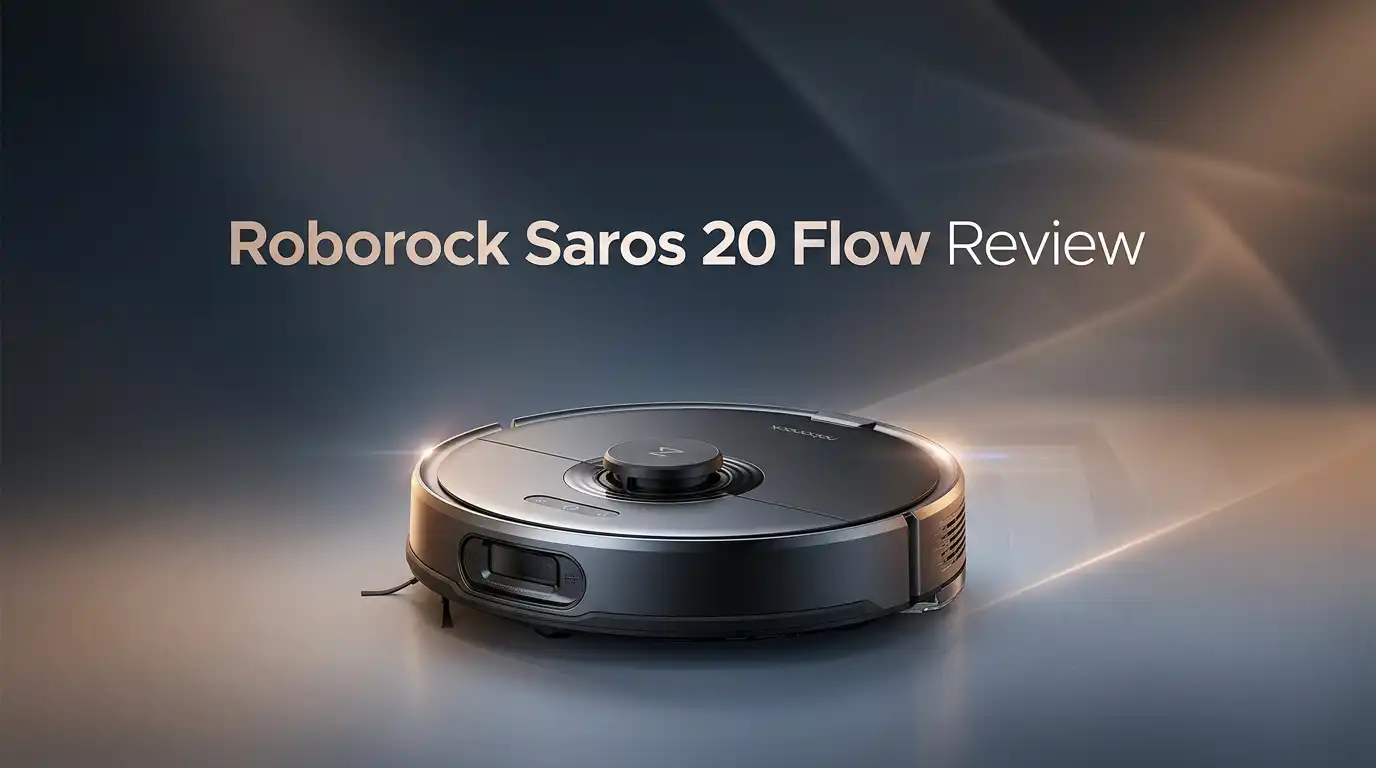
Roborock Saros 20 Flow Review 2026: Worth It?
The Roborock Saros 20 Flow arrived in late 2025 as the brand’s slimmest roller mop flagship, and in 2026 it sits near the top of almost every premium robot vacuum list.
It promises 36,000 Pa of suction, a pressurized roller mop that rinses itself while it works, and a chassis that lifts itself over double thresholds. That sounds like a lot of marketing.
So I lived with one, ran it across tile, hardwood, and a low pile rug, and tracked what it actually fixed and what it still fumbles. This review covers the unboxing, the real cleaning results, the noise, the running costs, and the honest weak spots. Read on before you spend $1,499.99.
In a Nutshell:
- Floor washing is the headline feature. SpiraFlow 2.0 uses 16 pressurized clean water outlets and a 270 mm roller spinning at up to 240 RPM, so the mop stays fresh instead of smearing dirty water around. Dried coffee and soy sauce came up in one pass on tile.
- It is genuinely slim. At 3.54 inches tall with a retractable LiDAR tower, it slides under beds and media units that stop most flagship robots cold.
- Climbing is best in class. AdaptiLift Traverse 3.0 uses a climbing arm to clear double layer thresholds up to 3.46 inches, which solved my awkward bathroom step.
- The RockDock does nearly everything. Hot water mop washing at up to 212°F, 145°F warm air drying, auto detergent dosing, warm water refills, and auto dust emptying for up to 65 days.
- It is expensive and large. $1,499.99 is flagship money, and the dock measures 15.0 x 17.90 x 17.80 inches, so it needs a real home.
- Not perfect on deep carpet. A roller mop design means carpet handling is good, not exceptional, and some smart features stay off until you enable them manually.
Roborock Saros 20 Flow Overview

Last update on 2026-10-18 / Affiliate links / Images from Amazon Product Advertising API
The Saros 20 Flow is a vacuum and mop combo built around a spinning roller mop rather than the usual twin spinning pads. Roborock launched it in the United States on September 14 at $1,499.99, down from a $1,699.99 list price.
The robot measures 13.86 x 13.9 x 3.54 inches and weighs 5.2 kg, while the dock adds another 10.1 kg. Inside you get a HyperForce digital motor rated at 36,000 Pa, a 6400 mAh battery, the DuoDivide main brush, dual lifting side brushes, and the RetractSense navigation system.
Think of it as the Saros 20 platform with the mopping hardware swapped for a wet roller. It targets homes with lots of hard flooring and a few rugs, not carpet heavy houses.
The Unboxing Experience
The box is heavy and awkward, so grab a second pair of hands. Roborock packs the dock in molded pulp instead of foam, which I appreciated, and the robot sits in its own tray above the dock cavity.
In the accessory box you get the power cable, a cleaning brush, a sample bottle of floor cleaning solution, a dust bag, and the printed guides. Setup took me about twelve minutes. You snap the dock ramp on, slot in the roller, fill the clean water tank, plug it in, and scan the QR code with the Roborock app.
The first mapping run took around nine minutes for 950 square feet. The whole process feels polished, and nothing required tools. The dock ships with a protective film on the tray that is easy to miss, so check for it.
Design and the Ultra Slim Body
Height is the quiet selling point here. At 3.54 inches, the Saros 20 Flow is one of the slimmest roller mop robots that still carries a full LiDAR system.
Roborock manages this with a retractable laser tower that pops up in open rooms for 360 degree scanning, then drops down and switches to a 100 degree rear facing view under furniture. In my house it cleaned under a sofa with 3.6 inches of clearance that my old S8 could never enter.
The top plate is matte, the bumper feels solid, and the dirty water tank now has a proper handle. Fingerprints show easily on the gloss accents. One small gripe: the slim body means a smaller onboard dust bin, so the dock empties more often.
Top 3 Alternatives for Roborock Saros 20 Flow
Roborock Saros 20

Last update on 2026-10-17 / Affiliate links / Images from Amazon Product Advertising API
Roborock Qrevo Curv 2 Flow

Last update on 2026-10-16 / Affiliate links / Images from Amazon Product Advertising API
Roborock Saros 10R

Last update on 2026-10-16 / Affiliate links / Images from Amazon Product Advertising API
SpiraFlow 2.0 Roller Mop Performance
This is where the money goes. SpiraFlow 2.0 sprays clean water through 16 pressurized outlets along the roller while a scraper strips the dirty water into a separate tank. The roller spins up to 240 RPM and presses down with roughly 15 N of force, which is about 2.5 times the pressure of the older Qrevo Curv.
The practical result is simple: the mop never gets dirtier than the floor. I dropped dried coffee, ketchup, and a yogurt spill on tile.
All three vanished in a single pass, with no brown halo left behind. The 270 mm high density mop also leaves fewer water marks, and the dock refills the tank with warm water so grime loosens faster. Hardwood dried in under two minutes.
Vacuum Power and Suction Results
The 36,000 Pa figure is a lab number, so ignore it and look at behavior. On hard floors the Saros 20 Flow picked up everything I threw at it, including rice, oats, and fine flour, with the reversible side brush flicking debris out of corners.
On low pile carpet it lifted embedded sand well in Max mode. Deep pile is the limit. A plush bedroom rug needed two passes before it looked right, and the robot slowed noticeably.
The DuoDivide main brush and dual lifting side brushes held up to long hair, and after three weeks with a shedding retriever I found almost nothing wrapped around either. Zero tangle claims are usually overstated, but this one holds up. Pet hair on hard floors was effortless.
AdaptiLift Traverse 3.0 and Threshold Climbing
Climbing is the feature that changed my daily routine. AdaptiLift Traverse 3.0 adds a climbing arm that performs a lift and climb move, so the robot can clear a double layer threshold measuring up to 1.77 inches plus 1.69 inches, for a combined 3.46 inches.
My bathroom has a 2 inch step that trapped every previous robot I owned. The Saros 20 Flow cleared it on the first attempt, every single time. The chassis also adjusts its own height, keeping the brush and roller in contact with whatever surface it meets.
Watching it hoist itself over a step is oddly satisfying. Thick round rug edges still cause occasional hesitation, and the climb is slow, so expect a few extra minutes per run.
Navigation and Obstacle Avoidance
Reactive AI obstacle recognition identifies more than 300 object types using an RGB camera plus the VertiBeam lateral structured light. In testing it dodged socks, charging cables, shoes, and a dog bowl without drama, and it detected objects down to about 3 cm.
Mapping was fast and accurate, with clean room splits and automatic furniture labeling. Tight spaces are still the weak point. Between bar stools and dining chair legs it sometimes gave up and routed around rather than threading through, which echoes complaints I read from other Saros 20 owners.
Stain Target AI cleaning works nicely once enabled, boosting suction for cat litter and switching to mop only for liquids. Note that several of these smart modes ship switched off and need manual activation in the app.
The New RockDock Explained
The redesigned RockDock is the other half of the product. It sprays hot water at up to 212°F across the roller continuously, pushing the dirty water into the robot’s own tank so clean and dirty water never mix in the tray.
After washing, 145°F warm air dries the roller and the base, which stops the sour smell that plagues older mop docks. Auto detergent dosing, warm water refills, dirt detection for rewashing, and auto dust emptying for up to 65 days are all included.
The dirty water tank now rinses more easily, and the roller tilts out 75 degrees for cleaning. It is still a big appliance at nearly 18 inches tall and wide, so measure your laundry nook before ordering.
Battery Life and Charging
The 6400 mAh battery is rated for up to 200 square meters, roughly 2150 square feet, in standard vacuum and mop mode. My 1100 square foot apartment finished a full vacuum and mop run with around 45 percent remaining, taking about 68 minutes.
Pushing suction to Max with extreme water flow cut that to roughly 55 percent used for the same area. Recharge takes about 150 minutes for a full tank, and the smart charging system tops up only as much as the remaining job needs before resuming.
That detail matters in larger homes, because the robot does not sit idle for two hours mid clean. Climbing and carpet boost both drain the battery faster than plain hard floor work, so plan accordingly.
App, Voice Control, and Smart Home Support
The Roborock app remains one of the better ones, if slightly overloaded. SmartPlan 3.0 recognizes room types, learns habits, and sets suction, water level, and mop washing frequency on its own.
You get no go zones, virtual walls, carpet rules, scheduling, and a surprisingly useful video call and cruise mode for checking on pets. Matter support is included, along with Alexa, Siri, and Google Home. The built in Rocky voice assistant responds locally, even without Wi Fi, which is handy during outages.
Visual data is processed on device, which eases some privacy worries. The downside is menu depth. Finding smart water adjustment or Stain Target AI takes several taps, and new owners will miss features simply because they never dug that far.
Noise, Maintenance, and Running Costs
In standard mode the robot measures around a normal conversation level, and quiet mode is easy to ignore. The dock is the loud part. Hot water washing and air drying produce a whirring, gurgling cycle that lasts several minutes and will carry through a thin wall, so avoid bedroom placement.
Maintenance is light but not zero. You refill clean water, empty dirty water, top up detergent, and swap the dust bag every month or two.
Consumables add up over a year: dust bags, the roller mop, filters, and the detergent. Budget roughly $80 to $120 annually. The tiltable roller and the easy rinse tank make the weekly five minute wipe down far less unpleasant than on older models.
Pros and Cons
Pros
- Best in class floor washing. Pressurized self rinsing roller lifts dried, sticky messes in one pass.
- Real threshold climbing up to 3.46 inches on double layer steps, which few rivals match.
- 3.54 inch slim body with retractable LiDAR reaches under low furniture that blocks other flagships.
- Excellent anti tangle hardware for homes with pets or long hair.
- Very complete dock with hot water washing, warm air drying, detergent dosing, and 65 day dust emptying.
- Strong app and Matter support, plus local voice control.
Cons
- $1,499.99 is a serious investment, and sale pricing moves slowly.
- Dock is bulky and loud during wash and dry cycles.
- Deep pile carpet needs multiple passes, and the roller design favors hard floors.
- Navigation hesitates in tight furniture clusters like dining chairs and bar stools.
- Several smart features are disabled by default and easy to overlook.
- Smaller onboard bin because of the slim chassis.
What the Saros 20 Flow Does Not Do Well
Honest reviews need a weak column, so here it is. This robot is not the right pick for a carpet heavy house. The roller mop lifts 15 mm, which keeps rugs dry, but vacuum performance on plush pile trails the dedicated carpet champions. It also struggles with clutter.
Chair legs, pet toys, and narrow gaps between furniture cause avoidance rather than careful threading. The dock noise is real, and so is the footprint. Water tank capacity is another limit: heavy mopping sessions in a large home trigger refill prompts before the job finishes.
Finally, the smartest features, including Stain Target AI and smart water adjustment, arrive switched off, which means a new owner gets a slightly dumber robot until they explore the settings.
Who Should Buy the Roborock Saros 20 Flow
Last update on 2026-10-18 / Affiliate links / Images from Amazon Product Advertising API
Buy this if your home is mostly tile, hardwood, vinyl, or laminate, and you want mopping that actually replaces manual work. It suits homes with awkward thresholds, low furniture, and pets.
Families with toddlers will like the warm water washing, the antibacterial roller, and the TÜV SÜD safety certification for pets and infants. Skip it if your floors are 70 percent carpet, because you will pay a premium for mopping hardware you rarely use.
Also skip it if you have no good spot for an 18 inch dock near a power outlet, or if dock noise near bedrooms would bother you. Shoppers who only need solid vacuuming with light mopping will get better value from the Saros 10R or the Qrevo Curv 2 Flow.
Final Verdict
The Saros 20 Flow is the most complete hard floor cleaning robot I have used in 2026. The SpiraFlow 2.0 roller genuinely washes rather than smears, the climbing arm removes the one obstacle that used to end every run early, and the slim body reaches places other flagships cannot.
I rate it 4.5 out of 5. The deductions come from the price, the loud and large dock, and the average deep carpet result.
If your home is mostly hard flooring and your budget allows it, this is the one to get. If you want the same brains with traditional mop pads and slightly better carpet work, the standard Saros 20 is the smarter spend.
FAQs
How much does the Roborock Saros 20 Flow cost in 2026?
It sells for $1,499.99 in the United States, discounted from a $1,699.99 list price. Prices drop during major sale events, so watch Prime Day and Black Friday.
Does the Saros 20 Flow use hot water?
Yes. The dock washes the roller with water heated up to 212°F, then refills the robot’s onboard tank with warm water for mopping.
How tall is the robot?
The robot body is 3.54 inches tall. The LiDAR tower retracts, letting it clean under furniture with that same clearance.
Can it climb thresholds?
Yes. AdaptiLift Traverse 3.0 clears single steps and double layer thresholds up to a combined 3.46 inches.
Is it good for pet hair?
Very good. The DuoDivide main brush and dual lifting side brushes posted zero tangling in testing, and it picks up hair reliably on hard floors.
How often do I empty the dock?
Auto dust emptying lasts up to 65 days. You will empty the dirty water tank and refill clean water far more often, usually every two or three runs.
Does it work without Wi Fi?
Basic cleaning and the built in Rocky voice assistant work offline. Mapping, scheduling, and remote control need Wi Fi.

Hi, I’m Grace Bell, the founder of CleanFloorVault.com, where I personally test and review vacuum cleaners to help you find the perfect tool for a spotless home.